
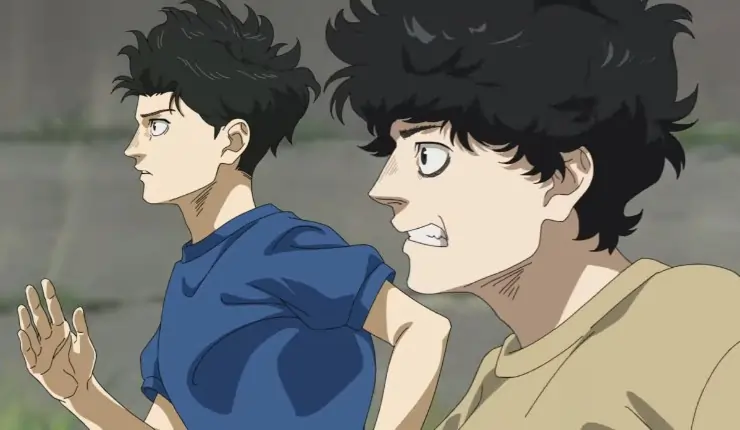
Ten seconds. At a competitive level, that’s all it takes to run a 100-metre race. Blink, and you could miss records being broken, champions being born, or a lightning bolt becoming a legend. Whenever the Olympics take place, the world seems to stand still as the runners take their marks and the starting gun fires. Eight athletes put everything on the line in pursuit of victory, while the world holds its breath. For mangaka Uoto, this race is a vessel for drama, an event that represents more than mere competition. He explored this in his manga 100 Meters, which has since been adapted for the screen under the same title.
Togasha is a child prodigy sprinter, constantly outrunning everyone in his class. Due to being born with natural talent, his life is shaken up when he meets Komiya, a new transfer student. Komiya struggles with anxiety, running not to chase victory but to escape reality, fleeing from his problems instead of confronting them, relying on determination rather than sheer talent. Wanting to help Komiya grow, Togasha begins to train him. Over the next fifteen years, we follow the two sprinters as their paths evolve, from high school tracks to the big leagues, where they forge connections with upperclassmen and racing legends.
While it’s repeated multiple times that the race lasts only ten seconds, 100 Meters, at a relatively short one hour and forty-six minutes, feels infinitely longer. For a story centred on such a brief event, one wishes the film had adopted the same quick pace. This may stem from the fact that the film condenses forty-two chapters of manga into such a short runtime. Chainsaw Man – The Movie: Reze Arc, while similar in length, adapts only fourteen chapters. In what feels like a rare occurrence, I found myself wishing 100 Meters were longer, giving us more time to connect with and understand the characters in greater depth, as what the film offers is truly one of a kind.
The film is thematically rich, exploring why these competitors run and strive to achieve greatness. It shows that the pursuit of being the best is intertwined with anxiety, depression, and joy, all natural parts of the journey. Life presents many hurdles, but fulfilment comes from how we overcome them. The narrative examines how racing shapes not only the protagonists but also the supporting characters, allowing for in-depth discussions around competitiveness. Textured and layered, the film may require multiple viewings to fully grasp everything it seeks to explore.
Similar to director Kenji Iwaisawa’s previous work, On-Gaku: Our Sound, 100 Meters, employs rotoscoping, a technique in which animators trace over live-action footage, frame by frame, to create realistic movement. This approach gives the animation a remarkable fluidity, especially during the running scenes. Every stride, baton pass, and subtle gesture carries a level of authenticity unlike anything I’ve seen before. The sheer realism can feel jarring at first, as the characters’ movements are strikingly life-like, but it ultimately enhances the authenticity the filmmakers are striving for. The animation truly shines, however, when the art style shifts, most memorably in an impressive long take that resembles a watercolour painting, as the runners prepare for the race under pouring rain.
That long take is a pivotal scene, marking the moment when the dynamic between Togashi and Komiya shifts. It also serves as a powerful showcase for the performances. Tori Matsuzaka and Shota Sometani are outstanding as Togashi and Komiya, respectively, bringing a remarkable range to their characters. Subtle changes in their delivery, particularly during the time jumps, convey emotion and characterisation that no line of dialogue could capture. Rie Takahashi is equally delightful as the supporting character Asakusa, infusing the high school portion of the film with genuine vitality, her clumsy joy proving truly infectious.
Pacing aside, 100 Meters is a truly splendid animated feature, utterly gorgeous in its use of rotoscoping and varied animation styles. Once the starting gun fires for the final race, you can’t help but sit on the edge of your seat, wondering who will come out on top, or if that even matters, since racing is ultimately about more than winning or losing.
★★★★
Screened as part of Scotland Loves Anime 2025 and In UK cinemas Now / Tori Matsuzaka, Shota Sometani, Koki Uchiyama, Rie Takahashi, Jun Kasama / Dir: Kenji Iwaisawa / Anime Limited / PG
Related
Discover more from
Subscribe to get the latest posts sent to your email.
