
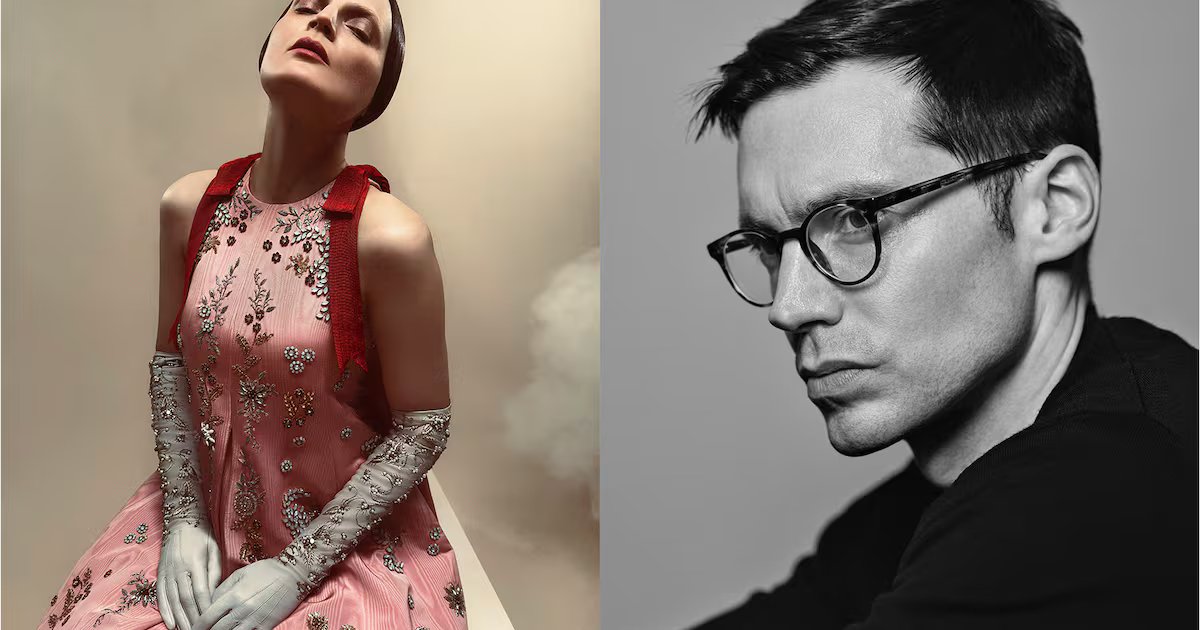
LONDON — While he was a student at the Royal College of Art, Erdem Moralioğlu worked as a shelver in the library. “I just ate books,” he remembers blissfully. “I’ve always loved them. I think there’s something really wonderful and powerful about a beautiful book.”
Over the decades, the designer has accumulated his own enviable library, its depth and range embracing volumes rare, precious and arcane. One recent addition is the lavish scrapbook he created with Rizzoli to mark his 20th year in business. “I felt a tremendous amount of pressure to make sure it wasn’t a fashion coffee table book,” he says. “It was important to me that it wasn’t chronological, but rather a collective group of thoughts and ideas, so that someone who doesn’t know me could kind of get inside the space between my ears.” Erdem tried therapy once. He lasted three sessions. For him, a book — especially one as visually striking as his own — seems a much more appropriate conduit to the inner life he has expressed through two decades of collections.
Erdem grew up in the suburbs of Montreal with a British mother, a Turkish father and a twin sister. In 2000, he relocated to London to study fashion at the RCA. He launched his own business in 2005 from a shared studio space in the bowels of London’s East End. The seamstresses who sewed his graduate collection at the Royal College helped out with his debut for Autumn/Winter 2006. He spray painted the shoes himself.
Giles Deacon, Boudicca, Jonathan Saunders and Roksanda Ilinčić were already showing, Richard Nicoll and Christopher Kane were in the wings. London was oozing fashion pheromones, so naturally the buyers from Barneys, then world’s hottest department store, came buzzing. They alighted upon Erdem. “The moment where it started truly was Barneys buying that first collection. I didn’t really even have London stores. My first stockists were Barneys on Madison Avenue and in Beverly Hills. What was interesting is that the young designers were all on the third floor and I was on the second floor with Marni and Tomas Maier and Alaïa. I was with Barneys for 15 years until they went bankrupt right before Covid.”
Erdem’s proposal of “Edwardian collars and Victorian dresses covered in love birds” elicited a love/hate response from the industry. “Like Marmite,” he says with a laugh. “This was the time of Robert Carey Williams and Marios Schwab. London was more sexual, harder, black leather. And along I come with my fascination with the feminine.” I remember thinking at the time it was prudish but also curiously fetishistic and tense, like something repressed was just waiting to explode. “The idea of tension excited me,” Erdem agrees. “Something masculine and feminine, covered and uncovered. Maybe you could argue there was a romanticism to it, but I always felt my woman had a spine of steel.”
He has stayed remarkably true to this vision ever since. That consistency might be one reason why, after 20 years that saw many of the peers he started out with folding their tents and slipping away into the night, Erdem has survived, building a respectable business that’s stood the test of time and is on track to generate $32 million in sales for the year ending 31st March 2026. Now 48, he practically has elder statesman status in London. The city itself, meanwhile, has become a more ruthless make-or-break place for young designers. It’s enough to try anyone’s pragmatism, let alone their optimism. “London gave me a place to start,” Erdem says. “And I think that’s part of it being a very open place, a very experimental place. It also comes with its challenges. It’s had highs and it’s had lows on a global scale: recessions, terrorist attacks, Brexit. That was the most interesting. Coming from two parents who were from two very different cultures and religions, I found Brexit to be like a formalisation of xenophobia. A foreshadow of the time we’re in now.”

Brexit was particularly toxic for the British fashion industry, but the failures of Barneys and Matches also walloped the UK’s fashion independents. And now there is the bankruptcy of Saks, with its attendants Neiman Marcus and Bergdorf Goodman, solid Erdem clients all of them. “When you put so much weight on one store, one entity, you learn a hard lesson,” he acknowledges ruefully. “Saks is something that’s ongoing, so we don’t exactly know what’s going to happen.” Do I detect a flicker of optimism? That is, after all, the salve of the independent. And Erdem is a true ambassador for that spirit, the natural heir of a designer like Dries Van Noten. “The virtues of independence are the same as the challenges, because every single decision, creative or financial, ultimately comes back to you. That’s tricky, but there is nothing more thrilling and frustrating than knowing we’ve really done this as an independent entity. And I say we, because there are 87 people working here. Our success as an independent has been the result of us doing it collectively.”
Of course, it can’t only be consistency that explains Erdem’s survival. There’s also his appeal to fashion’s soul. He returns once more to, “The idea of the feminine, all the codes I’ve always been really attracted to, even when I was a child. I was always interested in what that meant. Looking at my mother’s summer dresses or her bottle of Shalimar or red lipstick, something that insinuated the feminine I’ve always been attracted to. And I’ve always been fascinated by things that have a very human hand, whether it’s the way something’s woven together, or embroidered, or boned. There’s something about the kind of control of how something fits that I am drawn to. I like things that have a slightly higher arm hole. I like things that are nipped and precise. There’s a kind of precision to technique that I’m very attracted to, how something fits from the beginning, and getting it exactly right. Maybe that aspect has gotten more precise and also looser in a weird way. I feel there’s more scope to explore things that might not be so controlled.”

“I wonder if there’s something about growing up where I did,” he continues. “I definitely think there’s a psychology to fashion. As a designer, you’re examining a lot of things that are not just about who you’re designing for but also who you are as a person.” I would, in fact, go beyond psychology to psychiatry. He agrees. “I think probably a bit of both, yeah, because there’s something very analytical. There’s nothing more frustrating than when someone asks you what you do, and you tell them you’re a fashion designer, and they ask you if you like what they’re wearing. I always get so irritated by that question, because it almost puts what you do into a box, when actually what you make is a whole world that you examine. It’s something that can be so profound. You can say so much with it, actually.”
I can’t help feeling Sigmund Freud (Bella, too, come to think of it) would have a field day with Erdem’s roster of muses and inspirations over the course of his career. His library is the giveaway. He’s a people collector. “With every season, there’s a catalyst, this idea of a person, a character, that allows you to create a body of work,” he says, “and that body of work, in some way, shape or form, has to do with what is happening at the same time.” He refers often to his Spring 2019 collection, inspired by Ernest Boulton and Frederick Park who lived together as sisters Fanny and Stella in the 1860s. They were tried for “conspiring to commit unnatural offences,” essentially for living as women, and acquitted 25 years before Oscar Wilde met his fate. Erdem was consumed by his research at the National Portrait Gallery. “It was amazing to look at their archive of a kind of queerness. And it was so interesting to examine the idea of gender and identity at that particular time. The idea of people living their true selves was actually a really beautiful thing to explore.”

Erdem’s quest has embraced many other renegade inspirations, like Spring 2015’s Marianne North, another adventurous Victorian who travelled the world alone as an artist/botanist, discovering and painting exotic plants. He says, “That particular collection was probably more to do with obsessiveness and the idea of looking at something so closely it drives you insane.” More recently, the queer sensibility that compels Erdem was fully celebrated with a Spring 2025 collection that contrasted the male sartorialism of writer Radclyffe Hall, author of queer classic “The Well of Loneliness,” with the flapper femininity of her partner Lady Una Troubridge.
Tim Blanks: It seems like you’ve always been drawn to the sensibility of people on the margins of society. Rebels, even.
Erdem Moralioğlu: Yeah, I think that’s a fair observation. I’ve always been fascinated by the outsider. And I think half of my job is unpicking the idea of who that person might be. The other half is the actual, almost utilitarian part of my job, which is figuring out the shape, the form, the proportions, how something fits, how something looks. And that’s a different part of your brain in a weird way. But it somehow comes together.
What do you think that part of your brain is? Is it summoning order from chaos? You have these inspirations that are so obsessive and arcane and then there’s the precision and the quest for perfection in your clothes.
Maybe the sense of control in a situation where true control doesn’t exist. The kind of construction where the waist is quite nipped but the hem is frayed. I find “undone-ness” quite interesting.

We’ve talked about that a lot in the past. One thing that’s always struck me about your stuff is that there was a real extravagance in the fabrics, the silhouettes, the decoration but it’s felt almost punky because it was so unapologetic, so pushed to the max, and sometimes so not of the moment that it felt wrong, and fearless with it. Which is also the essence of the women who inspire you who have most of the time been renegade spirits.
Once again, I go back to where I grew up, in a yellow stucco bungalow with a big lake at the end of the street. It was a very ordinary suburban house with one bathroom. You worked in the mall and you had an abstract idea of this woman you caught glimpses of when you went downtown or went to Holt Renfrew. I remember my first grade teacher, Mrs. Burgess. She would lean against a desk and we’d all sit cross legged on the floor, as you did in grade one, and she’d have a tweed skirt, and underneath, you could just see the edge of her slip, a silk slip with a lace edge. And every day that slip would change. That insinuation of the feminine was something that I found so captivating. I think it’s something quite common for most designers to grow up in an upbringing that’s very far removed from the world that they enter. And I think that in order to be able to create that world, you almost have to not be from it. An outsider, in other words. I think that’s quite an interesting place. People will see what they want to see. The only thing that ultimately matters is when you have that woman in front of a mirror and she’s zipped into that dress, and she reacts.
Are you the person zipping her into the dress?
When it was those first Barneys trunk shows, I was definitely the one doing the zipping, but in London, we have a couple of stores [on South Audley Street and Sloane Street], so it’s hard to be in two places at once.

Would you say there was a sexual charge in the clothes?
I think there’s something kind of wonderful and powerful about the feminine. And certainly there’s a sexuality to the feminine.
I remember from the early days the vivid image you evoked of a woman on the night bus on her way home,
That was Fall ’09, when you came backstage, and I loved the idea of this hand-embroidered mini-dress in red silk Mikado, completely embroidered, and Nicholas Kirkwood had designed these strange little cap-toed boots, and the model had a little topknot and red lips and I imagined her taking the bus home.
There was always a highly cinematic bigger picture. I thought of it as women on the edge, like Hitchcock or Almodovar, the idea of control being subverted.
I think there’s something very interesting about the insinuation of something that’s about to happen or has just happened. I find the space between quite interesting. Again, you see what you want to see. You can simply see an embroidered cocktail dress. Or you might see something that relates to the conversation about Radclyffe Hall and cyanotypes, or the green carnation that represents Oscar Wilde.
Have there been times when you were surprised by what people saw? Or maybe when you felt out of sync with what was happening?
I almost have to ask the question — I don’t mean it in a defensive way — more out of sync with who? Because the most important person to me is the client, and that’s only been someone that I know more and I know less, weirdly, as we grow. When I first started, maybe my idea of who she was was one thing, and now, 20 years later, she’s so many different people. In the last 24 hours, I’ve fitted Charli XCX and Glenn Close!

He can’t say whether the challenges he’s faced over the past two decades have made him particularly savvy on the business side of things. “There was something about losing both my parents before I turned 30, understanding that that net was gone, which changed me profoundly. Maybe more than I realised at the time. Though that’s not to say I suddenly had fantastic business acumen. I’ve made terrible decisions, and not so terrible decisions.” In the name of steering others away from his stumbles, I insist he tells me about his biggest booboo. He reluctantly launches into the Case of the Stolen Shipment. “It was right at the beginning, when we were on Mare Street and there were three of us in the studio. We had a shipment going to Barneys and we’d filled in the insurance form but there was one little box we needed to tick and for some reason, we didn’t. So on the way from the studio to the shippers, the van and everything inside it was stolen. The box we hadn’t ticked covered that part of the journey. It was, like, a £30,000 order and we got something like £28 back. I think that was the cubic value. Always read the small print.”
As far as the “not so terrible” decisions go, opening his first shop ten years in is an easy choice. “It physically cemented what my world was. Until then, I didn’t have a place where the entire collection lived, where I could truly present my proposal to my customer.” And it’s only become more critical over the subsequent decade for Erdem to create spaces — online or in his own stores — that his customer can enter, where she can understand the full breadth of his world, and where the brand can engage her without middlemen. Last year, the business generated 35 percent of sales via its own channels, up from 10 percent five years ago.
I’m thinking back to how often Erdem has mentioned control while we’ve been talking, like it’s a psychological imperative. He’d make one hell of a couturier. Sure enough, he says, “It all goes back to my need to try and control something that you just cannot control, because life is an uncontrollable thing. And I think what I do has everything to do with my experience at a young age of understanding that nothing has control. All of it changes, histories continue and evolve. And what is something at a certain point can actually mean something else entirely at a different point.”

All of which explains why the tension between control and what he calls “undone-ness” has become his most potent design signature: the raw edge, the frayed seam, the sullied perfection. “When you begin, you do what you do because you don’t know any better,” he insists. “And as you get older, you do what you do and you just don’t care as much.” Much as I love the notion of Reckless Erdem, I think his new “care-lessness” has more to do with trusting his instincts and following them wherever they take him.
He revisits his old collections a lot. For the Rizzoli tome, Paul Kooiker photographed the designer’s most durable muse Guinevere Van Seenus in 20 looks from the archive. “I love her as a model because she transforms things. She can be Victorian Mennonite and 1940’s movie siren. And what was so interesting about the shoot was that it was a continuous, organic thing. There was in no way a chronology to it, like that is from 2006 and this is from now. It was all these ideas and muses and characters talking to each other, kind of interchangeable.” This, by the way, is about as much as he is prepared to give away about the anniversary collection he is showing during London Fashion Week on Sunday: “I feel there’s something interesting about the idea of an imaginary conversation or dialogue between lots of different people.”
Our not-at-all imaginary conversation ends where it began, in beautiful obsession.
Erdem Moralioğlu: Fashion’s in your bones. I think it’s something that you’re obsessed with.
Tim Blanks: Have you ever felt like you just can’t go on?
No, because I want to make the next collection better.
What collections have you liked most?
There are certain collections that resonate, like that Marianne North collection from Spring 2015, or the unhinged artist’s wife from Fall 2011, or Fall’09 which we were just talking about. But also, Radclyffe Hall’s Spring 2025.
What makes those in particular resonate with you?
Maybe it’s the idea of beginning somewhere and ending up somewhere else you didn’t expect to get to and somehow you ended up exploring something that you didn’t know you were going to explore. There’s that moment when you’re looking at the running order of a show and you have each model and each look, and this concept, this thesis that you’ve been working on for six months is live in front of you before it goes out into the world, and it’s just you and the team with it and there’s this fleeting moment when the idea is there. And maybe the collections that I’ve been most attracted to, or that I’ve loved the most, have been the ones where that idea is the clearest.
What creates the clarity?
I think there’s something in a show where you understand the arc of it from the beginning to the end. It goes somewhere beautifully. And that’s the right word. Ultimately, you want to create something that is beautiful.
