
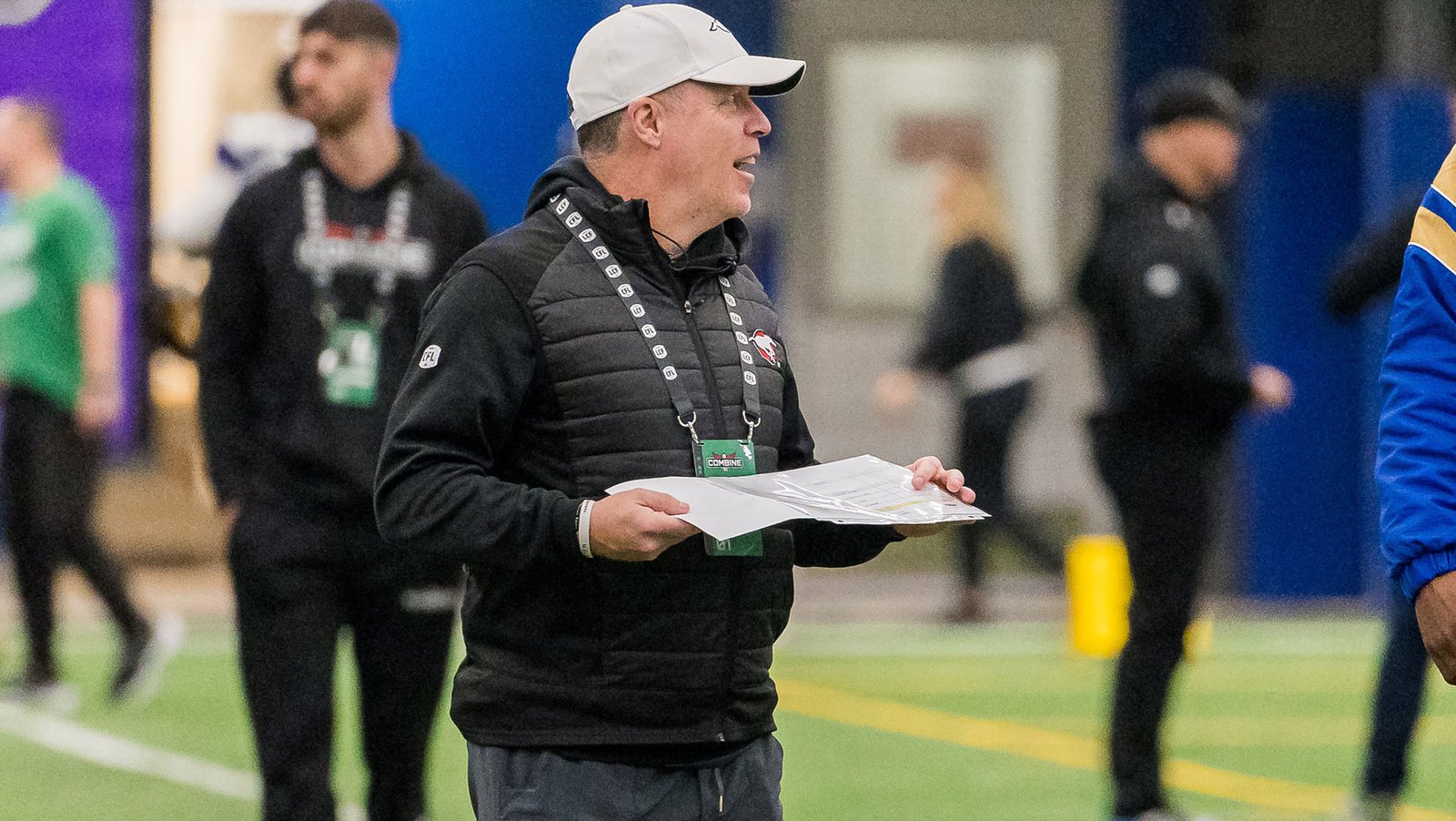
For young football players, the CFL Combine presented by Anytime Fitness Canada is the ultimate audition for their dream job in front of general managers, coaches and scouts.
For those who make their living evaluating talent, the CFL Combine, held later this month in Edmonton, is the ultimate opportunity to gather crucial information in advance of the CFL Draft.
“The biggest challenge for teams is trying to find out as much as they possibly can in such a short period of time,” says Dwayne Cameron, director of Canadian scouting for the Calgary Stampeders. “Every draft in every sport is a bit of a gamble.
To inform that decision, CFL clubs look for key traits in the prospective draftees — some obvious and some not.
Here are seven traits scouts look for.
CFL COMBINE PRESENTED BY ANYTIME FITNESS
» 1 position group to watch for every team at CFL Combine
» More CFL Combine insights and analysis
» CFL Combine 101: The basics behind every drill
» Roster: CFL Combine presented by Anytime Fitness
» 3 players that went from CFL Combine to stardom
RAW MATERIALS
The numbers determine the fate for many prospective players — and some are completely out of an athlete’s control.
Height, weight, body mass index, hand size, arm length, wingspan — all matter, even if it seems unfair.
“Some guys are always just naturally inclined to be better than others, and that’s just stuff that you can’t coach,” Cameron says. “They were just blessed by it. They picked the right parents.”
Drills such as the 40-yard dash, the 3-cone drill, shuttle, broad jump, vertical jump and bench press help measure speed, agility, power and upper-body strength.
Participants also slip on the pads for two days of practice.
“To play professional football, you have to meet a certain measurable or you’re just not going to be able to compete at the level that we need,” says Neil McEvoy, vice-president of football operations for the BC Lions. “If you’re too small, you’re just not worth bringing in, and if you’re too big and too slow, it’s just not worth it.”
FOOTBALL INTELLIGENCE/FBI
This is another category that separates average players from superstars, and it’s difficult to measure.
“I want to use the term FBI, because it sounds awesome, but it’s not the Federal Bureau of Investigation,” Cameron says. “It’s football intelligence. What are this guy’s natural instincts? Is this a guy that you have to teach everything to? Or is this a guy who just naturally understands and is predisposed to getting things?
“You could have two guys who are the same size, and you can have two guys who run the same speeds in the athletic testing. But you have one guy that always consistently performs at a much higher level than the other, and it’s not something you can measure.”
There’s only so much coaches can teach, even to players who ooze athletic talent.
“You can have all the measurables and everything,” McEvoy says. “But if you can’t read a playbook or don’t know where to go, then it’s almost as detrimental as being slow or not big enough. You have to have the combination of it all to be able to compete at the professional level.”
DURABILITY
The ability to play stellar football is one thing. The ability to play at that level throughout an 18-game regular season plus the playoffs is something else entirely.
Injuries are a fact of life in football — and often comes down to luck. But scouts can be wary of players with bulky medical charts detailing one injury after another or a chronic injury that just never seems to heal.
“When you get to the professional level, there are lots of practices,” McEvoy says. “It’s labour intensive on your body.
“You have to be as durable as possible, because we need you on the field and not just on the bike, riding on the sideline and watching.”
It’s not uncommon to see rookies start the season strong and then fade come September when their bodies start to tire.
“That’s one of the biggest issues that I find with the young men – that they’ve never had to play 18 weeks of games,” McEvoy says. “If you’re from a Canadian school, you play eight games. And if you’re from an American school, usually they play 10. But no schools play 18.”
LOCKER ROOM FIT
A football dressing room is much like any other workplace. Sainthood is not a requirement of employment, but it’s imperative that the workers — in this case, the players — unite toward a common goal, regardless of personal differences.
“The worst part is drafting a kid or bringing someone in who disrupts the apple cart, who disrupts the team,” McEvoy says, noting the vast majority of the players have already learned to play nicely with their teammates before reaching the professional ranks.
CFL clubs conduct extensive background checks and seek references from college coaches before they risk drafting someone who might disrupt team chemistry.
“You don’t need an entire locker room that’s going to go out to the movies together every night,” Cameron says. “With the locker room size that you have in the sport of football, it’s highly unlikely that you’re going to get 50-plus guys who are all best buddies.
“And so it’s really mostly about, are they respectful to each other as grown-ups and adults?”
These schools are showing UP at the 2026 #CFLCombine presented by Anytime Fitness Canada! 😤
See the full list on https://t.co/1mfD1u06kL: https://t.co/jRMrKUgoox pic.twitter.com/eAs643oolN
— CFL (@CFL) March 10, 2026
SELF MOTIVATION
The Stamps, Cameron says, are looking for players who are athletic and talented at an elite level, but also incredibly motivated and self-driven.
The ideal candidate, he says, is one coaches don’t have to push to become the best version of themselves.
“If you ultimately bring in somebody who is self-motivated, a lot of those other potential issues kind of go away,” he says. “You know they’re going to attack those areas in which they’re deficient.
“A non-self-motivated individual…they’re not going to improve, and they’re not going to become the best version of themselves if they’re just content with being who they are.”
OPENNESS TO FEEDBACK
Football players are human. Criticism of any kind can hurt the intended receivers, regardless of how big they are or how tough they may appear.
The ability to take that criticism and turn it into a positive is what often separates good players from the great.
“You’re dealing with alpha personalities across the board,” Cameron says. “So a particular athlete’s ability to accept constructive criticism or hard coaching can be the difference between them being able to become the best version of themselves or not.”
CONTROLLED NASTINESS
We’ll leave the last word to McEvoy on what he looks for in terms of personality in a player drafted by the BC Lions.
“I always look for grit,” he says. “I always like to have guys who on the field are as mean as possible, and off the field are as nice as possible.”
