
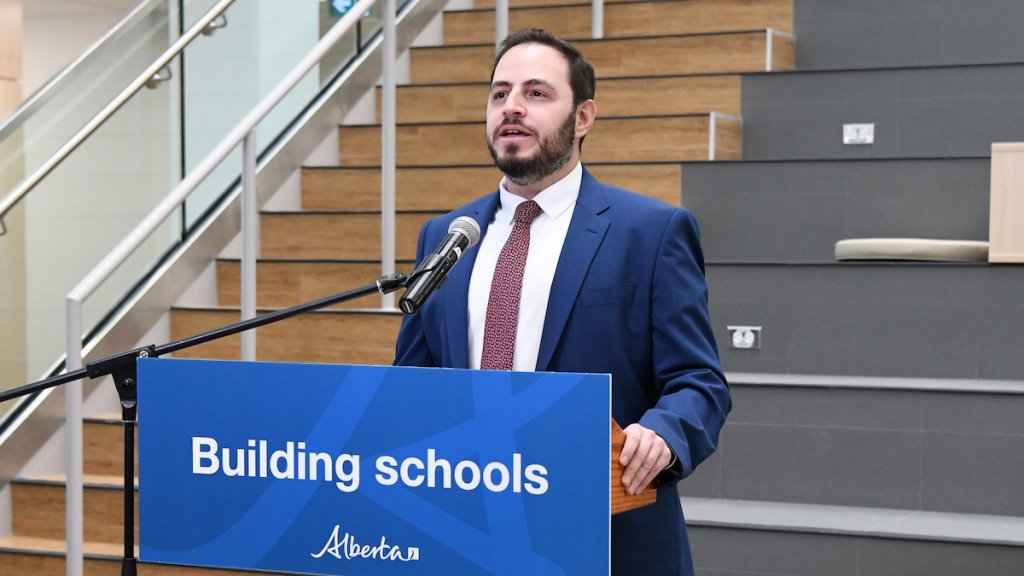
Critics say the United Conservative Government’s plan to fund private-school construction projects to the tune of $90 million over three years makes no sense.

Alas, the scheme announced by Education Minister Demetrios Nicolaides at the end of last week to “create 6,000 new student spaces at independent schools,” as the government’s news release tendentiously put it, makes plenty of sense from the government’s point of view.
It goes without saying it’s terrible public policy, deceptively packaged as offering “choice,” as a way to help children with learning disabilities, and as a partial solution to the shortage of public-school spaces that the government blames on immigration but is in fact caused by its own neglect and poor planning.
Credulous voters inclined to accept Dr, Nicolaides’ claims at face value, though, would be wise to beware neoliberal ideologues bearing gifts! A good question to ask when Conservative politicians start talking about choice is, “Who chooses, who loses?”
Consider that word “independent,” oft repeated in the minister’s talking points. In these circumstances, it means private, but propped up with public money. These schools may be publicly supported, but there will be no accountability, nor will they be required to educate all children.
All of us Alberta taxpayers – at a moment in the province’s history when our government has just warned us we’re in for another round of austerity – will be ponying up the cash to build new private school buildings to which we and our children have no access.
But it is good politics. After all, it will appeal to the government’s vocal and well-organized supporters in this province’s aggressive private-school lobby, which represents everything from chichi private prep schools catering to the very wealthy to religious academies offering, shall we say, a wide range of instructional quality.
Dr. Nicolaides made an effort to leave the impression the spending is intended principally to help students with “specialized needs,” a phrase used in the news release and repeated several times in an interview the minister gave to a UCP-friendly Postmedia publication. He said programs offering special-needs instruction would be prioritized for the handouts.
We’ll see how that part works out. Some of it will certainly be used that way, and some of the programs – which won’t be cost-free for parents, by the way – will do good work. But given the UCP’s well-known ideological hostility to public education and other public services, and Premier Danielle Smith’s clearly articulated desire to move quickly toward a U.S.-style voucher funding system, it is reasonable to suspect this is intended to be the thin edge of the wedge.
We are moving quickly now toward a system in which anyone can set up any kind of school they wish and exclude anyone they want, and we will all get to pay to help them build it, and run it.
Why not fund special-education instruction and facilities in public schools, where it is desperately needed? The government’s news release doesn’t answer that obvious question, although it strives to leave the impression this scheme is merely an enhancement of “the province’s significant investments in public education.”
This won’t “build on” public education, though. It will take from it. Everyone contemplating this significant expenditure needs to understand that.
“Eligible projects can include new schools, expansions, ready-made or modular classrooms, building purchases and leasehold improvements,” says the government’s news release. Grant funding will be forked over on a cost-matching basis – two from school operators to one from public funds for established private schools, four to one for new ones. And count on it, new private schools will be set up to take advantage of this program, further draining funds from public education over time.
The cash can be used for constructing new buildings or modular structures, including interiors, mechanical, electrical, materials and labour, for exterior servicing, landscaping, parking and play areas, for furniture and equipment, and for professional and permit fees,
Applications for 2026 are due by the end of May – which strongly suggests applicants have already been lined up among the government’s friends in private education to ensure that all $90 million is given away. This generosity will be repaid in votes and individuals’ donations.
“Independent schools serve more than seven per cent of Alberta’s students while receiving less than five per cent of education funding,” Dr. Nicolaides’ press release noted piously. Perhaps the real question we should be asking, though, isn’t why private schools get less public funding than public education, but why they get any at all?
