
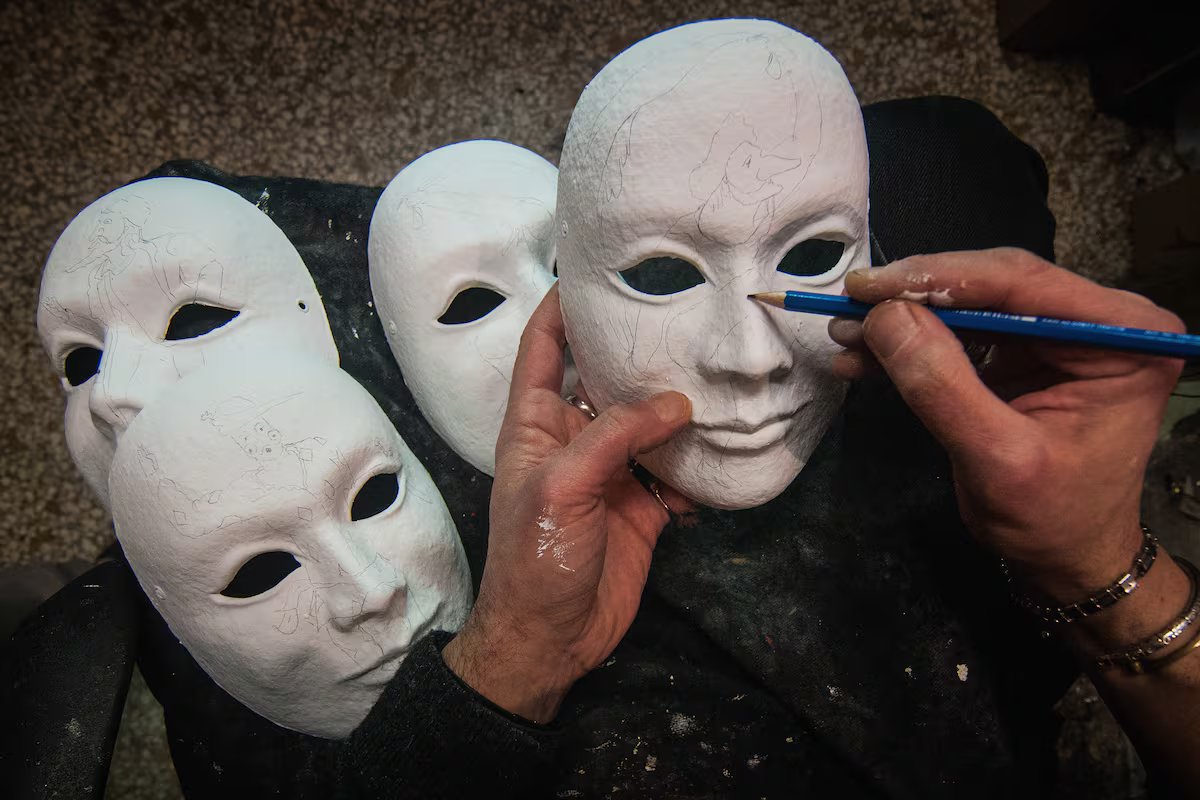
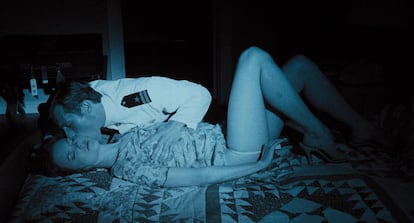
In Eyes Wide Shut, the film that Stanley Kubrick filmed just before he died in 1999, Bill Harford, a doctor played by Tom Cruise, discovers that many of his patients (politicians, businessmen and celebrities belonging to the New York elite) are taking part in masked orgies and rituals. With the declassification of each new batch of Epstein files, thousands of people have commented online how the documents — full of the names of famous people from across all kinds of sectors — may confirm that Kubrick based the movie on real life. In another twist in the world of conspiracy theories, some have even gone further, spreading the idea that the director did not die of a heart attack but was murdered for revealing the secrets of high society in the United States.
Conspiracy theories about powerful secret societies operating outside or against the state often come paired with the notion that the wealthy and influential people involved in these plots also behave in libertine and immoral ways. In this view, the elites’ boundless ambition is accompanied by an alleged bottomless sexual appetite and desires that deviate from the norm — along with, of course, the ability to act on them with impunity, even when others are harmed.
“Epstein has been Napalm to those suspicions,” says Noel Ceballos, author of El pensamiento conspiranoico (Conspiracy Thinking). “According to Lord Acton’s dictum, power corrupts and absolute power corrupts absolutely, and given the most recent headlines [such as the arrest of the former Prince Andrew], we’re inclined to think he was right,” continues Ceballos, who recalls that the historian also wrote that “Great men are almost always bad men.” “That vision of power as something inherently perverse and corrupting connects very well with the conspiratorial mindset.”
Beyond speculation, the truth is that stories about rich, narcissistic and insensitive men (women have historically been excluded from such circles of power) have fascinated us since the time of Marquis de Sade. The four protagonists (a nobleman, a priest, a banker and a judge) in his novel The 120 Days of Sodome, which the Frenchman wrote during his time in prison in 1785, turned their victims into instruments for their own pleasure.
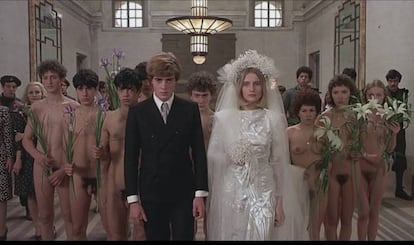
That theme is seen again in works from different time periods, like Luchino Visconti’s The Damned, Bret Easton Ellis’ American Psycho and more recently, Sara Barquinero’s Spanish-language book Los escorpiones (The Scorpions), which tells the story of cruel and decadent fetish clubs for aristocrats.
Although it is difficult to know whether the relationship between money, power, and perversion is a literary fantasy (one that conspiracies project onto reality) or a historical constant, experiments like those conducted by U.S. psychologist Paul Piff suggest that it is natural for people who enjoy certain advantages to end up behaving in less empathetic ways
Piff demonstrated this with a rigged game of Monopoly, in which he observed that individuals who were randomly assigned a better starting position (more money) eventually displayed overbearing behavior: they became rude, consumed more shared resources, and, by the end of the game, attributed their success to their own skill, ignoring the fact that the game had been stacked in their favor.
Although in this case it is unearned success that leads to undesirable behavior, we also tend to assume that many people who rise within organizations such as companies or political parties do so precisely because of their lack of scruples. This is essentially the argument made by criminologist Vicente Garroldo in his book El psicópata integrado (The Integrated Psychopath), which develops the idea that psychopaths — people who “do not make decisions based on moral principles, but on their strategic ability to get what they want”— “fit a certain widespread expectation of what the ideal corporate leader should be,” and therefore frequently end up occupying positions of power.
Although many of these issues appear as far back as the work of Shakespeare, in light of recent events, it is worth asking: does power and money corrupt, or is it rather that those already predisposed to corruption are the ones who most often gain access to privilege? Are we living in a world designed by and for psychopaths? And above all: why are we so fascinated by these stories?
Why are secrets so alluring?
The idea that people control our destinies behind closed doors, defending dark interests (that go far beyond Marx’s theory of class reproduction) and deciding on laws and policies through secret mechanisms outside formal democratic representation has long been widespread — at least since the beginning of modern democracy itself.
In fact, ever since the Jacobins were associated with the Freemasons and other secret societies such as the Illuminati (18th‑century Enlightenment‑era groups whose “essential aim was to guard against the excesses of religious influence and abuses by state powers, in Ceballos’s words), there has been constant talk of conspiracies against legitimate governments.
Many of these narratives are also laden with antisemitism. There is a direct line connecting them to The Protocols of the Elders of Zion, a fabricated document that circulated in the early 20th century and claimed to offer proof of a supposed Jewish conspiracy to conquer and control the world. None of these theories have gone away, but have rather transformed.
As Ceballos puts it, “If we accept that QAnon is the pop, post-modern version of The Protocols of the Elders of Zion, it becomes clear that George Soros is the supervillain that a story like that requires. Such obvious anti-semitic caricatures like that of The International Jew are no longer viable. Now the conspiracy theory must be synchronized with major cultural trends and fashions.”
Alejandro Sánchez Berrocal, a researcher from Madrid’s Complutense University who has a doctorate in philosophy, believes that the rise of conspiratorial thinking is a political symptom, and a sign of malaise. “Many conspiracy theories are flawed explanations, but they can serve as a barometer, indicating that the transparency of decisions, the accountability of those in power, and the ability of citizens to scrutinize power is falling short of what is promised by democracy,” he says. “Many conspiratorial beliefs express vulnerabilities, such as feelings of insecurity and political powerlessness, and they operate as part of a search for meaning and agency in contexts where, let us not forget, institutions can lie or strategically manage information and where inequality of resources makes some actors virtually immune to consequences.”
In this sense, Sánchez Berrocal says that it’s not so far‑fetched to think that — without the need for secret pacts, sects or plots — there are indeed hidden spaces of power that can’t be monitored by citizens or regulated by law: “The tools of class operate in plain sight: business, media, and experts. But that does not make discreet coordination unnecessary. On the contrary: in liberal democracies, it is functional for part of the action to take place in an opaque space. There is no need to invoke the Illuminati. Think of all kinds of closed and informal networks (clubs, lobbies, foundations, offices, dinners, corridors, etc.) that are unevenly accessible, where information, favors and expectations are exchanged.”
So does this mean we’re stuck with areas where no one is held accountable, or with people serving private interests that stay hidden from the public? “It depends a lot on the rules, oversight mechanisms and institutional culture,” says Sánchez Berrocal. “If power were better distributed and the political pact truly functioned as a legitimate contract [revocable, transparent and subject to control, to paraphrase P.J. Proudhon], it would be much more difficult for these spaces to be established. Corruption thrives where power is concentrated and poorly monitored. That is why the problem is primarily institutional.”
The lure of debauchery and evil
Conspiracy theories that portray elites maneuvering behind the scenes to consolidate and expand their power often have a second component: one that portrays the protagonists as perverse and libidinous individuals, fond of all kinds of sexual excesses and eccentricities. Nowadays, these prejudices extend to nearly all of the rich and famous, and the tabloid press has helped entrench them.
“It is probably part of a kind of demonization of the enemy,” says Noel Ceballos. “It is also a metaphor for the broader harm they cause in our societies, as it is still an imaginary world full of aggression against the weak by the powerful.”
In this way, class resentment turns into a kind of moral judgment that, paradoxically, ends up helping the most reactionary forms of populism
According to Vicente Garrido, a writer and criminology professor at the University of Valencia, the alignment between immoral public behavior and immoral private behavior “is only perfect in the integrated psychopath, who loves no one — neither inside nor outside the workplace.” “Outside of psychopathy, it is possible to behave decently in family life, although a person who lies, manipulates, and threatens in order to reach a position of power has a very lax ethical code,” she says. “The more immoral their rise to power, the more likely they are to be a bad person in their private life.”
Garrido points out that “power, status and wealth appear to be universal goals of human ambition, something that also leads to another great human incentive: sexual pleasure.”
In her book Decir el mal (Saying Evil), philosopher Ara Carrasco Conde also links, through the work of Sade, sexual impulse with harming others. What she argues is that, according to the logic of sadism, it is natural for the strong to dominate the weak and for vice to be the true law of nature. Within this framework, morality and virtue are artificial chains that constrain human beings, so doing evil becomes, paradoxically, an act of liberation — one that aligns with a supposed natural order of destruction and regeneration.
Sánchez Berrocal sees something similar in the “forbidden pleasures” associated with the ruling classes: it is not about pleasure for hedonistic reasons, but about the feeling of power and impunity. “It seems to me that the forbidden is not the goal here, but rather asymmetry and the transgression of limits. What sets these powerful people apart is not that they can do anything, but that they can do it without consequences — or with the ability to buy silence, apply pressure, or destroy reputations. Transgression works as a status marker and is tied to dynamics of domination, dehumanization, and social harm more than to pleasure in any banal sense.”
In 2025, Ianko López told EL PAÍS that Salò, or the 120 Days of Sodom (the Pasolini film based on the Sade book) expresses how “the violence that underlies the exercise of power in capitalist societies has not lost an ounce of power and validity.”
Another recent film, Jonathan Glazer’s The Zone of Interest, does not explicitly show Rudolf Höss committing sexual abuse, but it is suggested and becomes part of those routines of the banality of evil (to use Hannah Arendt’s expression for the bureaucratized cruelty of Nazism), where what is at work is not desire but power.
In this way, evil or perversity has less to do with social class than with the absence of checks, limits, or obstacles to exercising power. Regarding the recent wave of suspicions and conspiracy theories, Berrocal says: “It will always be necessary to discriminate on a case-by-case basis, recognizing that there is opacity, immunity and even specific conspiracies that allow us to transform suspicion into a democratic demand for control and accountability. The credulity or common sense that accepts any official version by default can be as disastrous in political terms as the paranoia that sees a hidden hand behind everything.”
Sign up for our weekly newsletter to get more English-language news coverage from EL PAÍS USA Edition
