
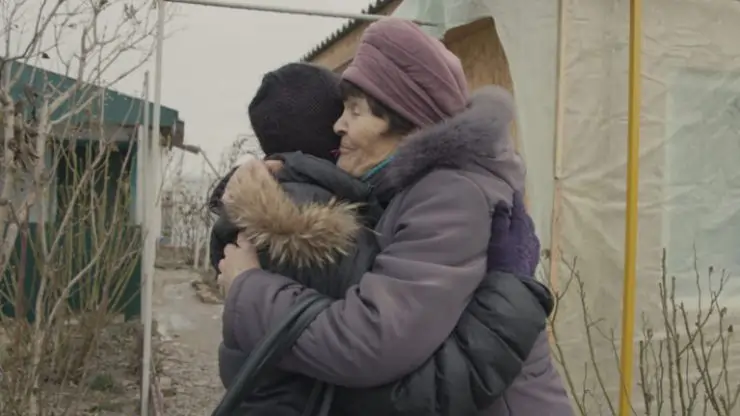
SEMA is a Ukrainian organization that fights against the stigma of women affected by conflict-related sexual violence. Striving for post-traumatic growth, it was founded in 2019 and, run by women, it has tripled in size since the start of the full-scale invasion. Traces (directed by filmmaker Alisa Kovalenko, who previously documented her own front-line experience) follows members of the team as they find more CRSV victims, female civilians of mostly older age, who’ve kept silent, hiding their experiences like open wounds under heavy-layered clothing.
Here’s a little piece of trivia that recently came to my attention: Putin, rumors have it, is a regular visitor of Mount Athos. As an overtly declared, ardent exponent of Orthodox Christianity, this comes at no surprise. But it’s worth holding this on the side here, since his visits are incognito and thus suggesting a level of honesty—a well-targeted twist. Over the decades, we’ve seen a plenitude of dexterous marketing tricks deployed from this disastrous oligarch (by the way, recently, Jude Law recently gave a fun impersonation of this, over The Wizard of the Kremlin). This one is relying on the inevitably strong pillar for attaining fondness and connection and, consequently, fanaticism, the kind that renders crowds blind to critical thinking and judgement and thus taking a stance: religion.
Christianity here has become a blessed ploy, meant to achieve greater volumes in his already unreasonably far-reaching group of followers across nations, in spite of his murderous politics. In light of this picture, though, let’s entertain the above fact for a second. What’s Christianity to do with disgracing human dignity? What’s Christianity to do with robbing one’s own reasoning for action and one’s own right to one’s own body? What’s Christianity to do with sexual violence and any violence as a matter of fact?
Permit me the yakking, as Traces has no reference to the self-assumed leader, nor does it resort to any religious appeal. But it does speak of the atrocities his soldiers have carried out in Ukraine since 2014, and although it doesn’t seek direct incrimination, it does look for support, redemption, and a kind of resolution for the hundreds (probably thousands) of victims who, for more than a decade now, have been suffering from the collateral and equally potent in impact sexual crimes committed in their homes.
With that in mind, the reference to Christianity is not in defense of (any) religious practices, but merely to annotate why this documentary works so well. In the same autobiographical directness held previously by its filmmaker, Traces is not raising awareness or insinuating sympathy or calling for action; but it is aiming at recalibrating perspectives. Which, in times of multiple and durational warfare, when the moral compass is easily confused, eroded, and (regrettably, in this case) misled, is actually rightful.
And look, thinking in line with its otherwise audiovisual elements, this documentary lacks symbolism just as it builds its connections and traces lines over weak aesthetics. But the content is sharply focused (this is not about the predators, namely the young soldiers educated under the regime of Putin, and so there’s hardly any man shown in the picture). It does not derail for a second from its subject, it does not soften for a second into sentimentality, and so it actually does what documentaries sought to do, in the utmost traditional sense: slice a case, pick a point, and lay it open in dissection for audiences to piece it back together with what’s currently at stake and what’s already existing in one’s own mind.
Which is to say, this documentary is an urge for anyone who’s thought that imperialism and war are justified and rightful if the leader espoused the same religion to rethink; this is for everyone to reexamine, at a personal level, their beliefs, the fringes of their faith, and the consequences.
★★ 1/2
Traces won the Panorama Audience Award for Documentary at the Berlinale, and it’s making its way to CPH:DOX 2026 (Urgent Matters & Brainwaves Sections).
Traces, 85’/ Dir: Alisa Kovalenko / Co-director: Marysia Nikitiuk/ Producers: Olha Bregman & Natalia Libet/ Ukraine, Poland
Related
Discover more from
Subscribe to get the latest posts sent to your email.
