
Borders are facilitators of exchange for the movement of goods and people, but also have the power to exclude. In Baja California, both sides of this axiomatic truth are clearly evident.
In 2023, more than 16 million people crossed the border between California and Baja California on foot, over 30 million in vehicles, 1.8 million of which were commercial trucks carrying the goods that fuel the CaliBaja region’s US $70 billion in cross-border trade annually.
The flow of people, particularly immigrants seeking a new life, is more politicized and thus more complex. In some cases, immigrants who have set their hearts on the U.S. never make it there, a situation that, over the years, has often made Baja California stronger and more attractive as a tourist destination, although immigrants have sometimes found life there difficult, too.
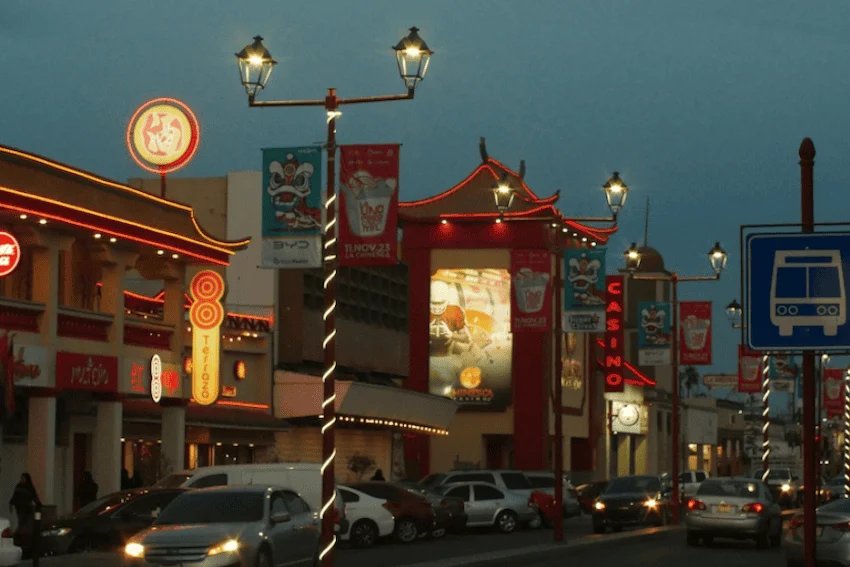
A good example of this is La Chinesca in Mexicali, the oldest and largest Chinatown in Mexico.
The origins of the Chinese community in Mexicali
Imported Chinese labor built the Western railroads that connected travel and trade in the U.S. during the 19th century. But after this backbreaking task was complete, Chinese workers found they were unwanted competition for other jobs. In 1882, the U.S. passed the Chinese Exclusion Act, a sweeping, racist immigration preventative that wasn’t repealed until the Second World War.
Mexico was more welcoming, at least initially, and by the turn of the 20th century, a Chinese community had begun to form in Mexicali. Indeed, before long, Chinese outnumbered Mexicans in the newly created town — Mexicali was officially established in 1903 — by as many as three to one, with many engaged in building canals or raising cotton for the Colorado River Land Company.
To avoid the intense summer heat, the Chinese built underground tunnels and subterranean spaces throughout the growing La Chinesca area, and by the 1920s, these were being profitably used for illicit entertainment for those escaping from Prohibition on the other side of the border. Hotels, bars and restaurants welcomed visitors above ground, while bordellos, gambling and opium dens were tucked out of sight below.


The evolution of La Chinesca as a tourist attraction
These tunnels have also proved handy in a period of persecution during the Mexican Revolution, when anti–Chinese sentiment ran high and over 300 people were massacred in Torreón, Coahuila. But Mexicali’s Chinatown survived, thriving during Prohibition and again following another influx of immigrants after the Second World War. Today, over 100 years after it was founded, some 20,000 or more descendants of this Chinese population still live in Mexicali’s La Chinesca district, and the neighborhood has become an increasingly popular tourism attraction for a new generation of cross-border explorers.
One reason is the unique fusion cuisine that has evolved in Mexicali, as Chinese recipes and wok-cooking techniques benefited from Mexican ingredients like skirt steak arrachera, avocado, chile de árbol and jicama, and birthed local specialties like “rice tamales” with a variety of tasty proteins, including carnitas. Since 2023, La Chinesca has been one of the more than 30 Barrios Mágicos established to promote tourism in Mexico, and was the first named in Baja California.
Notably, those satiated by the culinary offerings at Mexicali’s over 300 Chinese restaurants, many in La Chinesca, can also book public or private tours of La Chinesca’s famed underground tunnels.
Experiencing the Russian legacy in Valle de Guadalupe
Russians, in the form of Molokans, a pacifistic Christian sect that had split with the Russian Orthodox Church, first came to Baja California in the early 1900s to avoid army conscription by Tsar Nicholas II. Known as “milk drinkers” for their refusal to abjure dairy during religious fasts — one of many reasons for their schism — the Molokans left the Kars Region on the border of Russia and Turkey, and settled in Valle de Guadalupe, now the center of Baja California wine production in the state that produces some 70% of the national total.
The Molokans drank more than milk, but were teetotalers. Still, their influence on the region’s developing wine history was profound. After 105 families moved to Baja California in 1905, buying 13,000 acres of fertile land through an agreement with President Porfirio Díaz, and devoting it largely to the growing of crops, they also planted vineyards as early as 1915.
They weren’t the first winemakers in Baja California. Bodegas de Santo Tomás was founded in 1888 in the Valle de Santo Tomás. Nor were they the first to grow grapes in Valle de Guadalupe — Spanish missionaries had done it first. However, their introduction of European viticultural techniques and increase in production helped pave the way for commercial winemaking in Valle de Guadalupe.
The Molokan community formed an ejido in 1937 during the land reforms of President Lázaro Cárdenas. A, but a generation later, in the late 1950s, this ejido — originally named Guadalupe, later El Porvenir — found itself repeatedly beset by aggressive squatters.
“Although there is some dispute over what happened next, most of the Molokan community claim that Governor (Braulio) Maldonado expropriated 300 acres of their land to the squatters, who by then called themselves the Francisco Zarco group, after a young intellectual journalist of the early 1800s.”
So wrote Ralph Amey in his 1990 book on regional winemaking, “Wines of Baja California: Touring and Tasting Mexico’s Undiscovered Treasures,” adding: “In October 1962, Baja governor (Eligio) Esquivel, (Maldonado’s successor), recognized the claims of the squatters and rededicated the village of Guadalupe in the name of Francisco Zarco. By then, many of the remaining Molokans had sold their land at depreciated prices and emigrated to the United States.”
Molokan-related tourism attractions
It was a shameful episode, a theft sanctioned by the state’s highest office holders. For by this time, the Molokans, like the Chinese in Mexicali, were gradually, through marriage, becoming absorbed into Mexico’s broad mestizo culture. More to the point, they had a legal right to the land two times over, through deed and ejido.
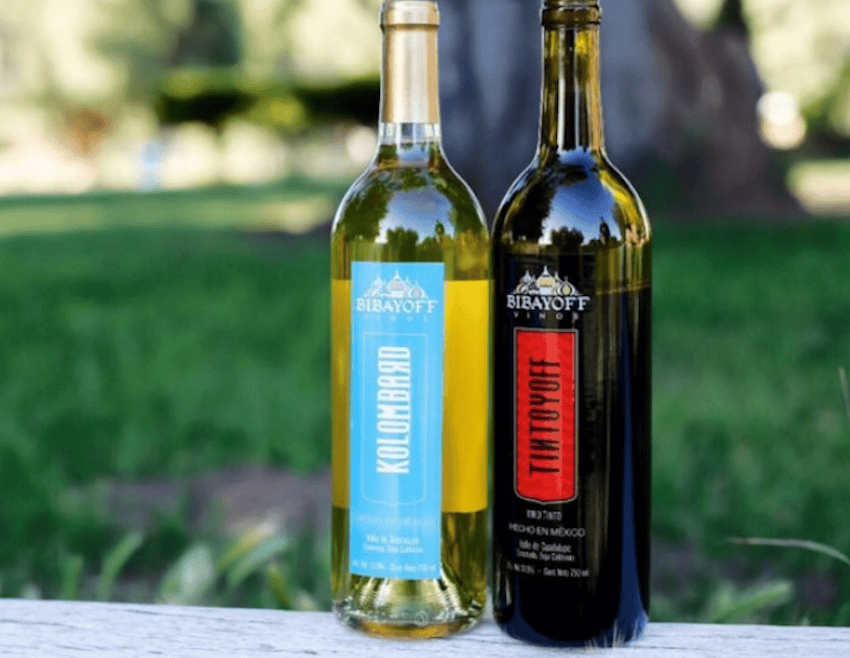
But not all left of them left, and there is still a rich legacy that can be enjoyed by visitors to “the Valle.” Most notably, at Vinos Bibayoff. The roots of the winery trace back to Alexie M. Dolgoff, a Molokan who had been growing grapes since the early 1930s and selling them to commercial wine producers like L.A. Cetto and Domecq. In the 1980s, Vinos Bibayoff began commercially producing wine on its own under the stewardship of Dolgoff’s grandson, David Bibayoff, who steered it to success. Today, Daniel Bibayoff continues the tradition with the Molokan heritage of the family honored in a small on-site museum.
Only a few kilometers away, along the Carretera Francisco Zarco-El Tigre, in the small town of Francisco Zarco, on land that once belonged to the Molokans, lies another museum: the Museo Comunitario Ruso. Housed inside a former Molokan home built in 1905, the museum houses artifacts and photos, from traditional dress and samovars to a layout showing the original community. Next door, visitors can dine at the Restaurante Ruso Familia Samarin, which serves traditional Russian heritage dishes like borscht, babka and peroshki, as well as Mexican dishes, and is operated by descendants of the Molokan community.
Chris Sands is a writer and editor for Mexico News Daily, and the former Cabo San Lucas local expert for the USA Today travel website 10 Best and writer of Fodor’s Los Cabos travel guidebook. He’s a contributor to numerous websites and publications, including The San Diego Union-Tribune, Marriott Bonvoy Traveler, Forbes Travel Guide, Porthole Cruise and Travel, and Cabo Living.
