
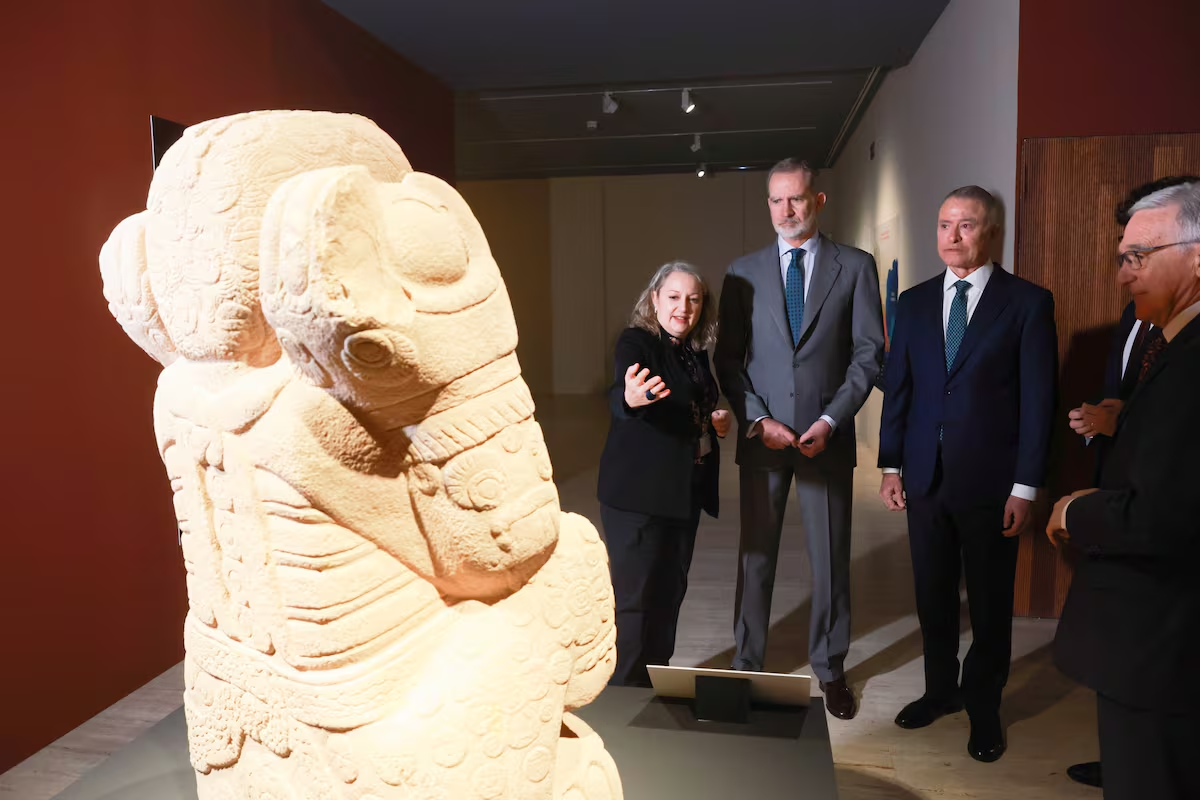
Spain’s King Felipe VI acknowledged on Monday morning, during a visit to the exhibition Half the World: Women in Indigenous Mexico, organized jointly by the Spanish Ministry of Foreign Affairs and the Mexican Ministry of Culture, that “there was much abuse” during the colonization of the Americas by the Spanish conquistadors.
“There have also been struggles, let’s say, moral and ethical controversies regarding how power was exercised from the very beginning,” King Felipe said in an informal conversation with the Mexican ambassador to Spain, Quirino Ordaz, as seen in a video released by the Spanish Royal Household on social media.
“That is, the Catholic Monarchs themselves, with their directives, the Laws of the Indies, and the legislative process, show an intention to protect, which then, in reality, wasn’t fulfilled as intended, and there was much, much abuse. And also, as I said before, we must value the fact that from this knowledge, we will appreciate each other more,” he added.
In an event that did not appear on his public schedule, the king made a surprise visit to this exhibition at the National Archaeological Museum of Madrid, which highlights the role of women in pre‑Hispanic cultures and includes nearly 250 pieces, many of which had never been displayed outside Mexico. Felipe VI’s visit, of high symbolic value, represents a gesture of reconciliation between the two countries after, in 2019, the then Mexican president Andrés Manuel López Obrador demanded in a letter that Felipe VI apologize for the abuses committed during the conquest of the Americas, and the monarch, in agreement with the government, left the letter unanswered.
Felipe VI’s silence, which López Obrador interpreted as a snub, opened a serious diplomatic crisis that worsened when the new Mexican president, Claudia Sheinbaum, decided not to invite King Felipe VI to her inauguration and the Spanish government chose not to send any representative.
The opening of this same exhibition served as the setting, last November, for Spain’s Minister of Foreign Affairs José Manuel Albares to take a first step toward rapprochement. “The shared history between Spain and Mexico, like all human history, has its light and shadow. There has been pain and injustice toward Indigenous peoples. There was injustice, and it is only right to acknowledge and regret it. That is part of our shared history; we cannot deny it or forget it,” he said.
The opening of this same exhibition last November served as the stage for Foreign Minister José Manuel Albares to take a first step toward rapprochement. “The shared history between Spain and Mexico, like all human history, has its light and dark sides,” he said. “There has been pain and injustice toward the Indigenous peoples. There was injustice, and it is right to acknowledge and regret it. This is part of our shared history; we cannot deny or forget it.”
Mexican President Claudia Sheinbaum responded positively. “Congratulations on this first step, Spanish foreign minister,” she said hours later from the National Palace, noting it was the first time a Spanish official spoke of regretting the injustices of the Spanish conquest. “Forgiveness elevates nations; it is not humiliating. On the contrary. Recognizing history, acknowledging grievances, asking for forgiveness — or expressing regret — and embracing it as part of history elevates governments,” she added.
Despite these words, in the view of Mexican authorities, a gesture from King Felipe VI was still missing to definitively close a crisis that López Obrador had centered on the monarch.
Sources from the Spanish Royal Household said that the exhibition visited by King Felipe “is part of a binational project that was born with the aim of strengthening the ties between both countries through the recognition of the historical importance of the Indigenous cultures and the fundamental role of women in the Indigenous communities of Mexico precisely in this year 2025 in which their legacy is being commemorated in that country.”
During the visit on Monday, King Felipe was accompanied by the director of the Spanish Agency for International Development Cooperation (AECID), Antón Leis García; the Mexican ambassador to Spain, Quirino Ordaz Coppel; Andrés Ciudad, professor of Anthropology at the Complutense University of Madrid and a member of the exhibition’s scientific committee; and the director of the National Archaeological Museum, Isabel Izquierdo. Among other pieces, Felipe VI was able to view the pair of eagle warrior and jaguar warrior from Tehuacán; the small Olmec terracotta figurines representing elderly women from the Gulf Coast; the priestess from Palenque; a Mayan incense burner; and the powerful young woman from Amajac, a sculpture discovered a few years ago in Veracruz.
Last autumn, an ambitious exhibition program was launched in several venues in the city of Madrid, showcasing the richness of Mexico’s native cultures and the role of women in Indigenous communities, as part of a major cultural initiative that took place as diplomatic relations between the two countries were beginning to improve.
Sign up for our weekly newsletter to get more English-language news coverage from EL PAÍS USA Edition
