
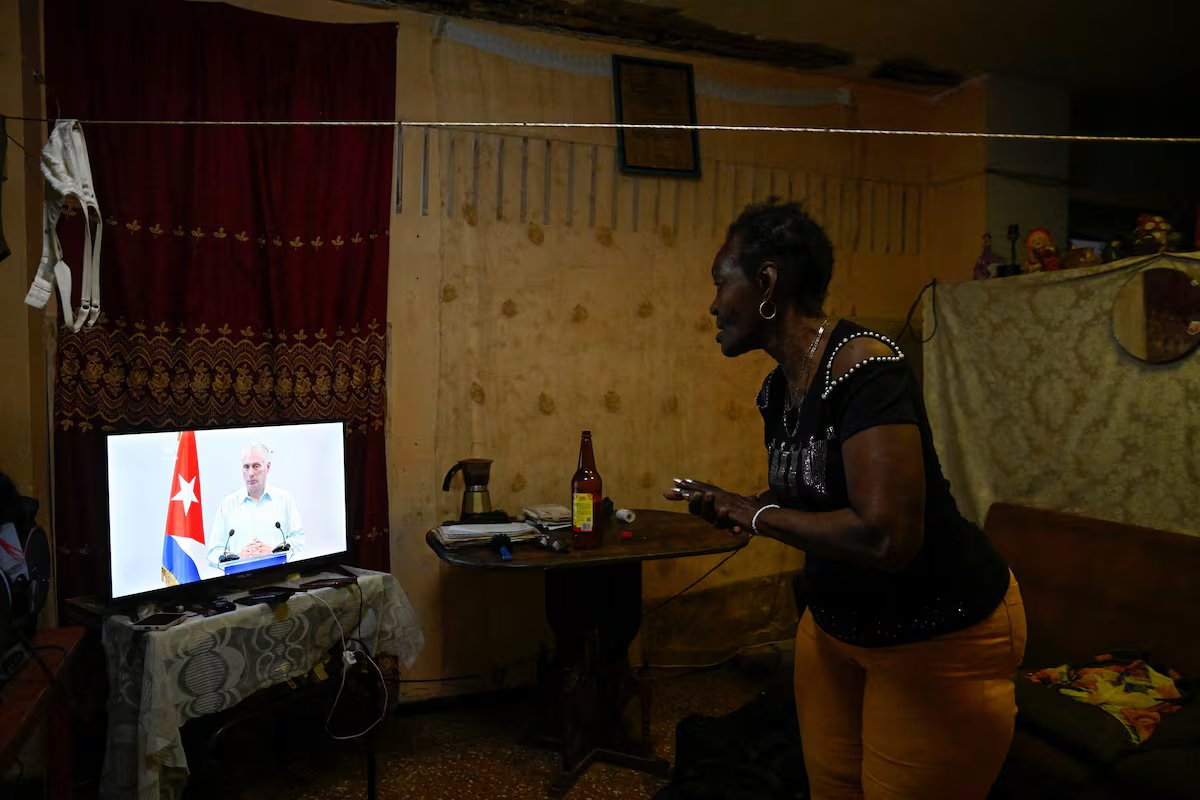
When Lisandra Ferro, a 43-year-old Havana resident, woke up on Friday amid yet another blackout, her heart was racing. She had been feeling anxious since the night before, when she learned that President Miguel Díaz-Canel Bermúdez would be holding a press conference at 7:30 a.m., after several weeks of fuel shortages that have brought the island and everyone living on it to its knees. She wanted to hear something that would pull her out of the stupor she had been living in: caring for two small children, enduring power cuts of more than 15 hours a day, and having to change jobs twice in a single month.
To make matters worse, she had barely opened her eyes when she saw a a message on her phone made her even more nervous. “They say that zero hour [the total collapse of fuel supplies] begins on Sunday. Stockpile water and non-perishable food. Take care,” a friend in Madrid had sent her via WhatsApp.
So Lisandra jumped out of bed, woke the children, got them ready — bread with mayonnaise and sugar water for breakfast — and told them that “you’ll be arriving a little later to school today.” And together they sat down, at exactly 7:30 a.m., in front of a radio to find out what the president had to say to Cubans in the face of a crisis that had been dragging on for 43 days.
This time, the Cuban government did have something genuinely significant to announce. The news that Cuba is opening a dialogue process with the United States could be the first step toward easing the dire situation in the country, which has been gripped by a structural crisis for years — one that has been compounded by direct pressure from the Donald Trump administration.
The fact that Cuban authorities announced the start of negotiations with the U.S. government to “seek solutions” and “move away from confrontation” confirms what, until now, had been a rumors, anonymous statements from U.S. officials, and assertions by Trump that Havana did not contradict.
President Díaz‑Canel had gone a month without facing the press, limiting himself to inconsequential messages on X and brief appearances in official meetings that later became state‑media reports. True to the government’s usual secrecy, Cuban authorities unexpectedly broke the silence on Friday morning — with the conspicuous presence of Raúl Guillermo Rodríguez Castro, known as “El Cangrejo,” the powerful grandson of Raúl Castro. The announcement caught many Cubans off guard, including Lisandra, who longs for real change that will improve her hectic life as a single mother and her children’s future.
Still, any meaningful improvement seems far off. “Meanwhile, this man [Díaz-Canel] keeps asking us to resist. But at least they’ve finally confirmed the so-called negotiations,” says Lisandra. After dropping her children at school, she joined a long line in her neighborhood in El Cerro, waiting to buy a bottle of cooking oil for 900 Cuban pesos (about $2) — a bargain at a time when the now‑scarce product usually costs around $3 when it can be found at all.
In the line Friday morning, another woman, somewhat younger, is also waiting. She’s from Santiago de Cuba, has lived in Havana for two years, and works two jobs as a community manager. After watching the press conference, she says she accepts the government’s explanations “despite everything,” though she admits that “the situation is unsustainable.” Her work requires constant internet access and long hours at the computer, something that has become nearly impossible, especially in the past week, when a partial collapse of the national electrical grid left more than half the country without power — a problem authorities have struggled to reverse.
“This situation affects the way you live, your social life, your nervous system,” says woman, who explains that she’s on edge 24 hours a day and often sleeps only two hours because “the moment they turn the power back on, I have to get up to do laundry, cook, turn on the water pump.” If the situation continue like this, “we’ll all be zombies,” she says.
‘He’s a master at dodging questions’
Díaz-Canel’s words offer little comfort. “He’s a master at dodging questions, always giving the same answer: it’s all the fault of the blockade,” complains another Cuban woman, who wished to remain anonymous. The woman — from the province of Cienfuegos, in the center of the island — watched the president’s address on television at home while preparing breakfast, and was struck by his talk about upcoming measures related to Cuban emigrants and the possibility of them investing in Cuba without so many restrictions. “I hope all these absurd obstacles are eliminated,” she says.
Still, as she listened, she expected only two possible outcomes: “That he would say they’d throw in the towel and admit they can’t take it anymore, or that he would just spout nonsense, endlessly justifying himself. The latter happened.” But, amidst all the rhetoric, Díaz-Canel did clarify a few points, such as the fact that no oil has entered Cuba in the last three months.
In the municipality of Cárdenas, Ariel G. believes that, beyond the announcement of negotiations with the United States, new measures will soon be revealed regarding Cuba’s relationship with its diaspora and the FBI experts expected to travel to the island to investigate the recent incident involving a speedboat from Florida. Everything else in the president’s remarks felt like “more of the same.”
He was not reassured even when Díaz‑Canel addressed the workers who have been suspended from their jobs and will be reassigned to other sectors or companies during the current emergency. Ariel is one of those affected. He works at the Iberostar Selection Varadero hotel, where occupancy has dropped to about 50 guests out of 900 available beds. As a result, the hotel has let him go. The alternative offered to him is to work as a gravedigger or cemetery guard for about 3,000 Cuban pesos a month (roughly $6). He calls it “a total insult to tourism workers.”
Ariel, who works in gastronomy, says he would rather fish independently while time passes, hoping that “to see if this [Cuban government] will finally fall.”
Andy Vázquez, a young entrepreneur who runs a delivery company with a fleet of about 30 mostly electric vehicles in Havana, describes the Cuban government as “a dying system buying itself a little more time.” He is referring to how the authorities are handling the deepening crisis and to Díaz‑Canel’s responses during the press conference. “Once again, it seems like the people are to blame for not knowing how to reinvent themselves,” he says, challenging the president to call free elections “to see if the people really love you that much.”
Andy admits that keeping his two‑year‑old business afloat is becoming harder every day, and he has little hope left after hearing the government’s message in the middle of the current collapse.
This daily struggle is shared by many Cubans on the island: those trying to start new businesses, young people attempting to enter the workforce, and single mothers who must find a way to feed their families despite soaring prices and hours-long blackouts. All of them watch the days go by waiting for something to change — for someone to finally tell them that things are different.
Sign up for our weekly newsletter to get more English-language news coverage from EL PAÍS USA Edition
