
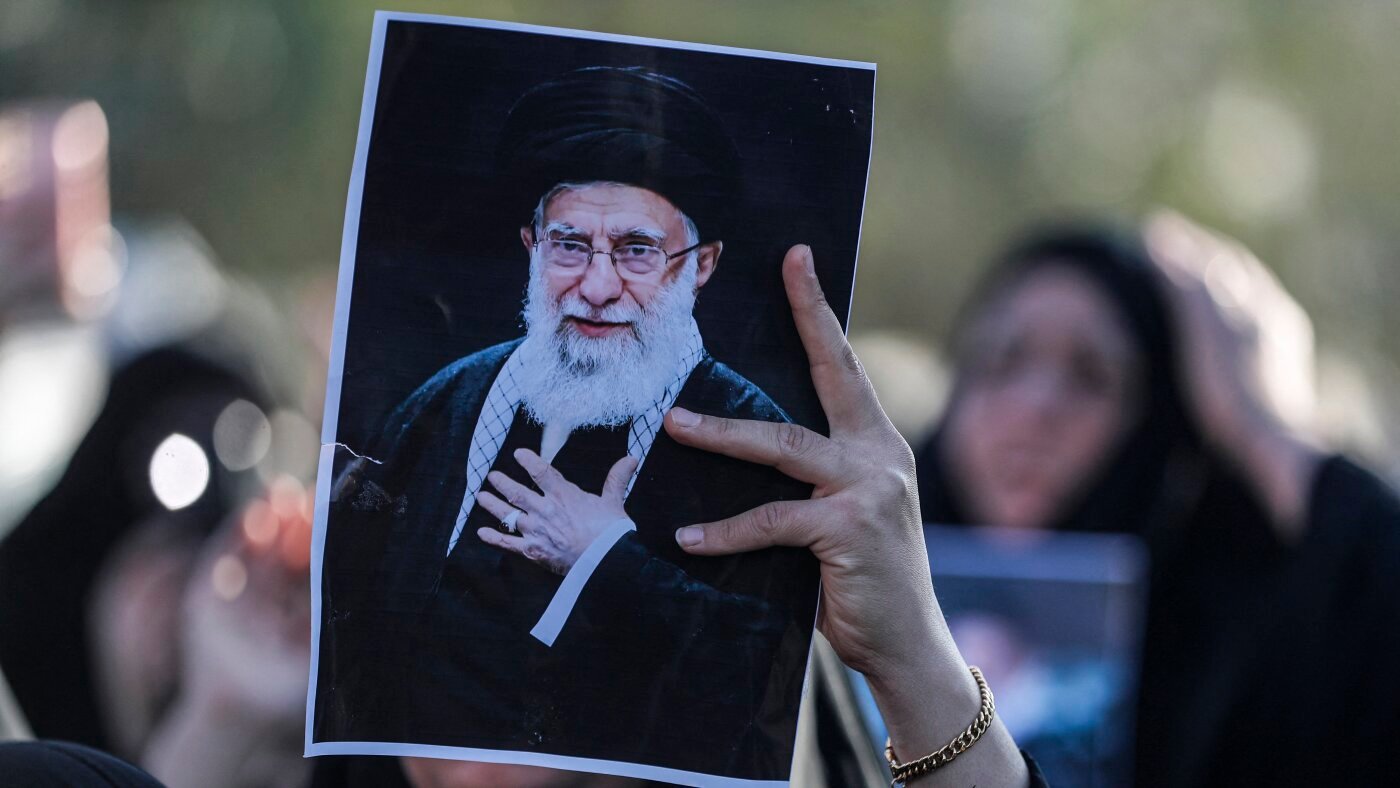
Ahmad Al-Rubaye/AFP via Getty Images
Stay up to date with our Politics newsletter, sent weekly.
The opening strike of the U.S.-Israeli war on Iran was a highly sophisticated operation that dealt a major blow to the Islamic Republic, killing Supreme Leader Ayatollah Ali Khamenei in his office in central Tehran.
The U.S. and Israel used an array of high-tech intelligence and military hardware to pull it off—a stunning display of power and lethal precision. But lost in all that modern wizardry is a fundamental moral and strategic question: Should the U.S. be in the business of assassinating foreign leaders?
“Technology sometimes takes us to places we’ve not been before, before we’re ready for it,” said Columbia University historian Timothy Naftali. “And our ability now to take out foreign leaders is putting us in a place we’ve never been before. We should take stock of the strategic, philosophical and moral implications of that.”
The U.S. has had a long and shifting relationship with the idea of killing foreign heads of state.
In the first few decades of the Cold War, the U.S. wanted to keep all options on the table, including assassinations, in its global struggle against the Soviet Union.
“There was certainly a sense that assassination was just another contingency, and something that the United States could not entirely exclude in the confrontation with the Soviet Union that was seen as this sort of all-powerful and terrible enemy,” said Luca Trenta, a professor at Swansea University in the U.K. and the author of a book on assassinations in U.S. foreign policy.
In the early years of the Cold War, the U.S. often helped set the stage for the removal or killing of a foreign leader, by providing weapons or intelligence, but local allies pulled the trigger, Trenta said.
The 1961 assassination of Rafael Trujillo, the dictator of the Dominican Republic, is one example. The Eisenhower administration wanted Trujillo removed but ultimately a group of Dominican dissidents gunned him down.
The CIA was also willing to take direct action.
In 1960, it plotted to assassinate Congolese Prime Minister Patrice Lumumba, even sending poison to the Congo to kill him. Ultimately, Lumumba was assassinated by Congolese rivals, not the U.S.
Throughout the 1960s, the CIA also repeatedly plotted to kill Cuban leader Fidel Castro, including once with a poison pen. None of those efforts succeeded, and Castro ruled Cuba for another four decades.
Church Committee prompts self-reflection
This was all done in the shadows, without the American public’s knowledge.
It came tumbling out in the mid-1970s when revelations of CIA abuses led to congressional investigations, including one known as the Church Committee, led by Idaho Democratic Sen. Frank Church.
The panel issued an interim report in 1975 that examined U.S. involvement in plots to kills foreign leaders, and determined the U.S. was indeed implicated in such efforts.
It also declared that “short of war, assassination is incompatible with American principles, international order and morality;” the panel stated that assassinations should be rejected as a tool of foreign policy.
“The investigations of the Church Committee really provide a brief moment of self-reflection for U.S. politicians, for the U.S. public, in which there is a sense that maybe if we are a democracy and we are to be different from the enemies that we are supposedly fighting, we should not be doing these things,” Trenta said.
In 1976, President Gerald Ford issued an executive order banning the U.S. government from engaging in political assassinations.
Columbia University’s Naftali said the consensus that developed in that era against assassinations was a product of several things, including public dismay over the imperial presidency in the wake of the Vietnam War and the Watergate scandal.
The political elite, meanwhile, were still deeply affected by the assassinations of President John F. Kennedy, his brother Robert Kennedy and civil rights leader Martin Luther King Jr., he said.
“Gerald Ford felt that this was not a tool that he wanted to use, and what’s really interesting is that his successors expanded the ban,” Naftali said. “So Ronald Reagan and Jimmy Carter both felt that the United States should not be in the assassination business.”
Multi-decade pause on assassinations, with an asterisk
For the next 20-plus years, the U.S. was not in the business, although with an asterisk or two.
In 1986, the U.S. bombed several sites in Libya, including leader Moammar Gaddafi’s family compound. And twice in the 1990s, the U.S. struck Iraqi leader Saddam Hussein’s palaces.
Brent Scowcroft, who served as President George H.W. Bush’s national security adviser, was interviewed by ABC News’ Peter Jennings about the targeting of Saddam in 1991.
Asked whether the U.S. wanted to kill Saddam, Scowcroft replied: “Uh, well, we don’t do assassinations, but yes we targeted all the places where Saddam might have been.”
Jennings followed up by asking whether that meant the U.S. deliberately set out to kill Saddam if it could. After a long pause, Scowcroft said: “I guess, yeah, that’s fair enough.”
In Naftali’s view, the operations against Gaddafi and Saddam weren’t cloak-and-dagger conspiracies to kill a foreign leader, but instead were military operations targeting command and control facilities.
“These military operations were not designed as assassination plots, but if the head of state had died, the United States wouldn’t have wept any tears,” he said. “And I think that’s how presidents Reagan, Bush and Clinton got around the assassination ban.”
That reflects, as least in part, that presidents found assassinations distasteful, and thought the American public did as well, Naftali said.
The shift after 9/11
That changed with the al-Qaida terrorist attacks on Sept. 11, 2001. Congress responded by authorizing all necessary means to go after the perpetrators of 9/11.
“All necessary means includes assassination,” Naftali said. “And I think that the taboo, if you want to call it an elite and public taboo, against using assassination disappears.”
In the post-9/11 world, the U.S. adopted a new technology, the armed drone, to kill al-Qaida leaders around the globe. But these strikes targeted alleged terrorists, not foreign government officials.
President Trump blurred that line when he ordered the drone strike that killed Iranian Gen. Qassem Soleimani in January 2020 in Baghdad. While the U.S. considered Soleimani a terrorist, he was a high-ranking Iranian government official.
Iran responded with plots of its own to assassinate Trump and senior administration officials.
Now, six years later, a joint U.S.-Israeli operation has killed Iran’s top political and religious leader, Khamenei. The U.S. provided intelligence while Israel conducted the lethal strike.
Trump crowed about the operation, saying on social media that Khamenei “was unable to avoid our intelligence and highly sophisticated tracking systems.”
Those sophisticated intelligence and military capabilities make it increasingly easy to target foreign leaders with a high likelihood of success, Naftali said.
“That was not possible in the Cold War and in the early post-Cold War. And in that kind of environment, it might make the threshold, or does make the threshold, lower for that decision to engage in political assassination,” he said.
That makes America’s adversaries more vulnerable, but also the U.S. as well.
“Sometimes mutual vulnerability leads to deterrence, but sometimes it can lead to existential angst and instability,” Naftali said. “And again, not to mourn Ayatollah Khamenei, but at this moment we should just take stock of how rare it should be for the United States to assassinate a foreign head of state and try to maintain a sense of taboo about it. And then as a nation, have a conversation about when we may violate such a thing, but keep that threshold very high.”
