
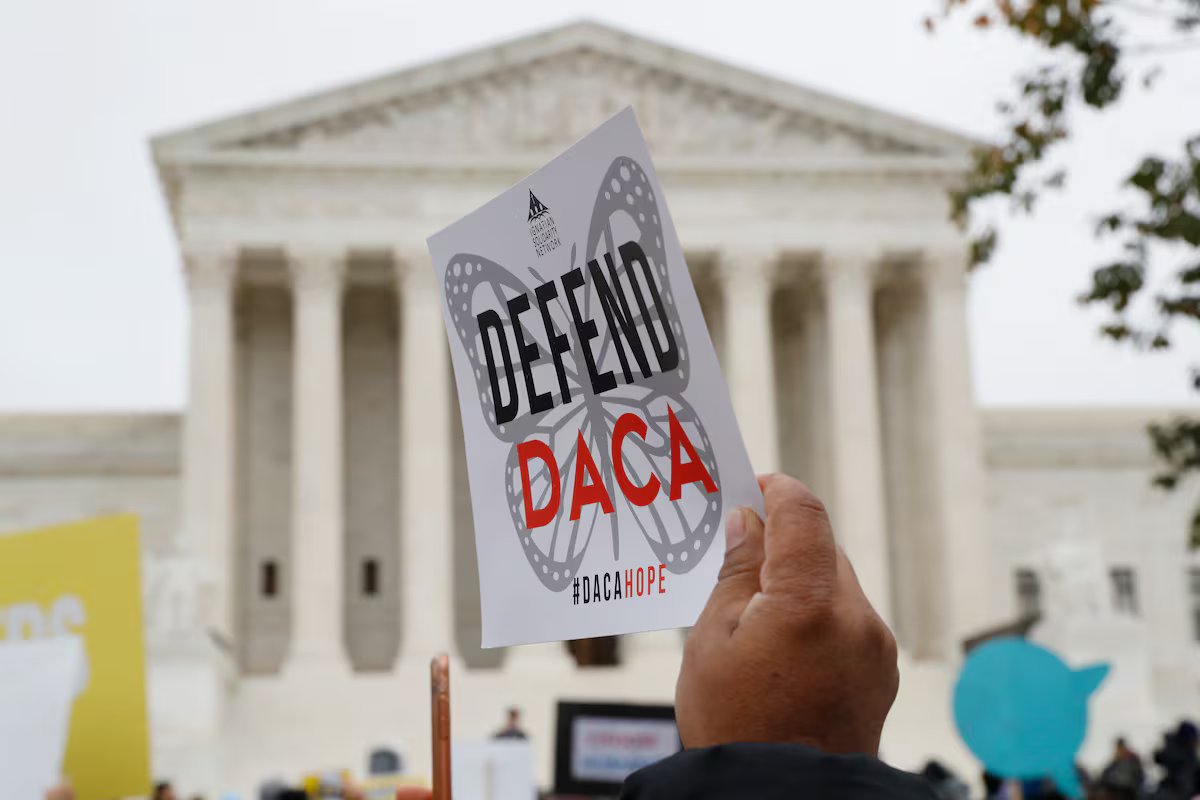
They arrived as children decades ago and made the United States their home, the only one many of them know. The law classified them as undocumented because their parents brought them in illegally, but for years they have built their lives in the country that welcomed them. They have studied, raised families, worked, and paid taxes. They are the so-called “Dreamers,” who, thanks to the DACA (Deferred Action for Childhood Arrivals) program, created by Barack Obama, obtained temporary residency and work permits. Now they are being deported.
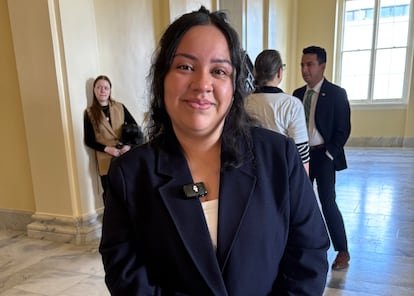
On Tuesday, several Democratic members of Congress met in Washington to denounce the attacks on Dreamers as one of the reasons they are blocking the Department of Homeland Security (DHS) budget. “This is part of the problem, it’s one of the reasons” why Democratic members of Congress have voted against DHS funding, said Congressional Hispanic Caucus Chairman Adriano Espaillat. “Because of this aggression and their actions, which I would categorize as illegal, we are denying funding to ICE (Immigration and Customs Enforcement). And we don’t want the other agencies within DHS to be affected,” he added.
The DHS is the only department in the administration whose funding has not been agreed upon. For over a month, its budget has been blocked because Democrats oppose providing more funds for detaining migrants until the use of force by agents is regulated and it is established that people can only be detained with a warrant.
This includes the Dreamers, who, since the program’s inception, were immigrants whose contribution to the country was valued by most Democrats and Republicans. They were the only foreigners on whom there seemed to be bipartisan agreement. They were the ones safe from deportation. Until Donald Trump arrived. Since the Republican returned to the White House, ICE has detained 260 Dreamers, deported 86 of them who were DACA recipients, and a further 174 who had applied for and were in the process of obtaining protection.
“My mother was unjustly arrested”
María de Jesús Estrada Juárez was one of them. She arrived in the United States at 15 and lived in Sacramento, California, with her 22-year-old daughter, Damaris Bello. On February 18, she went to an appointment with U.S. Citizenship and Immigration Services (USCIS) regarding the process for obtaining a green card for permanent residency. ICE agents were waiting for her. She was detained and, in less than 24 hours, deported to Mexico. “I feel like I’m mourning her, even though she’s still alive,” Bello said. “She followed the rules. She checked her status. She worked. She paid taxes. She attended all the appointments the government scheduled for her. My mother was unjustly detained. She believed that if she did everything right, she would finally have stability here. But instead of stability, they took her away,” she said through tears.
Adding to the sadness of losing her mother is the difficulty of surviving without her, as she was the sole breadwinner. Bello is being forced to move because she can no longer afford the house they lived in, or even the car payments. “My mother worked her whole life so that I could have the opportunities she never had. Every sacrifice she made, every long day, every struggle was for me. She is very sad, very disappointed, she feels defeated, because the protection the government gave her didn’t protect her,” she told EL PAÍS.
Neither Bello nor her mother expected this situation to arise. Despite witnessing how Trump’s anti-immigrant agenda disregarded protections for refugees, asylum seekers, and other foreigners, they believed the DACA program would protect her. President Obama created it in 2012 through an executive order after Congress failed to pass the DREAM Act, which would have legalized the Dreamers. DACA protects undocumented young immigrants who meet the requirements from deportation and grants them renewable work permits for two years.
Renewal requests can be submitted 150 days in advance. Trump has attempted to end the program, which benefits more than half a million people, during both his terms. Currently, new applications are not being processed, but renewals are. However, the processing time at USCIS has increased so much that beneficiaries are left in limbo until they receive approval. While the process previously took about four weeks, it now takes up to five months. During this time, they can lose their jobs and even be deported.
“Historically, this wasn’t a problem. But now, Trump is forcing every DACA recipient to undergo extensive background checks, regardless of how long they’ve been in the United States. Furthermore, due to Justice Department cuts, USCIS is understaffed and backlogs are piling up. As a result, Dreamers are unable to obtain work authorization on time and are losing their jobs. In my district, a Dreamer lost their job at the Oregon School Employees Association, not for any wrongdoing, but because of Trump’s administrative hurdles,” stated Andrea Salinas, a Democratic representative from Oregon.
Letter from the senators
Nevada Democratic Senator Catherine Cortez-Masto and Illinois Senator Dick Durbin sent a letter Tuesday, signed by 39 senators, to DHS Secretary Kristi Noem and her successor, Markwayne Mullin, who will take office next month, urging them to reduce processing times for DACA renewals. “DACA recipients contribute billions of dollars annually to the national economy and serve vital roles in our communities. Administrative delays in DACA renewals undermine not only individual stability but also broader economic resilience,” the letter states.
The deportation of DACA recipients is further proof that the crusade against migrants is not aimed at expelling criminals, as the government repeatedly claims. “During the campaign, Donald Trump told the American people that he was going to go after the worst criminals. He lied. Over the past year, we have seen how he has terrorized our communities, violated the Constitution, and sown fear and chaos. He is not going after criminals or gang members. He is going after undocumented youths, those whose parents bring them to the United States hoping for a better future,” Salinas added.
Sign up for our weekly newsletter to get more English-language news coverage from EL PAÍS USA Edition
