
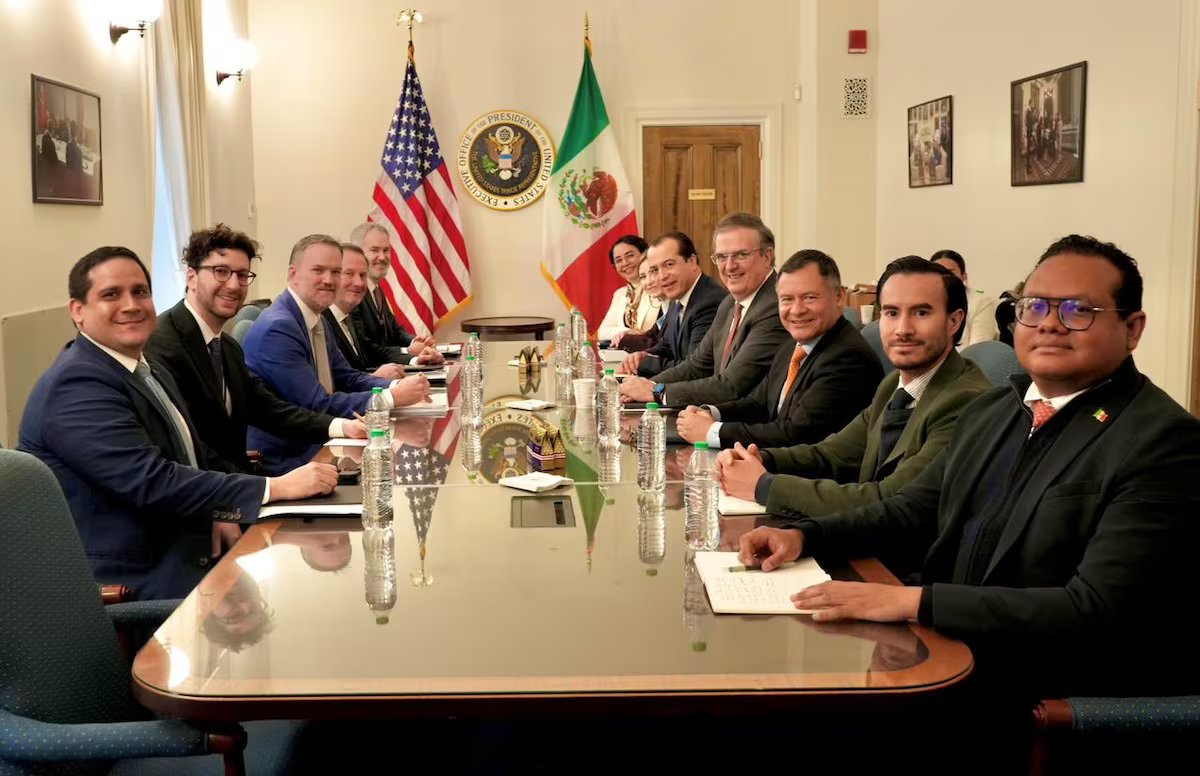
The review of the United States-Mexico-Canada Agreement (USMCA) began Wednesday in Washington with a meeting between Mexico’s Secretary of Economy, Marcelo Ebrard, and the U.S. Trade Representative, Jamieson Greer. Ebrard shared a photo of the two countries’ teams at the U.S. Trade Representative’s office on his social media accounts. The Mexican Secretary explained that the purpose of this first meeting was to discuss the countries’ expectations for the future of the trade agreement.
“Mexico’s vision is to reduce our dependence on other regions, work as a team, see what we each want to do regarding rules of origin, and how we can secure the supply chain,” he explained to Mexican television upon arriving at the meeting. Ebrard had already indicated that Mexico’s interests lay in resolving issues such as trade asymmetries, and the tariffs that the Trump Administration has imposed on trading partners in the last year on products such as steel, aluminum, and the automotive sector.
The initial talks between the United States and Mexico will serve to outline each country’s expectations for the review, which is scheduled to take place by July 1st, according to the timeline established by the USMCA partners in 2020. Following this, working groups will begin addressing specific aspects of the treaty’s 34 chapters. “We’re going to present a lot of data; we’re well-prepared, to be honest,” the Secretary of Economy added this Wednesday at the start of the bilateral discussions. Canada will join the talks later, likely in May.
The USMCA represents 29% of global GDP in trade and has become the foundation of the three countries’ economies in recent years. Greer revealed in December that among the issues of interest to the United States regarding Mexico are economic security and guarantees that Mexico will not be used by countries like China as a gateway to the U.S. market; labor conditions in Mexico—an issue on which there is unanimity across all ideological sectors in the United States; and the restrictions the Mexican government has placed on energy companies entering the electricity and oil sectors.
Sign up for our weekly newsletter to get more English-language news coverage from EL PAÍS USA Edition
