
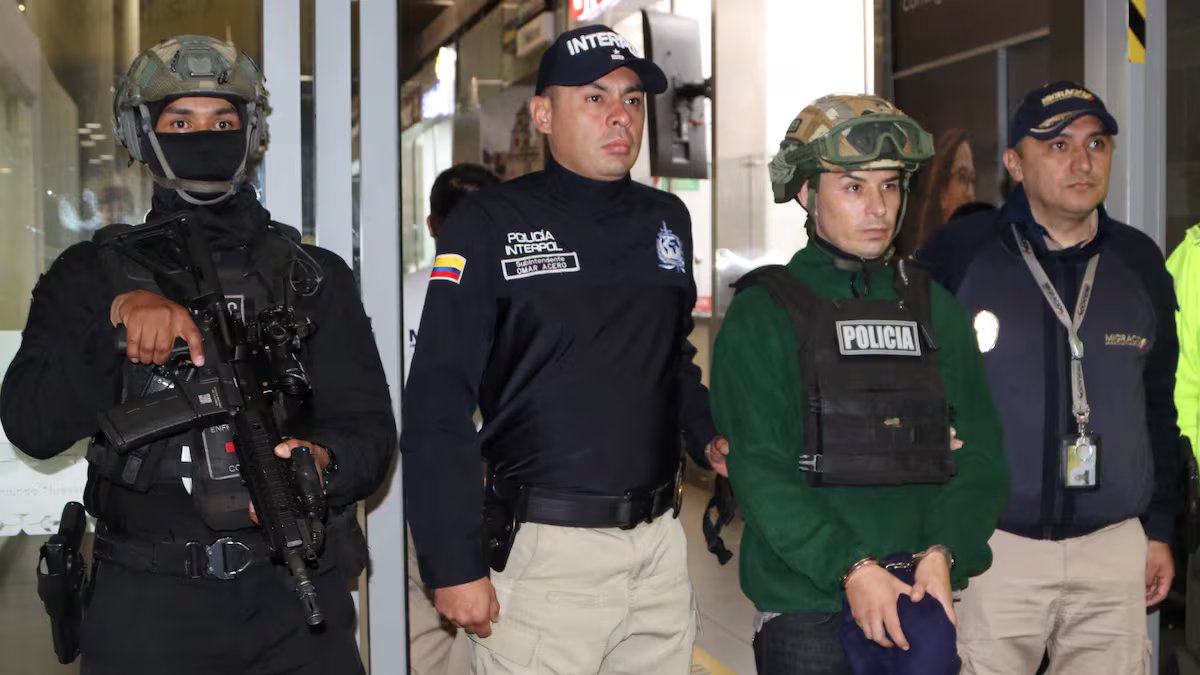
Mexico on Wednesday captured Ángel Esteban Aguilar, alias “Lobo Menor,” one of the leaders of the Ecuadorian criminal group Los Lobos, which was designated a terrorist organization by the United States in September. Having arrived in Mexico under a false name, Lobo Menor was transferred to Colombia on Wednesday, a necessary step before facing justice in Ecuador, whose Interior Minister John Reimberg explained that Aguilar was wanted for the 2023 murder of Fernando Villavicencio, then a presidential candidate.
Arrested in Polanco, an upscale neighborhood in downtown Mexico City, Aguilar’s presence in the country sheds light on the criminal network operating between Mexico and Ecuador, with Colombia as a mandatory stop. The president of Colombia, Gustavo Petro, celebrated the operation and indicated that, in addition to having ties to Mexican criminal groups, Lobo Menor is linked to Iván Mordisco, leader of the conglomerate of FARC dissident groups that reject the peace agreement signed 10 years ago.
The question is what Lobo Menor was doing in Mexico — was he in hiding or conducting business? For some time now, at least a decade and a half, authorities in various countries in the region have pointed to the connection between Ecuadorian criminal gangs and Mexican cartels. The former channel cocaine produced in Colombia to Ecuadorian ports and then send it north, where the latter handle the final link in the logistics chain: its transport to the United States, the world’s number one consumer.
In the case of Los Lobos, one of Ecuador’s most powerful gangs, the Trump administration has pointed to their likely ties to structures linked to the Jalisco New Generation Cartel (CJNG), a criminal group with a presence in virtually every Mexican state, including the capital. Authorities have not detailed the possible reasons for Aguilar’s stay in Mexico City, where the Colombian community — the country that issued the criminal’s false passport — has grown in recent years.
The Ecuadorian government has been aware of the CJNG’s ties to local organized crime for at least five years, according to Mexican army documents obtained by EL PAÍS. At that time, the group was linked to Los Lagartos, a sister gang of Los Lobos, which failed to consolidate its power. The recent death of CJNG leader Nemesio Oseguera, alias “Mencho,” in a confrontation with the military in Jalisco, central Mexico, obscures the current criminal alliance between Mexican and Ecuadorian groups. The volatility of the gangs in Ecuador, which are constantly fragmenting, further complicates any potential understanding.
Lobo Menor is no ordinary figure on Ecuador’s criminal map. Police identify him as the second-in-command of Los Lobos, the gang formerly led by Wilmer Chavarría, alias “Pipo.” In 2021, amid a crisis of brutal prison violence in the country that left dozens dead and a sense of utter chaos, Pipo faked his death and fled to Spain. He was captured there in November 2025 and remains in custody awaiting possible extradition. In his absence, control fell to his stepson, Lobo Menor.
Aguilar’s criminal history began more than a decade ago. In 2013, at just 22 years old, he was sentenced to 20 years for the murder of Juan Antonio Serrano, brother of José Serrano, then the powerful Minister of the Interior in Rafael Correa’s government. Years later, however, Aguilar was granted early release. The judge ordered monthly check-ins by the government agency in charge of prisons, SNAI, but the agency opted to conduct them virtually. It was insufficient: Lobo Menor disappeared from the radar and left the country.
The rise of Los Lobos partly explains its current position. In just a few years, the organization went from being a splinter faction of Los Choneros, a gang that dominated organized crime in Ecuador a decade ago, to becoming an independent structure with thousands of armed members, controlling more than half of the country’s provinces. Its growth was fueled by funding from drug trafficking networks — including that of Ecuadorian Leandro Norero, who was murdered in the Cotopaxi prison in an ambush ordered by Pipo — and by the support of the CJNG.
The fracturing of the criminal system accelerated in 2021, following the death of José Luis Zambrano, alias “Rasquiña,” leader of Los Choneros, who for decades had managed to maintain the hegemony of smaller gangs working for his organization. After Rasquiña’s assassination, prisons became battlegrounds for the rise of a new leader. Los Lobos challenged Los Choneros for control in a series of massacres that left more than 100 inmates dead. In the end, “Fito” (who has now been extradited to the U.S.) and “JR” shared leadership of Los Choneros, while the rival gangs finally broke away. Los Lobos consolidated their power through violence, seizing entire cities for drug trafficking and forcibly taking over important mining territories.
In that context, Lobo Menor’s power grew and grew. His tentacles even reached Colombia. Petro has pointed to his ties with Iván Mordisco, a recycled warlord who is currently the country’s public enemy number one, to the point that authorities are offering a five billion peso reward (over $1.3 million) for his capture. Néstor Gregorio Vera Fernández — Mordisco’s real name — heads the structures grouped in the self-styled Central General Staff (EMC), which brings together dissident factions that remained armed after breaking away from the peace agreement signed in late 2016 between the government and the FARC guerrillas.
According to the Prosecutor’s Office, Aguilar’s role within the Los Lobos organization transcended mere hierarchy, as he was responsible for planning and ensuring that the plot to assassinate Fernando Villavicencio remained secret. The candidate’s murder marked a turning point for Ecuador, which has suffered an extraordinary increase in homicides over the past six years. On August 9, 2023, Villavicencio was gunned down as he left a campaign rally in northern Quito. One of the hitmen died at the scene. The other six, all of Colombian origin, were arrested and, days later, murdered in an Ecuadorian prison. With them, a crucial piece of the truth was lost.
Villavicencio had built his political career on accusations of corruption during the Correa administration and the links between organized crime and politics. His death definitively exposed the collapse of security in a country that, in just a few years, went from being an island of relative calm to a territory riddled with violence and gang warfare. On March 12, 2026, the Attorney General’s Office closed its investigation into the case.
Sign up for our weekly newsletter to get more English-language news coverage from EL PAÍS USA Edition
