
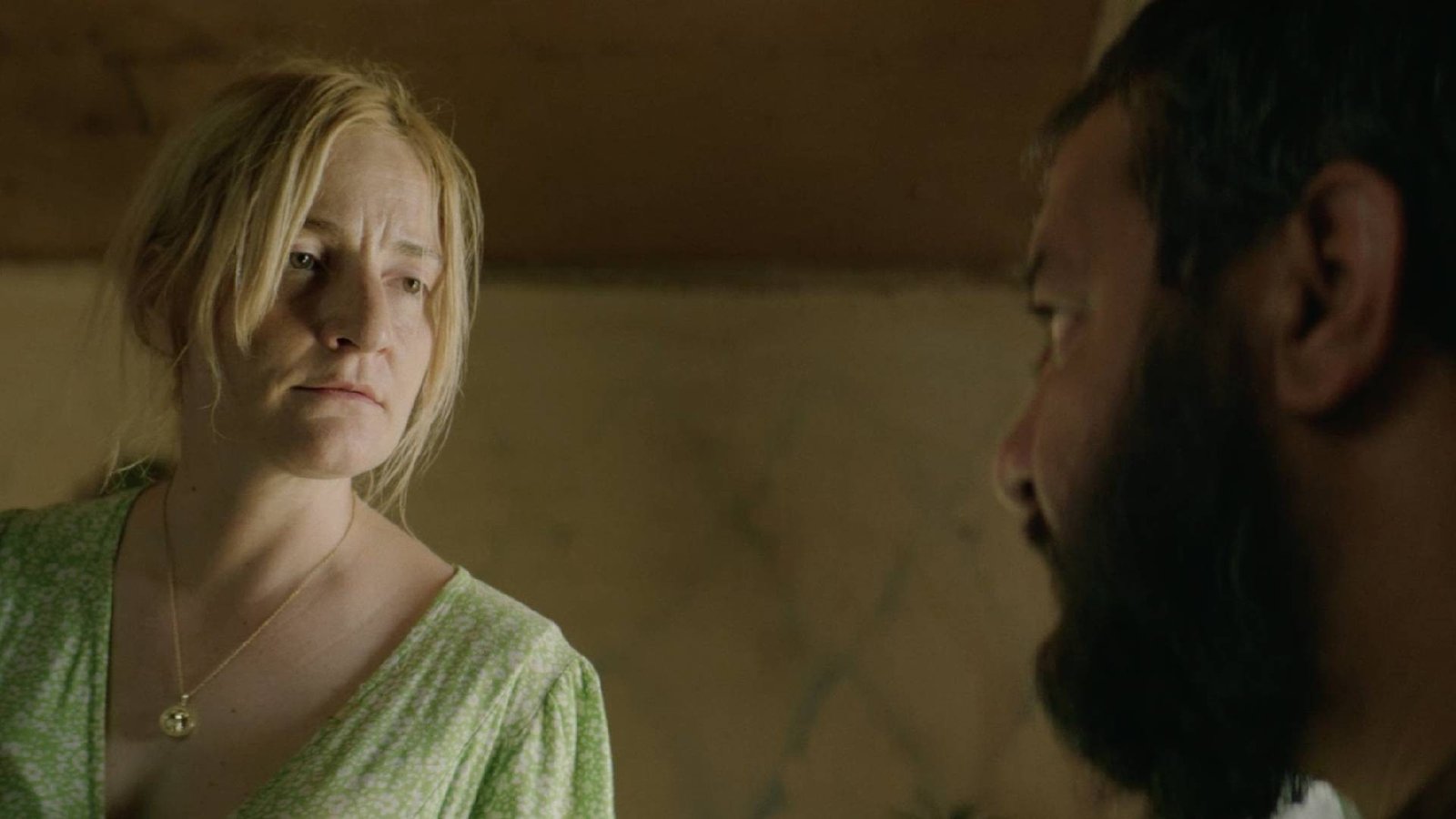
– Romanian debutante Andreea Cristina Borțun observes the shaky dynamics in the household of a mother and her teenage son somewhere in a vast valley near the Danube
Mihaela Subtirica and Vasile Pavel-Digudai in A River’s Gaze
If anyone has been missing Kornél Mundruczó’s Eastern psychedelic miserabilism – now that he works mostly in the West – such as that found in his earlier works like Tender Son – The Frankenstein Project [+see also:
film review
trailer
film profile] (2010) and especially Delta [+see also:
film review
trailer
interview: Kornél Mundruczó
interview: Orsi Tóth
film profile] (2008), it is back with a vengeance in Andreea Cristina Borțun’s slow, hesitantly pieced-together drama A River’s Gaze [+see also:
trailer
film profile], just shown at the Kino Pavasaris Film Festival, within the SMART7 competition. The film is about a single mother trying to steer her adolescent son through life, even though she seems to have lost track of her own. The deserted setting, reminiscent of Delta, unfolds amid poor Roma communities in the Danubian region – a landscape steeped in loneliness and abandonment – and, reminiscent of Tender Son, albeit more loosely, it deals with a father’s absence and the broken bonds within a tense parent-child relationship. The action drifts along slowly and painstakingly, while a layer of dust from neglect, coating the entire film (alongside a layer of boredom), clings to the viewer’s senses.

The life of Lavinia (Mihaela Subtirica) is a mess that she keeps trying to piece back together while dreaming of a beautiful house for herself and her 13-year-old son, Dani (Stefan Costea), as they live in her grandfather’s half-ruined, barrack-like dwelling. Driven out by Dani’s father and, more recently, by her Roma lover, Marian, “the Gypsy” (Vasile Pavel-Digudai, already featured in similar roles in other Romanian films such as Soldiers. Story from Ferentari [+see also:
film review
trailer
interview: Dawid Ogrodnik
interview: Ivana Mladenovic
film profile] and Immaculate [+see also:
film review
trailer
interview: Monica Stan, George Chiper-…
film profile]), who dumped her so he wouldn’t beat her to death, she begs for work and struggles to make ends meet, wavering between her inability to carve out independence and her failure to be a docile wife sharing a home with a man. Meanwhile, Dani longs for a protective father figure that his beer-soaked biological dad fails to embody – Marian commands more of that respect, but his habit of getting into fights ultimately backfires on him. The vagrant life of both Dani and his mother stretches out endlessly before them like the flat plains along the Danube, with no prospect of improvement – even adding a second floor to their ramshackle house is a chimera – and their stagnant existence, like the film’s plot, remains exactly where it started an hour and a half earlier.
An artist, university professor and researcher with an affinity for ethnography, Andreea Cristina Borțun likely knows a great deal about the impoverished communities along the Romanian Danube, but can identify little, if at all, with their fate and way of life from her investigative desk. This may well explain the detached gaze, the overall even rhythm and the predominantly dark tones — what can one really know about the nuances of a life not directly experienced? — which ultimately convey an all-encompassing sense of indifference. Professional actress Mihaela Subtirica also looks pretty lost in her task of embodying an underprivileged outcast of a woman with an emotional register that remains unclear even to those who created her character, so her acting strategy is mostly to stare listlessly in the scenes where she isn’t screaming in despair.
Nevertheless, A River’s Gaze is just the first part of a trilogy “on love in the rural”, observed from a safe urban setting. Hopefully, in her next endeavours, the director will dare to trust the instincts of more non-professional actors to breathe life into her otherwise sterilely conceived characters, who struggle to elicit empathy.
A River’s Gaze was produced by Romania’s Atelier de Film in co-production with Avanpost, France’s Films de Force Majeure and Slovenia’s Perfo Production.
