
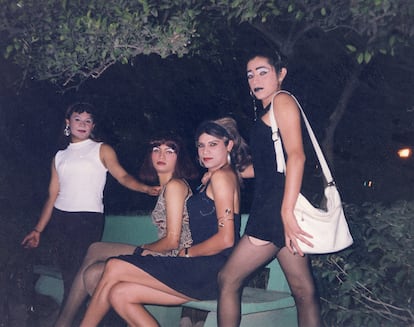
Abigail Reyes Galindo holds up a photo from 30 years ago. In it, she appears in El Obelisco Park in Tegucigalpa, Honduras, posing with her trans sisters: La Campero, Bessy Ferrera and Michell. With a fragile smile and soft but firm voice, she says, “This is the photograph I love the most, it means so much to me. I am 27 years old here, though I look younger. We’re at a place where we used to do sex work. That day we didn’t have any clients, and we were sad. I’m with two of my friends who were murdered. This is the photo that hits me the hardest.”
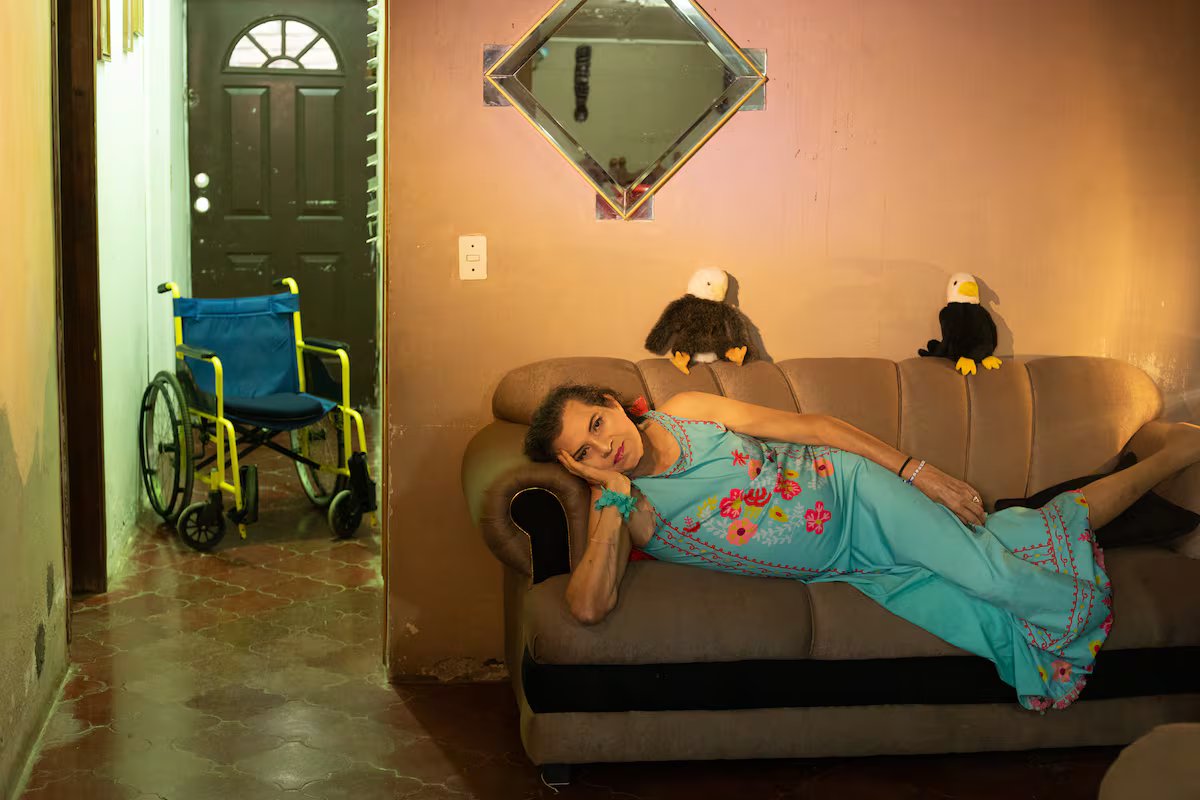
Bessy and Michell were victims of killers who were never brought to justice. The former was shot several times in a drive-by, the murderer leaving her to bleed out on the sidewalk. The latter was so brutally slain that her friends had to identify her by her tattoos. Today, Galindo is an icon of the Honduran queer community, and guards both the photo and its memories in the Cuir Honduras Archive (AHC), of which she is a proud co-founder. The name of the physical and digital archive is written on the prosthetic leg she wears after losing her limb to diabetes complications. It is a project that sheds light, primarily through photographs, on the cruel losses, defeats and eventual joys and victories of the LGBTQ+ community in Honduras. The work of memory is like free diving. And when one speaks of discrimination based on sexual orientation, you have to plunge down deep, all the way to the era of colonialization.
The National Archive of Honduras stores documentation of a case against Lorenzo Banegas and Gonzalo Hernández, “Indians from Guasirope who committed the heinous sin.” That “sin” refers to the love that dare not speak its name: homosexual relations. It is the first document in the AHC, which is now made up of 2,500 items. Today, violence and segregation against the trans community continues. The life expectancy for transgender individuals in Honduras is 35 years old. But what does belong to another time is the silence. At least when it comes to Galindo, who speaks freely in her home located in a peripheral neighborhood of Tegucigalpa. “They have tried to kill me eight times,” she says. “But here I am. Now my wish is to recover the memories of my murdered sisters.”
Over the course of the last eight years, she has compiled more than a thousand photographs, many of them the last remaining traces of dear friends. “When I was 16 years old, I picked up a 35mm camera,” she says. “I began to unconsciously document my life. I did it as a hobby. Then, when I saw that they were killing us all over, I started taking photographs of my friends, because I didn’t know if I would be with them the next day, that maybe today was our last time together. And maybe two weeks laters, they’d be murdered.”
Galindo tells in words what her immortality machine — a Canon Sure Shot that rests on a shelf in her home — cannot. For example, what life was like for a trans woman in the 1980s and ‘90s. “We took care of each other, but it was very dangerous. We thought like kids, we weren’t very mature. Our life was going out at six in the afternoon, going to the nightclub to have a drink for bravery and then heading out to the street. We told the clients, ‘You pick her up here, you’re going to drop her off here.’ We walked around with a notebook and a pencil, where we took down the cars’ license plate numbers. We always carried a knife. When someone didn’t come back, we would organize. One of us went to the jail, others to the hospitals, and it was up to me to go to the morgue. I never knew who I was going to find.”
In her eyes, crime against trans women in Honduras was, and is, nothing more than the product of dehumanizing hatred. “They murder us violently. They can’t kill a trans with a single knife wound, they have to kill her with 25 or 30. It’s pure rage. There are times that a compañera is recognized by a tattoo, an earring, because otherwise, she’s a pile of meat that you can’t tell what it was, a man, woman or animal.” To take back their humanity, and their voice, in 2022 she answered the call of photographer and researcher Dany Barrientos. “I realized that history is written in the universities and that it doesn’t include us. That the state benefits from the fact that queer history-memory does not exist,” Barrientos explains in an email.
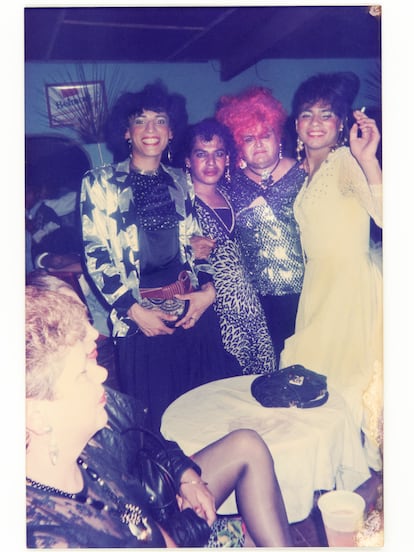
Over time, AHC has grown, coordinating art exhibitions, a book sponsored by the non-profit Cooperación Española and the Honduras Training and Entrepreneurship Center, workshops and panels in institutions like Barcelona’s Museum of Contemporary Art and Madrid’s Reina Sofía. But the core of its mission is its collection of photographs going back to the 1970s, when the trans community won its first concession from the government; the right to move freely in areas designated as sex work “tolerance zones.”
The archive also features press clippings on Sigfrilda Shantall, the country’s first woman to receive gender-affirming surgery in 1978. In 1988, Shantall sued the Honduran government to be legally recognized as a woman and 10 years later, was killed in her home. The archive reflects the struggles of her and other pioneers in LGBTQ+ political movements, like Alma Violeta and Corazón, and the trans beauty contests that have taken place since the ‘80s. It includes a glossary of terms like Joligud (Hollywood) that were used to alert each other of the arrival of police and members of the military, as well as period testimonies like that of José Zambrano, who said, “I identified as a transvestite in the ‘80s and ‘90s. Then they murdered all my friends and I stopped being a transvestite for my own safety. What I wanted was to survive.” That fear is still present: 2023 was the most violent year on record for LGBTQ+ people in Honduras, with 46 murders.
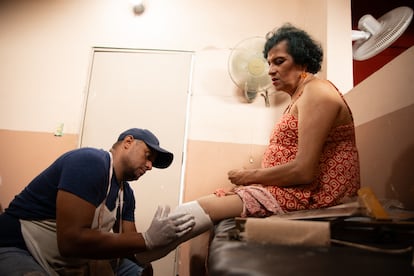
Barrientos and Galindo know that one way of fighting back is to invoke the names of the trans women who have been slain. For Barrientos, the utility of this exercise lies in being able to inspire new generations and create other forms of community. “There is so much love and magic contained in these archives that they are transformational. Young people, when they hear the stories we have saved from being forgotten, the memories contained in these images, begin to get interested in creating community.”
For Galindo, it is an unavoidable fact that this work has more personal aspects: “I think about the stories of my sisters. That their memory must not die when no one remembers them. Many times, when a trans woman is killed, not even their families want to know. Sometimes they don’t even let us say goodbye to them in the cemetery.” She thinks about the past, but also about the future. When asked about her next steps, she answers, “We are fighting for a gender identity law. It is my biggest wish. But these struggles are collective. One swallow doesn’t make it spring.”
Translated by Caitlin Donohue
Sign up for our weekly newsletter to get more English-language news coverage from EL PAÍS USA Edition
