
When the Soviet Union collapsed in 1989, Cuba entered an unprecedented crisis that Fidel Castro dubbed “the Special Period.” The island’s energy, trade and financial dependence on the recently-dissolved socialist bloc resulted in shortages of fuel, food, and raw materials, as well as a GDP drop of more than 40% in just three years.
Today, many who remember the 1990s in Cuba find parallels with the current crisis, which has worsened since the United States took control of Venezuela, the island’s main fuel supplier.
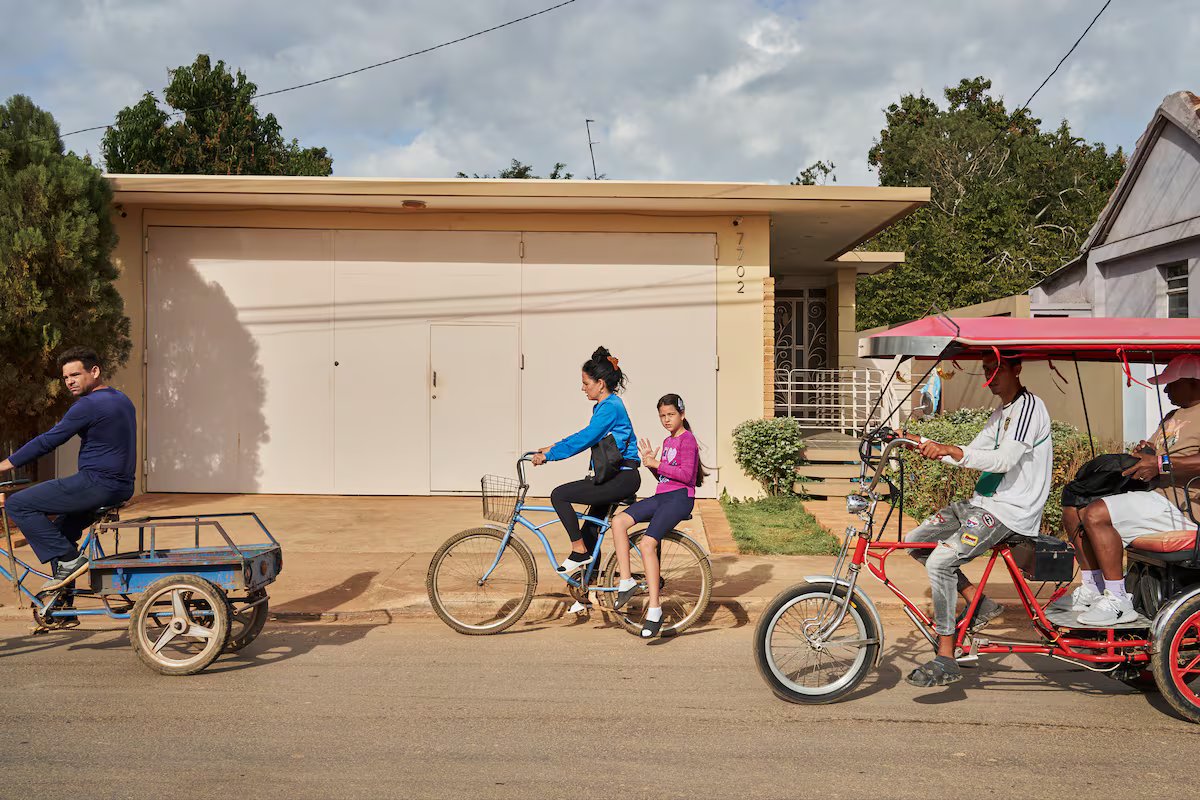
One phrase — “there’s no oil” — affects every aspect of daily life for Cubans. The fuel shortages have resulted in blackouts, reduced access to basic necessities and, of course, limited transportation. The streets of Havana are now almost empty of buses and cars, except for a handful of colorful vintage American convertibles that ferry around the few tourists who still venture to visit the island.
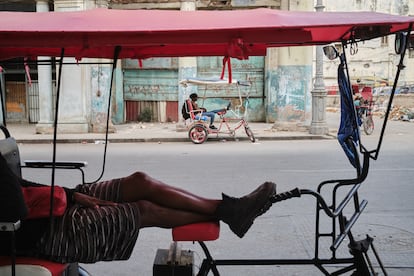
What you do see, and with increasing frequency, are electric motorcycles, scooters, and rickshaws, in addition to bicycles.
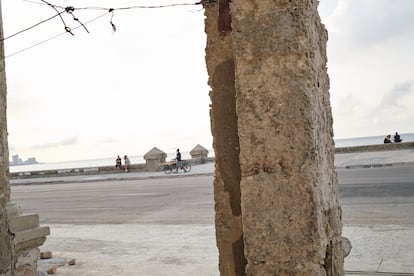
“The bicycle is the Cuban means of transportation,” says Yoan, a 52-year-old fisherman, with his bike and hands resting against the Malecón (the esplanade and seawall that stretches along the coast in Havana).
“Every time there’s a crisis in this country, the first thing to go is fuel. Then, everything gets really expensive… so, it’s better to ride a bike. It’s cheaper, faster and, besides that, you get exercise.” He recalls that, before the 1990s, there were Russian bicycles. Then, when the Special Period began, Chinese bicycles started arriving. “This was a country filled with bicycles.”
To compensate for the lack of motorized transportation, the government imported more than a million bicycles from China, selling them at ridiculously low prices, or directly assigning them to state workers. Isabel was one of these civil servants: in 1993, she worked as the director of sports in Santiago de Cuba, the second-largest city, located in the far east of the country. At the time, she rode a Forever ’26. Isabel used the bike for her job, part of which consisted of daily commutes to neighboring municipalities like El Cobre, about 15 miles from Santiago.
“The Special Period transformed Cuba’s urban landscape,” she describes. “Suddenly, there were many bicycles on the streets, with only the occasional car.” She recalls how bike racks were also built, “with rebar, iron, whatever was available.” These bicycle stands became “extensions” of schools, factories, and workplaces. Later, “all of that became anachronistic, because we [eventually] emerged from the Special Period… and people stopped riding bicycles.”
The fact that the bicycle boom coincided with a crisis is etched in the memory of many Cubans: to this day, the automatic association between bicycles and scarcity is common. Some, like Yasser González Cabrera, owner of the Citykleta project in Havana, even speak of a “trauma” that they’re trying to dismantle. Since 2015, this restless computer scientist — originally from Isla de la Juventud (the “Isle of Youth”), who migrated to Havana to study — has been organizing bicycle-related events in the city, such as “Bicicletear La Habana” (“Cycling Havana”), which takes place on the first Sunday of every month. In its heyday, it brought together up to 200 cyclists. His motivation is to spread the benefits of this mode of transportation and help transform beliefs that are deeply rooted in Cuban culture. “The bicycle is autonomy and freedom,” he affirms. “[Bicycling] has given me a lot.”
The educational aspect of Citykleta is now the project’s mainstay, as city bike tours have been halted due to the lack of tourism. Along with other equally passionate young people, Yasser runs “Learn to Ride,” a course held every weekday afternoon in a park in Havana’s Vedado neighborhood, where 12 people are taught to ride a bike. “We were aiming for 100… and we already have more than 250 people enrolled,” he says, a little overwhelmed, but visibly happy. Although most are from the neighborhood, Havana residents from more distant boroughs such as Diez de Octubre and Boyeros have also signed up. And there’s another interesting fact: 84% are women.
Dayelis is a 20-year-old who studies accounting and finance at the University of Havana. She had been meaning to learn to ride a bike for a long time. And recently, she finally decided to do it. “I see [people biking] on the street and I think it’s beautiful… and I love feeling the speed going down a hill. It’s so exhilarating.” Although she lives near the university, she imagines herself biking to her classes (when they resume in person). But above all, she imagines taking a ride around the city and ending up watching the sunset on the Malecón.
Citykleta promotes the bicycle not only as an efficient means of transportation, but also as a way to access leisure. For Yasser, “people are postponing enjoying life, waiting for a moment of prosperity… [even though] there are many things that can already be [experienced] with a bicycle.” For example, exploring green spaces in the city, or heading to the sea for a swim and then getting an ice cream. “Making two or three plans in one afternoon by bus is impossible,” he explains, “but with a bicycle, it’s very easy.” According to him, today, the average Cuban is very disconnected from enjoyment, because they live “in survival mode.”
To design his educational program, Yasser drew inspiration from cycling organizations in Belgium and the United States: Pro Velo and the League of American Bicyclists, respectively. He studied their methods to understand how they were applied in Brussels and New York City; the latter proved more useful, because traffic laws are more similar to those in Cuba. And so, he developed his own program for Havana. He presented the project to the German Embassy, which provided 12 bicycles, a cargo bike, a repair kit, and locks.
Thanks to those materials, the initiative is now operational. However, Yasser is concerned about how he’ll sustain it in the long term. Besides bicycle maintenance and the garage rental fee, he pays — symbolically — the instructors, like Daniel, who is 23 and finds “happiness, tranquility, and peace” at this time of day. He likes the community that Citykleta has created; the activity also allows him to “escape the power outages and worries at home,” he explains.
At a safe distance, Elisa and Ernesto — 55 and 59, respectively — watch the class. They’re Dayelis’ mother and stepfather. Ernesto has always ridden a bicycle. And, for the last couple of years, he’s had a Shimano, sent to him by his brother from the United States. He’s added a bike seat, so that he can take Elisa along. They both work in the area of the Casino Deportivo, in the Cerro neighborhood, commuting there together by bike: about nine miles per round trip. “Cars are too expensive; it’s not possible,” Ernesto notes. “Besides, the bike gives you energy.” Anette, 39, also watches the class with curiosity. She says that she’s thinking of signing up, because even though she has a car, she only has enough gas at home “to last a month.” When it runs out, she sighs, “I’ll have to ride a bicycle or an electric motorcycle… so, I have to learn soon.”
Isabel, who learned to ride a bicycle as an adult, points out that “many people are dusting off their old bikes to use them again.” Before the Forever bike that she used in Santiago, she had received a Minerva bike while serving as a delegate for the Young Communist League (UJC). For her, the promotion of cycling in the 1990s “was one of the many actions designed by Fidel [Castro] to resist and continue life in all spheres,” she affirms. “It was a demonstration of the resilience of our people, without losing sight of progress.” And, she adds, “we’ll do it again.”
Meanwhile, Yasser acknowledges that cycling is a good option in the current context, but he doesn’t want to dwell on that connection. “Relating cycling to crisis is counterproductive, because one understands that it will be temporary,” he says. “I want to promote cycling as a lifestyle, as a tool for life that allows you to get things that you don’t currently have.”
Sign up for our weekly newsletter to get more English-language news coverage from EL PAÍS USA Edition
