
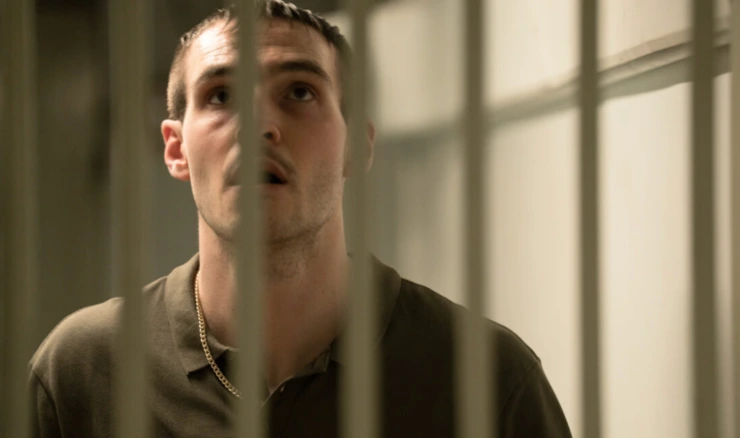
No Ordinary Heist isn’t your typical heist thriller, even though it’s inspired by true events – The Northern Bank Robbery of December 2004. It instead chooses to focus more on the fictionalised characters behind the gripping tale of two bank employees thrust into a difficult situation rather than the heist itself. Forced to orchestrate a £26.5 million robbery to save their families’ lives, Barry (Éanna Hardwicke) and Richard (Eddie Marsan) must work together to execute a robbery without the gang behind it ever actually stepping foot inside the bank. It’s an artistic choice that allows Director Colin McIvor (Zoo) to strip away the usual heist spectacle. There are no flashy getaways or elaborate plans, just tension, heightened emotions, and the pressure of being trapped with everything on the line.
The real strength of No Ordinary Heist is the performance of the leading duo. Their chemistry and characterisations carry the film, turning small gestures and glances into moments of real emotional weight. Their scenes in the vault itself felt like a pressure cooker, with their delivery and the way it’s shot perfectly reflecting the claustrophobia and strain of their situation. With the film, McIvor isn’t interested in emphasising the usual heist mechanics, but in how people react when everything spirals out of control. I was particularly drawn to the evolution of the characters over the course of the film. Richard, the boss of the Bank, is shown towards the start to be a very committed worker with limited friendships, but the focus on the duo throughout allows the audience to have characters to root for as they change as a result of their difficult situation. By the end of the film, Richard and Barry have silently bonded through their trauma, and in turn, Marsan and Hardwicke are given room to show a huge array of depth and range to their character’s story that they handle with an eloquent ease and strength.
CHECK OUT OUR EXCLUSIVE INTERVIEW WITH DIRECTOR COLIN MCIVOR HERE
From a visual perspective, No Ordinary Heist keeps things tight, intimate, and precise. The cramped setting of the bank allows the camera to frequently focus on faces, hands, and other details. This heightens the sense of anxiety that pervades the film. The sound design, from the background music to the echoes of footsteps, adds to this sense that something could shift at any given moment. This is a controlled, purposeful aesthetic that mirrors the tension of the story perfectly. The pacing of the film is similarly deliberate, which may be infuriating to viewers who want to see more of a traditional heist film. These slower burn moments give the story even more room to breathe, allowing the characters and emotion to take centre stage tonally. Ultimately, the quieter moments are just as engaging as the conflict, if not more so.
I think for me, it’s the tone that really makes No Ordinary Heist stand out from other heist movies. Despite the life-or-death nature of the situation for the main characters, there’s a level of choice throughout with McIvor’s decisions that makes the tension build until all the important scenes. The little bits of gallows humour, awkwardness, and humanity that are inserted into the film are all part of what makes this film work, as they bring a level of realism to the story that makes you care more deeply about Barry, Richard, and their families.
It’s a heist story that proves there’s more than one way to build up suspense for audiences. By focusing on people rather than plot, No Ordinary Heist delivers a fresh, but still incredibly tense, take on a crime many watching may feel like they already know. It just shows that sometimes the most compelling part of a heist film isn’t the crime itself but how the people left inside it survive.
★★★★
In cinemas on March 27th / Eddie Marsan, Éanna Hardwicke, Eva Birthistle, Michelle Fairley / Dir: Colin McIvor / Wildcard Distribution / 18
Related
Discover more from
Subscribe to get the latest posts sent to your email.
