
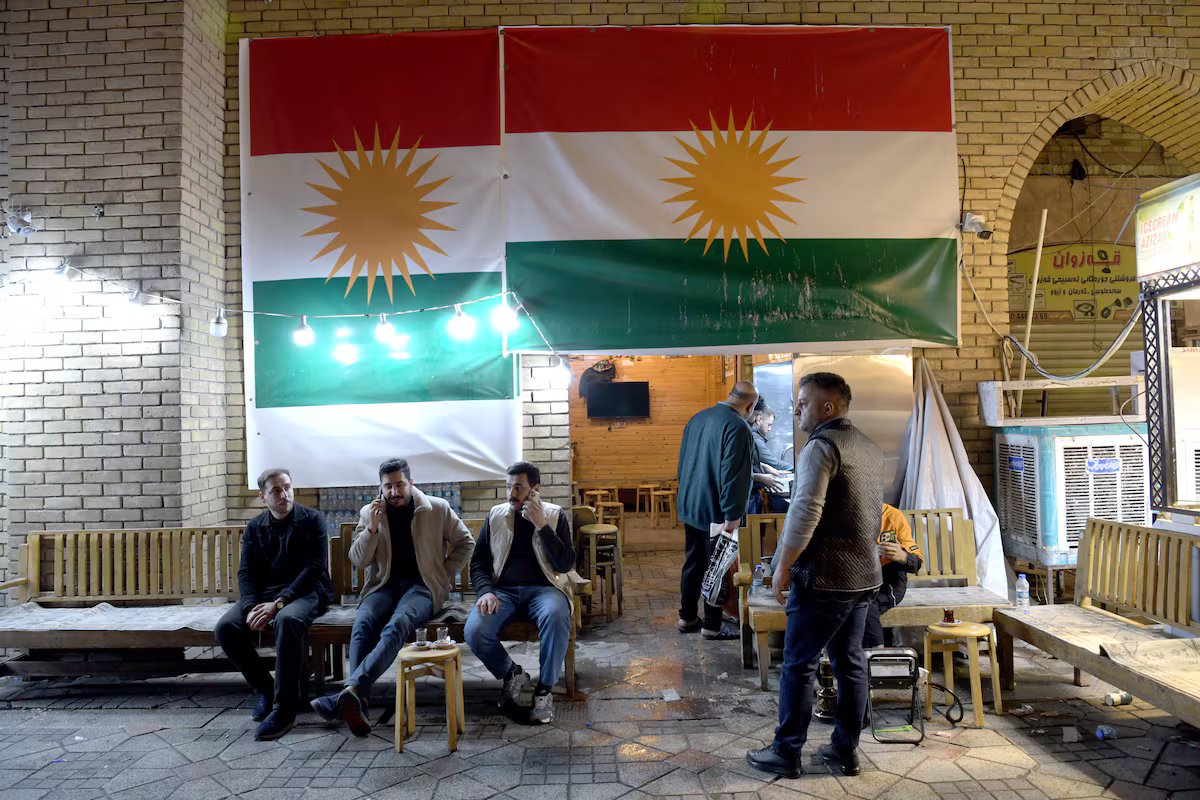
With Iraqi airspace closed due to the U.S.-Israeli war against neighboring Iran, the main gateway to Iraqi Kurdistan is through the Turkish border crossing at Khabur. The journey to the Kurdish capital, Erbil, takes about five hours along roads that, as night falls, are illuminated by countless flashes in the sky. Some are caused by lightning from an untimely nighttime storm. Others are from drones or missiles launched from the east, from Iran, either to strike — or be intercepted en route to — a U.S. installation or a base of the Kurdish-Iranian forces stationed on Iraqi soil. Amid the flashes of the storm and the war, fireworks lit up the sky on March 20 to celebrate the unusual coincidence of the Kurdish New Year, Nowruz, with Eid, which marks the end of the Muslim month of fasting, Ramadan. The colored balls shot into the crowded sky by young Kurds and Arabs were followed by cheers, the clamor of a people who refuse to be dragged into war once again.
“People are afraid to go outside for fear of being hit by missile and rocket fire. Then we spend the day looking up at the sky every time we hear a noise,” says Yassamin Jabbar, a 40-year-old beautician in Erbil’s old city who recently arrived from Baghdad to spend the holidays with her husband’s family, who are Kurdish. Since February 28, the start of the joint Israeli-American offensive, the CPT center for Iraqi Kurdistan has recorded 307 attacks by the Iranian Revolutionary Guard and its allied militias in Iraq against the territory of the Iraqi Kurdistan Regional Government (KRG). Another attack this Saturday raised the death toll to nine, with 51 wounded, in addition to causing significant material damage.
Iraq is reluctant to enter a war that is not its own, but it harbors within its territory all the elements to be engulfed in it: it has vast oil reserves, Kurdish-Iranian militias in the northeast opposed to the regime of the ayatollahs, pro-Iranian Shiite militias in the center and south of the country, U.S. military bases, and, above all, it is currently the only border in the Middle East — Iran and Iraq share almost 1,500 kilometers — from where the U.S. and Israel could launch a ground operation with allied troops in the event of a collapse of the Iranian regime.
“You can’t overthrow a regime simply by bombing it. You can weaken it, but you can’t overthrow it without boots on the ground,” explains Mohammed Shareef, a professor and expert on Kurdish affairs and U.S. foreign policy toward Iraq, in an Erbil café. The Trump administration has already sounded out the five main Kurdish-Iranian militias stationed in the KRG about their potential role in a ground attack. Furthermore, it has urged them to coordinate by uniting under a single umbrella called the Coalition of Political Forces of Iranian Kurdistan.
“The KRG is caught between a rock and a hard place. Between its alliance with the U.S. and the potential risk of war against Iran,” argues Shareef. The Kurds are a strategic U.S. ally in the region, and Washington’s pursuit of Iranian Kurdish support to overthrow the Tehran regime is precisely what it did in 2003 when it turned to Iraqi Kurds to overthrow Saddam Hussein, later institutionalizing relations with the KRG.
Sources within the Erbil government confirm to EL PAÍS that they have asked the Kurdish-Iranian militias not to launch an attack from Iraqi-Kurdish soil, fearing reprisals from a neighboring country that is far stronger and more militarily capable. “It’s not our war,” says a high-ranking official, echoing the regional mantra that resonates in the Gulf capitals, where Iranian fire is bombarding American targets and has wreaked havoc on the global supply of hydrocarbons, on which 90% of Iraqi exports depend.
The day after the attack on Iran, the U.S. president held separate calls with two Iraqi Kurdish leaders, Massoud Barzani, president of the Kurdistan Democratic Party (KDP), and Bafel Talabani, head of the Patriotic Union of Kurdistan (PUK), to discuss a possible offensive from Iraqi soil. “We’re very friendly with the Kurds, as you know, but we don’t want to make the war any more complex than it already is. I don’t want the Kurds going in. I don’t want to see the Kurds get hurt, get killed,” Trump contradicted himself a week later.
Price hikes and power outages
The war is also taking its toll on people’s wallets, due to the rising prices of imported Iranian goods, such as fruit, and the gas they are unable to extract during this period of conflict. Power outages leave his shop in darkness, explains 27-year-old Mudafar Hoshno, who runs a small, practically empty café in Erbil’s Citadel. As night falls, several groups of young people defy fear, gathered around electronic punching bags, waiting their turn to test their strength. Hoshno says he is waiting to see what happens, because the signals coming from Israel and the U.S. are confusing: “One day Trump says the war is over, and the next day he asks for $200 billion to keep sending troops.”
For now, the Kurdish-Iranian militias — estimated by experts to number between 4,000 and 10,000 fighters — have received only calls for restraint from Erbil and few guarantees or weapons from the Trump and Netanyahu administrations, while their bases endure daily attacks by Iranian drones and missiles in their mountain positions along the border with Iran. In the Middle East, wars are decided in the skies. And while the KRG has enjoyed a no-fly zone under U.S. protection since 1991, the Kurdish-Iranian militias are not receiving air cover from either Israeli or American fighter jets. Without this protection, a ground offensive now would result in heavy casualties among their ranks and would leave them vulnerable to Iranian artillery, still capable of crushing internal insurgencies.
They are also aware of the other side of the coin of being a “Kurdish strategic ally” of the U.S. The KRG has become the most successful prototype of the Kurdish autonomy that is also desired in the Kurdish regions of Iran, Turkey, and Syria, where they number 40 million people in total: six million in Iraq and 10 million in Iran. But in Syria, the experience is more bitter. After a decade of fighting on the ground against the Islamic State and under the air cover of the U.S.-led International Coalition’s fighter jets, Trump has opted to close its bases, leaving the allied Kurdish militias exposed in a strategic shift in the alliance with the new Damascus government after the overthrow of Bashar al-Assad’s regime.
Regime change failure in Iraq
Twenty-three years after the U.S. invasion of Iraq, the country is still trying to rebuild. The operation has become a cautionary tale in the history of U.S. military interventions and has been widely invoked by the military establishment in the two regime-change operations launched in Venezuela and Iran. The pro-Iranian militias gathered under the umbrella of the Popular Mobilization Forces are a legacy of the institutional collapse that occurred when U.S. Marines landed in Iraq in 2003 to overthrow Saddam Hussein. Composed of more than 50 factions, mostly Shia and backed by Iran, they are part of the so-called “axis of Shia resistance,” along with Hezbollah in Lebanon and the Houthis in Yemen. Since March 10, attacks with suicide drones and rockets against oil interests and U.S. bases or delegations concentrated on the outskirts of both capitals, the Kurdish regional capital, Erbil, and the Iraqi capital, Baghdad, have been identified.
SECURITY ALERT – U.S. EMBASSY BAGHDAD, IRAQ – MARCH 21, 2026
Location: Iraq
Iran-aligned terrorist militias have conducted widespread attacks on U.S. citizens and targets associated with the United States throughout Iraq, including the Iraqi Kurdistan Region (IKR). U.S.…
— U.S. Embassy Baghdad (@USEmbBaghdad) March 21, 2026
The latest attack occurred Saturday against a U.S. military base near Baghdad airport, prompting the U.S. Embassy to urge American citizens to “leave Iraq now” via its X account. Faced with the risk of being caught in the crossfire, NATO has suspended its mission, and Spain this week evacuated the 205 soldiers and military personnel it had deployed in the country.
“KRG is a U.S. ally in the Middle East, and is perceived as such by pro-Iranian militias, so we must be cautious with a much larger and stronger neighbor like Iran,” a source close to the KRG government, speaking anonymously, points out. The KRG’s armed forces —some 10,000 Peshmerga fighters — have chosen not to respond to attacks by pro-Iranian armed groups in order to prevent the country from heading toward a possible civil war.
Amid the intensifying crossfire looming over Iraq’s 47 million citizens, people go about their daily commutes to work or visit family. Jabbar is already planning her return route to Baghdad on Monday, when her vacation ends. She will navigate the new military checkpoints along the way, avoiding military bases and militia positions.
Sign up for our weekly newsletter to get more English-language news coverage from EL PAÍS USA Edition
