
At the end of the day, we should be grateful for Donald Trump’s obscene imperialism when he says he will be “having the honor of taking Cuba” because “he can do whatever he wants whenever he wants.” This level of shamelessness destroys the rhetorical refuges of minor political actors, who have nowhere to hide in the face of the usurper’s frivolities and humiliating antics. There is something primal, unrefined, in Trump’s cruelty, surely because through him the unconscious of capitalism is expressed. In this role of a Goyaesque figure unleashed, of betrayer of a techno-Christian colonization project, only Javier Milei goes further. Just a few days ago, in his speech before the Córdoba Stock Exchange, the Argentine president went so far as to ask why the Creator had given the planet to humankind, if not to destroy it.
What Trump, in his position as president of the United States, was supposed to protect — the democratic formalities of dispossession — has been promptly dismantled. Contrary to one of the Tales of Count Lucanor, here the rogues who sew the king’s clothes (and these rogues would be most Western leaders, and some from a little further afield) insist on making the common people believe that the king is still dressed, but it is the king himself who keeps reminding them that he is naked. The consequences of this admission are proving traumatic, although at the same time it has destroyed the automatic mechanisms of agreed-upon political language, and from such destruction a new language should emerge.
The king knows, the rogues know, the common people know, but what no order can withstand is the transparency of everyone knowing that no one is unaware. In a passage from Capitalist Realism, Mark Fisher points out that this is why Khrushchev’s speech at the 20th Party Congress was so dangerous: because, even though everyone knew about Stalin’s excesses, it prevented them from continuing to feign ignorance. What is remarkable here is that, in the narrative of neoliberalism, Trump has been both Stalin and Khrushchev at the same time — both its champion and the one who signed its death warrant.
A solution for Cuba on Washington’s terms might eventually bring the release of political prisoners, some opening to private investment, perhaps the removal of a high-ranking figure in the communist establishment, but the ultimate goals of such an agreement would serve the interests not of a foreign government, but of an even more predatory entity: an oligarch. If Cubans believe that Trump might learn of the recent phenomenal uprising in Morón, Ciego de Ávila, against the repressive Castro regime, and that he would consider including those people and their lives at a supposed negotiating table, it is because they have overlooked how the mind of a wealthy person works. For Trump’s class to seize or control Cuba, just as they have been doing in Venezuela, is precisely what Trump considers political change, and along that path there would be no reason to get rid of the Castroist elite.
One oligarch is not the enemy of another, and the kind of stability an oligarch needs cannot come from a popular mandate. Nor is there any reason to compel the Cuban government to comply with certain norms of liberal democratization when what remains of those norms is being dismantled everywhere. The required transformation could be limited to welcoming billionaire investors and gaining economic control of an island that cannot continue adrift amid the upheavals of a world order subjected to the delusions of a religious war.
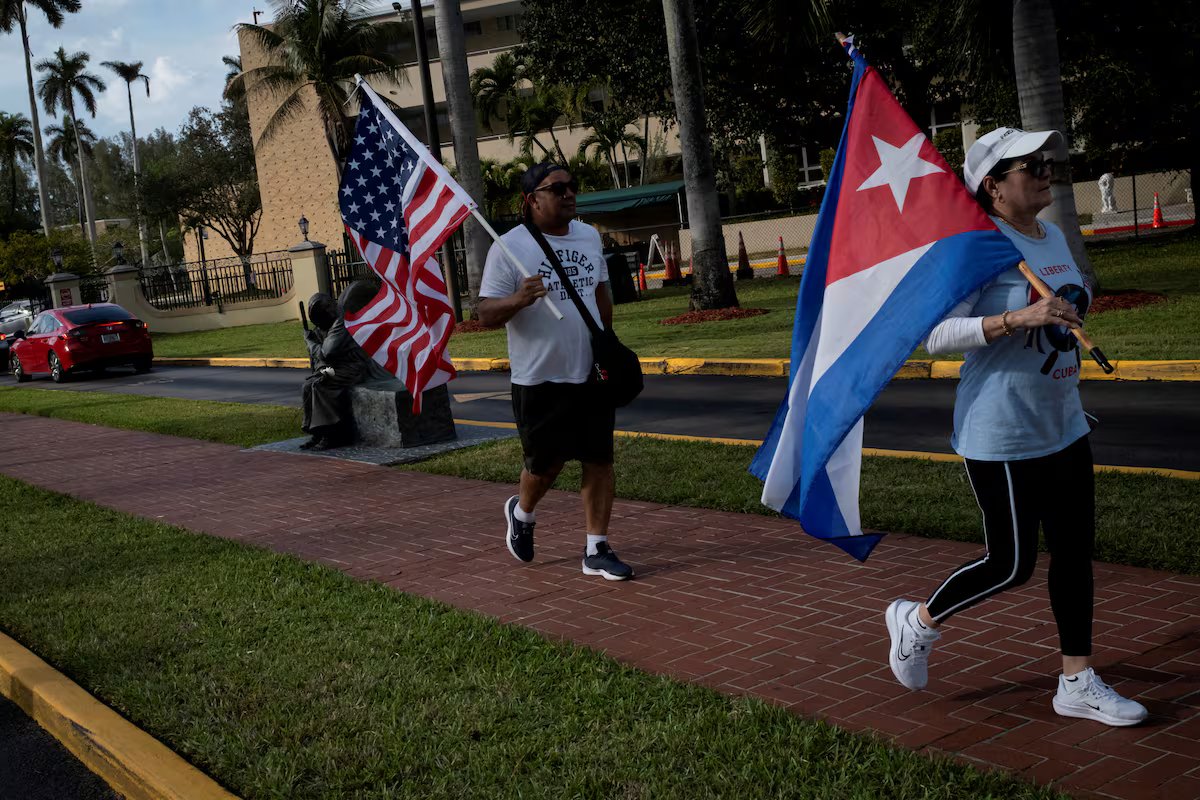
In the Cuban exile community, where many of its political figures have sold their souls to Trump (though one could well argue that those souls had been sold beforehand), the U.S. president’s overbearing attitude and tone of contempt toward Cuba has met with little resistance, placing them in a position of subservience from which the language of the opposition cannot save them, even with all the moral relativism that anti-Castro rhetoric allows for beyond the island. With the exception of Ramón Saúl Sánchez, leader of the Democracy Movement, no visible figure seems outraged by such degrading treatment of their country, perhaps because the public blackmail to which the Cuban diaspora is subjected prevents them from breaking the martial slogans of dissent. One of them — perhaps the most serious, since it goes against the very reason for being a dissident — is the one that proclaims that the nation is greater than Castroism, but at the same time is not willing to admit that the care of the nation does not end with the denunciation of the Castroist order, since that would imply not taking care of Cuba in its entirety.
Given Trump’s inability to carry out his abuses in private, no one has been more taken aback than the Havana regime itself. They have never received such explicit insults and threats from any U.S. president, and they have never responded with less force. After Trump’s recent statements referring to Cuba as his “loose cannon” (likely the place where he will go to pay for his sins when he is left humiliated in the Middle East), Miguel Díaz-Canel posted a tweet saying that “any external aggressor will encounter an impregnable resistance.” International opinion has interpreted this as a heated response, but anyone familiar with the decibel levels of bravado in official propaganda knows that his message means nothing.
Ultimately, this kind of script, which sounds like a recitation of a funeral dirge, has a purely commercial character, having turned the revolution into a commodity. It is aimed at the left wing, which not only trivializes the Palestinian genocide by proposing an aid flotilla to Havana using the same arguments employed in Gaza, but also insists on ignoring the lesson learned in Venezuela. Despite so many warnings, even from within the left itself, those who until very recently continued to speak of the “Bolivarian process” had to confront the fact that a corrupt and criminal elite had betrayed them overnight.
The same thing is going to happen in Cuba, and my problem with what I believe is appropriate to call “emancipatory colonialism” is that its practitioners will do anything to hand Washington the monopoly on injustice in order to reserve for themselves the monopoly on outrage. This distribution of roles reproduces an extractive logic, and although what I’m saying might be confused with the typical vindication discourses of identity politics, I’m really pointing elsewhere: to the justification of inequality and poverty within the territories of capital, in the name of global anti-capitalism; to the way in which the grand political stage can ignore concrete economic reality. The experience of a worker in the hands of the wrong owner carries less weight than the moral truth of an altruist intoxicated by their provincial universalism.
Faced with ideologically aligned regimes, the guise of internationalism serves as a pretext for landing in countries after the United States has dictated the terms of reality. The humanitarian flotilla could have arrived in Havana five months ago, two years ago, or four years ago; the country’s situation is no worse today than it was then, but at that time there was no anti-imperialist photo op to be had. Thus, like conquerors, they plunder the symbolic reserve of the disputed conflict. Why would anyone on the left go to Cuba under such conditions, if not to cultivate their own reactionary narrative? And that is the true essence of the trip, its touristic imprint, something decided by history and beyond the control of any of those involved.
The tons of aid the convoy carries to the island are the price of a promotional package to the archaeological site where the ideological ruins of a dead utopia lie. Twenty tons of supplies to shudder at the past, distribute philanthropic crumbs, and shake the oppressor’s hand is an affordable sum, paid for on credit, just as others pay for a Caribbean cruise to visit the paradisiacal beaches of the Bahamas or the Dominican Republic. These are images from advertising whose exoticism awakens consumer impulses, and where the gringo from Missouri appears next to a coconut tree, with a turquoise sea in the background and a mulatto woman at his waist, the guerrilla fighter from Madrid appears in a propped-up house, holding the hand of an 80-year-old militiawoman, sitting in a wicker chair in front of a blank television and on the verge of starvation. Both pay a bargain price for a plenitude that is far too expensive for the landscape that fosters it.
The exorcism of the dead, the bourgeois satisfaction with one’s own emotions, makes this delegation a “new age” collective looking to be scammed with Fidel Castro-era ayahuasca brews designed for white backpackers. But, as we know, every tourist who gets scammed is actually the architect of the scam. And it makes sense. Long before they arrived, there was nowhere like Cuba where pretending to be a revolutionary was so cheap.
Sign up for our weekly newsletter to get more English-language news coverage from EL PAÍS USA Edition
