
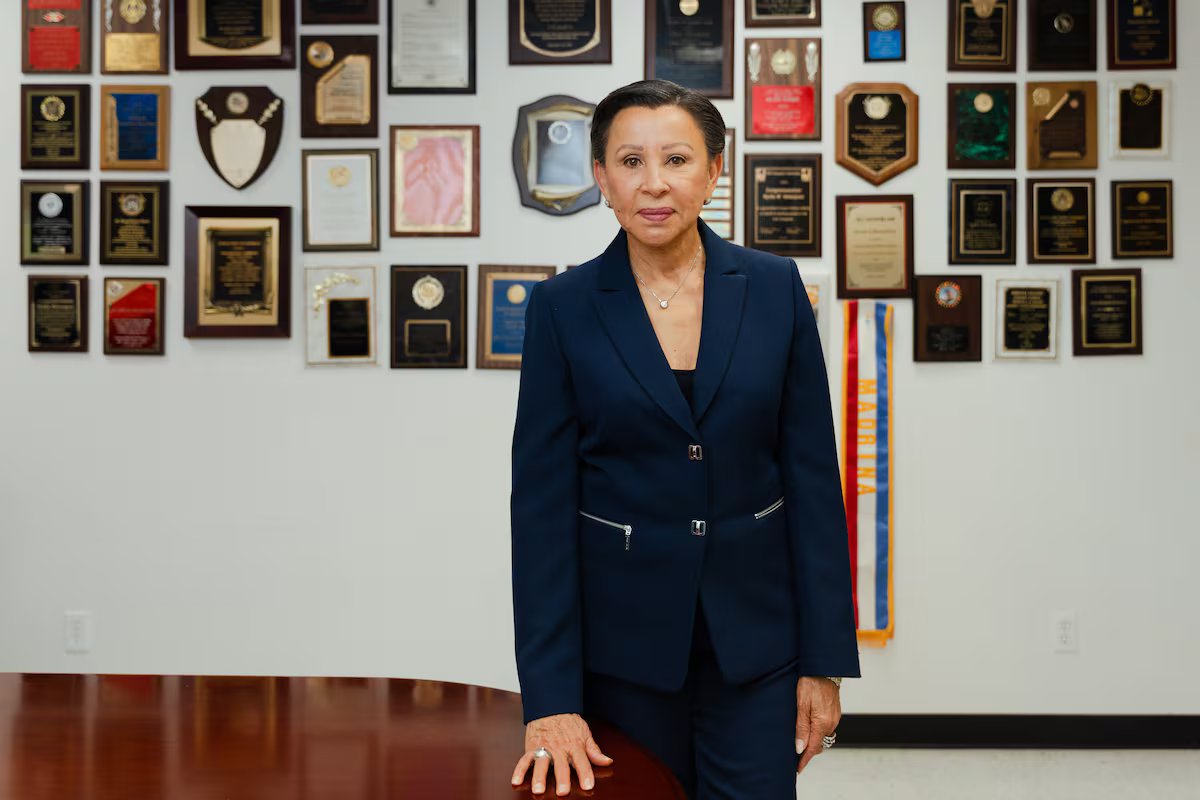
Nydia Velázquez, a Democratic congresswoman representing New York’s 7th District, introduced a legislative initiative on Tuesday—a War Powers Resolution, in Capitol Hill jargon—that, if it were to pass, would prevent President Donald Trump from launching a military offensive in Cuba without the authorization of Congress.
In the text of this joint resolution, which EL PAÍS has obtained, Velázquez points out that only the legislative branch has the power to declare war, a power granted by Article I of the Constitution. “The President has a constitutional responsibility to take actions to defend the United States, its territories, its possessions, citizens, service members, and diplomats from attack,” the resolution states, adding that this obligation is triggered only after a prior act of aggression. And Congress “has not declared war upon Cuba or upon any person or organization within Cuba, nor enacted a specific statutory authorization for the use of military force within or against Cuba.”
For Cuba, the initiative comes after months of economic strangulation following the shutdown of Venezuelan fuel supplies after the January 3 arrest of then-president Nicolás Maduro, who now awaits trial in New York, along with his wife Cilia Flores. Velázquez also cites the ongoing military blockade that has crippled the Cuban electrical grid—leading to frequent blackouts, the latest this past Tuesday—as well as Trump’s statements about his desire to “take” Cuba.
The joint resolution comes after similar measures concerning Venezuela and Iran failed to pass due to opposition from the Republican majority. The party controls both houses of Congress, so the fate of the resolution on Cuba is, at the very least, uncertain, although it will serve to reveal the true positions of members of Congress if the vote reaches the floor. It will be interesting to see how influential Cuban-American representatives like Carlos Giménez and Mario Díaz-Balart, both from Florida, vote on it.
The abandoned pact
Washington’s pressure on Havana has intensified in 2026 after nearly six decades of the Castro regime and more than five decades of embargo. This also comes just over 11 years after the announcement of the restoration of diplomatic relations under an agreement between Barack Obama and Raúl Castro in December 2014, which Trump canceled during his first presidency (2017-2021).
A couple of weeks ago, the Cuban government confirmed that talks were underway with the United States to reach some kind of agreement. The island’s authorities declared a national emergency on January 29 after losing fuel shipments from Venezuela and Mexico.
“Donald Trump’s belligerent foreign policy is creating new wars and conflicts across the world. As our country is already embroiled in a new war with Iran, the President has set his sights on regime change in Cuba,” said Velázquez. “This administration’s foreign policy is totally out of control and is putting countless American and foreign lives at risk. Trump’s military blockade, his threats, and his track record this term show that Congress must reassert its constitutional authority and stop more disastrous intervention before it’s too late.”
The Puerto Rico-born Nydia Velázquez, 72, is one of the most influential members of the Democratic progressive caucus in the House of Representatives. Upon arriving in Washington in 1993, she made history as the first Hispanic woman from her party to win a seat in the Capitol, where, in addition to her district, she pays special attention to the affairs of Puerto Rico and Latin America. In November, she announced that she would not be running in this year’s elections, in which the entire House of Representatives is up for renewal. Her retirement is therefore planned for January 2027.
Last February, the congresswoman introduced a resolution in the Capitol demanding that the State Department abandon the Monroe Doctrine, established more than two centuries ago by a speech from the fifth U.S. president, James Monroe, which unilaterally placed Latin America within the U.S. sphere of influence. In December 2023, Velázquez had already introduced a similar measure in the House of Representatives.
Sign up for our weekly newsletter to get more English-language news coverage from EL PAÍS USA Edition
