
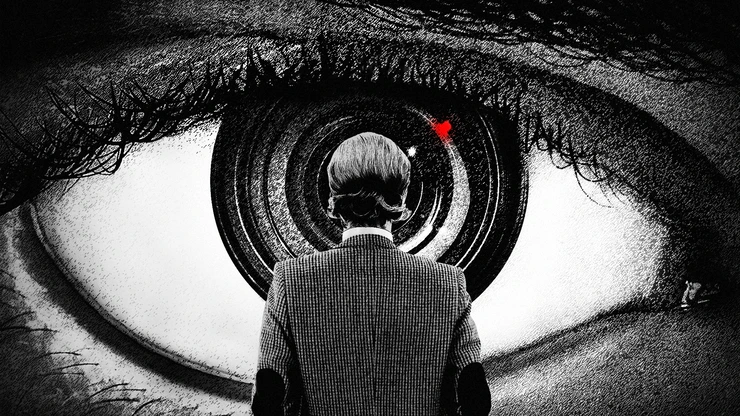
If the title Orwell: 2 + 2 = 5 makes you think you might be accidentally about to walk into a maths lesson, then don’t worry, there’s no calculator required. Instead, you’re going to be given an awful lot to think about over the space of two hours. For those who don’t know, this is a documentary about George Orwell, the writer who gave us 1984 and Animal Farm, and who was also known for spending a lot of his life worrying about what happens when people in power start playing with the truth. It’s directed by Raoul Peck (I Am Not Your Negro) and takes Orwell’s own words, read by actor Damian Lewis, and mixes them with historical footage and various scenes from today’s world. With the question of the documentary being: what if the scariest parts of Orwell’s books weren’t fantasy, but actually careful observations about how the world already works?
From there, the film really expands out in a way that is far, far more than just a retelling of the life of Orwell. It becomes more a question of trying to understand how a man who lived through empires, war, and revolution came to write as clearly as he does about manipulation and control. For instance, there is a powerful use of a childhood photograph of Orwell in colonial India, which is in the possession of his Indian nursemaid. The film frequently attempts to draw lines between Orwell’s life and the use of language today. It is a subtle reminder that, for him, issues of power and inequality were not abstract.
It’s not all just intensity, though. Some of the most memorable moments come from the sweeping drone shots of the Isle of Jura, where Orwell retreated to write 1984. The landscape is wild and open, full of cliffs and sea, and there’s something almost poetic to the idea of using those kinds of images to talk about the power of words that still resonate today. It’s those kinds of scenes that allow the film to breathe, even as they subtly reinforce the idea that one man, writing in isolation from an island, managed to capture the fears that would continue to resonate for decades to come.
By the end, it’s no longer feeling like a warning siren; it’s feeling more like a hand on the shoulder. It’s not arguing that Orwell was able to see into the future; it’s arguing that Orwell understood human systems and their weaknesses very well. The question that it leaves you with is a very important one. If someone in power is telling you that two and two make five, should you agree with them? Should you disagree? In that sense, it’s an accessible and important documentary. It’s a reminder that the truth is not just present in a novel; it’s present in life.
Of course, the timing still doesn’t feel entirely untimely. In a world in which the conversation about truth, misinformation, and power is everywhere, Orwell: 2 + 2 = 5 is a film that arrives at a time when thinking about these things is rather pertinent. That’s also a large part of what makes it significant, which in turn underscores one of the tricky realities. Those who are already well-versed in Orwell’s world and the ideas that he was working through may not learn anything new here, and those who haven’t been inclined to learn about these things in the first place may never bother to seek this film out. The challenge that the film presents, and possibly its greatest strength if it is successful in doing so, is in presenting a case that these ideas are worth engaging with.
★★★★
In cinemas on March 27th / Damien Lewis, George Orwell / Dir: Raoul Peck / Altitude / 15
Related
Discover more from
Subscribe to get the latest posts sent to your email.
