
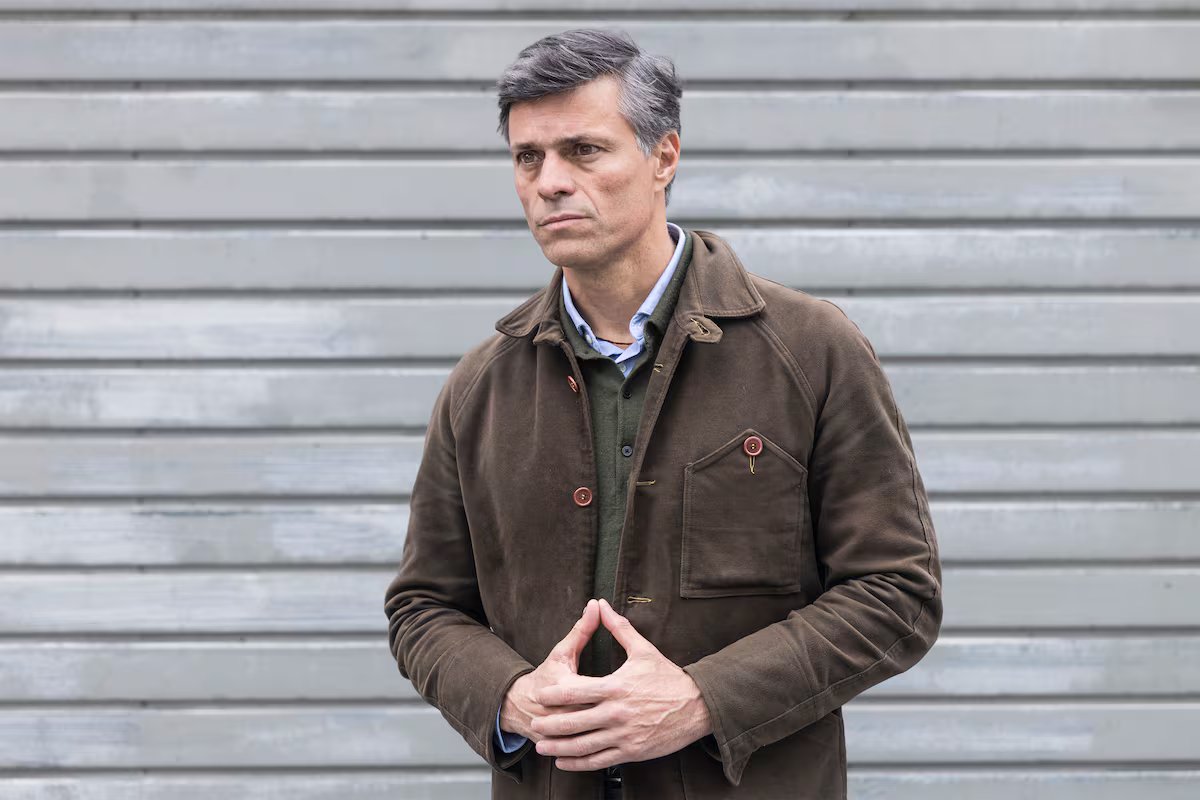
When Leopoldo López, 54, was being held in Ramo Verde prison, he had a recurring fantasy. “At some point, this dungeon should be turned into a museum of memory,” recalls the Venezuelan opposition leader, who spent more than three years in there, accused of inciting the 2014 protests against the government of Nicolás Maduro. More than a decade later, he believes that moment is approaching, although the transition process that began on January 3 with the capture of Nicolás Maduro is still in its early stages.
López has been living further from the spotlight since seeking refuge in Spain in 2020, but he has never distanced himself from the core of the anti-Chavista coalition now led by María Corina Machado. In an interview with EL PAÍS, he argues for the need for all opposition actors to press for an election calendar, which, under the tutelage of U.S. President Donald Trump, is still nowhere in sight.
Question. It’s been two and a half months since January 3rd. What has changed in practice in Venezuela?
Answer. Maduro is no longer in power, and he’s in prison. Seeing him behind bars has significantly changed the outlook in Venezuela. There is undoubtedly a transition underway, one that prioritizes stability and economic recovery, particularly leveraging the oil and gas industry, but there is still no clarity on the political transition. The political transition, to which millions of Venezuelans have dedicated so much effort and so much hope, remains the unfinished task. I believe it is inevitable that it will take place in order to form a truly legitimate government, because Delcy Rodríguez’s government is not legitimate. Delcy is just as illegitimate as Maduro. The only way to have a legitimate government is through elections.
Q. What timeframe do you think this scenario could take?
A. I don’t know, but what I can say is that this has to be the priority of a democratic country and its democratic leadership: to build a collective effort. Many things are happening in Venezuela; there’s a transformation in the hydrocarbon sector, in the economic sphere, and there’s a very significant US presence in all areas of national life. There’s a decline in the presence of Cuba, Russia, China, and Iran. But the issue around which all of us who want democracy must unite is how we build a path toward holding elections. In my opinion, it must be a general election, an election that opens all avenues and breathes new life into Venezuela. The struggle we’ve waged has always aimed for fair, free, inclusive, and verifiable elections. And we still don’t have that today, so the objective remains the same.
Q. You criticize Delcy Rodríguez, but she is now Trump’s chosen one.
A. What I’m saying is that if we’ve done everything possible for the last two decades to have elections, we still have that expectation today. But a lot has changed in Venezuela. I think we have to see the positive aspect of Maduro no longer being in power. There are opinions about what the influence of the United States means. Many times when I hear the criticism from those who talk about tutelage, I would say that we come from the tutelage of Cuba, Russia, Iran, and China. The fact that Venezuela will be in the United States’ sphere of influence is not new. We just won the Baseball World Cup. What is foreign to Venezuelans is that the food menu on Margarita Island is in Russian. Logically, our trading partners should be the Americans and the Europeans. But it is up to us Venezuelans—because that is not, nor will it be, the priority of any external country, nor of those currently in power—to push for elections. And there can only be an election if a new electoral council is appointed.
Q. However, for a transition to be considered as such, a fundamental step is that the exiles can return to Venezuela.
A. It’s a fundamental issue. I believe that Edmundo González and María Corina Machado must return to Venezuela; all of us in exile who wish to return should be able to do so. But it’s clear that there isn’t even the slightest opening for the minimal tolerance of political activity.
Q. And when do you plan to return?
A. I would like to return as soon as possible. However, there are some realities. Today I don’t even have a home to return to, because the only property I own in Venezuela, which is in my wife’s name and is located a block and a half from Delcy Rodríguez’s residence, was seized by the dictatorship, completely looted, and two of my dogs were killed. Furthermore, they stripped me of my citizenship, something that is expressly prohibited by the Venezuelan Constitution. I am stateless. I even had a conversation with my youngest daughter about this. She asked me, “So you’re not Venezuelan anymore?” Of course I’m Venezuelan; identity isn’t granted by the owner of a bureaucratic process. And there are millions of Venezuelans who have no access to consular services or the ability to renew their passports in Venezuela.
Q. At the same time, some developments are taking place in Venezuela. How do you view the approval of the amnesty and hydrocarbons laws or the recent dismissal of the Minister of Defense, Vladimir Padrino López?
A. It’s an incomplete transition. It appears that things are changing, but in reality, the same power structures and the same level of arbitrariness remain. The amnesty law and the hydrocarbons law, which seem to have nothing in common, actually do. Both are discretionary. The power structure, with all its arbitrariness, can grant or deny concessions and decide who receives amnesty. Is it positive that prisoners have been released? It’s very positive. Do we owe that to Delcy Rodríguez? No, we owe that to the United States.
Q. What role would you like to play in a transition and what have you discussed about this with María Corina Machado?
A. I think that belongs to another stage. Today we’re in one stage, and we have to concentrate on this one, which is how to achieve a transition. It’s very basic: we all have to demand elections. And for everyone to demand elections, we have to have a new National Electoral Council (CNE), and everyone has to be included. Once that’s achieved, a different issue is how the candidacy is structured, whether it’s a presidential election only or a general election. We think it should be a general election in which the Assembly, governors, mayors, etc., are renewed. And in a third stage, we have to consider what a government would look like. But it’s a mistake to see the last stage as if it were the first. Today there isn’t even an electoral timetable.
Q. But in an electoral scenario, would you accept the participation of everyone, including Chavismo?
A. Of course, that’s a democracy. I was the first one to be disqualified, and political rights are based on the right to vote and the right to be elected. Both of my rights were violated: the right to be elected and the right to vote.
Q. You fled to Madrid in 2020. Have you considered the Spanish Transition as a model?
A. Although no two transitions are alike, I was struck by how complex it was to include the communists in the process so they could participate in the election. They had hoped to get 25% or 30% of the vote, but they ended up with 10% and then 4%. But they were able to participate. I believe that in Venezuela, only through an election will we be able to take a step toward a true transition.
Q. Who from Maduro’s inner circle do you think could be included in a transition?
A. If there are elections that lead to a new government, there will be no obligation to include anyone, whether Chavista or not. The new government will decide with whom and how it governs. Now, there are a number of names that have a responsibility before the law. I am not a judge, and if there’s one thing I’ve learned, it’s that when politicians try to become judges, they commit abuses. What I want are institutions that can administer justice and judges who deliver justice.
Q. In transitional processes there are different models: general amnesties, truth commissions… Which model would you recommend?
A. I agree that there should be a process where justice is served. What are the mechanisms? I think the circumstances will determine what the mechanism will be. It’s an issue here in Spain, it’s an issue in South Africa, where I’ve been, and it was also an issue for many years in Chile. In other words, there are experiences that should enlighten us. There has to be justice, but there also has to be remembrance. For example, I think El Helicoide should be a museum of memory, where it’s forever remembered that this was a building where people were tortured, persecuted, and killed. And Ramo Verde as well.
Q. Did María Corina Machado do the right thing in giving the Nobel Prize to Trump?
A. It was her decision.
Sign up for our weekly newsletter to get more English-language news coverage from EL PAÍS USA Edition
