
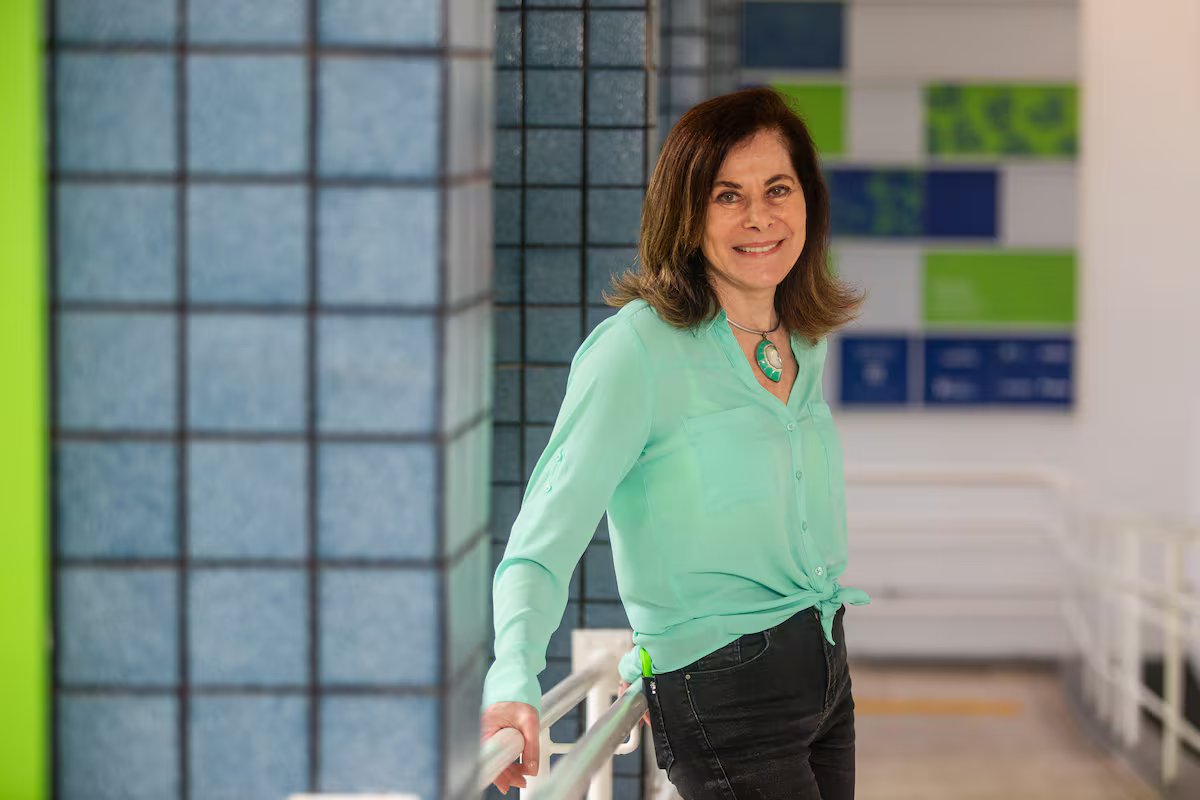
On the day Milton celebrated his 108th birthday, he invited about 40 friends to his home in Brasilia. During the evening, the host addressed each one by name to tell them how they had influenced his life. Among those present was a woman with whom Milton frequently exchanged emails, the Brazilian geneticist Mayana Zatz, who recalls the scene to illustrate the enviable cognitive performance exhibited by some of the nearly 200 centenarian volunteers, including some supercentenarians over 110 years old, who are participating in a genetic study she coordinates at the University of São Paulo (USP).
“I was wondering about the latest developments, how gene-editing techniques were progressing, or how we were going to study the immunological aspects,” the scientist explains in her office at the USP Human Genome and Stem Cell Research Center. Milton didn’t enter the pantheon of supercentenarians because death surprised him in his sleep after a life that included coffee and a whiskey every morning.
The research in search of the keys to healthy aging, reviewed in January in the journal Genomic Psychiatry, has focused on this molecular biologist considered one of the great Brazilian specialists in muscular dystrophies, understanding their causes and acting to prevent them.
Until April 2025, the three oldest people in the world were Brazilian, the scientist points out. João Marino Neto, at 113 years old, has been the oldest man in the world for the past four months, according to the Gerontology Research Group, which tracks and verifies supercentenarians worldwide. “We just took samples from a 111-year-old man,” the geneticist says, looking pleased.
Brazil is home to a significant number of centenarians (more than 37,000), despite being a developing country, far from longevity champions like Japan, the United States, or Mediterranean countries. But even more striking is the existence of Brazilian supercentenarians. Their eight-person team is constantly on the lookout for volunteers, who must remain physically active and be at least 95 years old. Once they agree to participate, a blood sample is taken.
One of the hypotheses being considered by Brazilian researchers is that the key lies in genetic mixing. “One of our hypotheses is that multiracial people are fortunate enough to possess resilient genes from various ethnic groups.” In other words, some of these Brazilians may have won the lottery and inherited the best genes from their Black, White, Indigenous, Asian, and other ancestors.
Brazil has one of the most diverse populations in the world. It combines the descendants of the natives who survived the invasion of 1500, mixed with the blood of Portuguese colonists, of Africans who survived the Atlantic crossing and were enslaved for three centuries in sugarcane or gold mining, and of immigrants from Europe, the Middle East, and the Far East invited in the 20th century to populate the country and, incidentally, to whiten the population, in line with the racist eugenics of the time. They failed. Since 2022, a majority of Brazilians identify as multiracial.
The team from USP, a public university considered among the best in Latin America, is studying another variable because the public health system has very unequal access and this is not a country that stands out for having a healthy diet: it practically jumped from hunger to ultra-processed foods.
Zatz and her colleagues are trying to demonstrate that “centenarians, especially those living in remote regions without access to modern medicine, were selected during their childhood, since in Brazil it was very common for a woman to have 10 children and for only one or two to survive. Those who survived were more resilient.” This could be the case of João Marino Neto, who has lived his 113 years in the interior of Ceará, in one of the poorest regions of Brazil. He lives in Apuiarés, a tiny rural municipality.
“We want to understand how the genes work” in these Brazilians who enjoy a healthy old age, in order, she explains, “to help people who weren’t lucky enough to be born with those genes.” “For example, we have centenarian athletes like Laura, who is a swimmer. She’s 107 years old and comes from a family of centenarians. We want to understand what maintains that strength,” or why Milton, the one from the birthday party, or Sister Inah Canabarro, a nun who became the oldest person in the world, were so lucid until the very end.
Zatz began studying centenarians after discovering several who had suffered COVID-19 during the pandemic and recovered. Perhaps focusing on these remarkable survivors was a consequence of a career dedicated to very serious genetic diseases, such as Duchenne muscular dystrophy, which affects children, preventing them from walking from adolescence onward, and often preventing them from reaching their 20s. “One day I realized that working, on the one hand, with these dystrophies, with diagnoses that are devastating for families, and on the other hand with happy elderly people, is perhaps a way of balancing things out.”
The study’s coordinator herself looks remarkably healthy at 78. She stopped running daily a few years ago after developing asthma, but she still walks between six and seven kilometers a day, hasn’t eaten meat since her twenties, and has no hobbies. Her life revolves around research and teaching. She’s delighted to continue teaching and to have rid herself of the most tedious university tasks. A mother of two, she says that she has never felt discriminated against in Brazil for being a woman. “I felt discriminated against in the United States, where there’s no maternity leave and you have to negotiate your salary. Here, we get paid the same; it depends on the position.”
The scientist was born in Tel Aviv just a few months before the creation of the State of Israel, where her parents had arrived from Romania fleeing Nazism. But life proved too difficult, and after a year, they moved to France. That curious little girl had just turned seven when a friend living in Brazil told her parents that it was a promising country. They settled in São Paulo. “Even in school, I was interested in how characteristics are passed from one generation to the next. At that time, genetics wasn’t being discussed. My mother had a hard time explaining to her friends what her daughter was going to study,” she says, adding that she studied biology to specialize in medical genetics.
One of the contributions of Zatz and her team has been to diversify genomic databases, which are dominated by samples from Europe and Asia. A few years ago, they contributed two million Brazilian variants by sequencing the genomes of 1,200 Brazilians.
She explains that among the centenarians, they have discovered three women with the genetic mutation responsible for a hereditary form of breast cancer—the same one that led actress Angelina Jolie to have her breasts removed. “We discovered three women over 90 years old who had not developed breast cancer, which indicates that this mutation, which in a person of European descent may be responsible for cancer, may not be in someone of mixed ancestry, demonstrating the importance of these protective genes.” She emphasizes that research with centenarians will contribute to advancing precision medicine.
She laments that the media attention surrounding the centenarian research hasn’t been accompanied by new funding. “Let’s see if any of those American millionaires who want to live forever contribute to our work,” she jokes, emphasizing that her only source of funding is FAPESP, a São Paulo state government foundation that allocates 1% of state taxes to research. In Brazil, “we have centers of excellence like this one at USP, where we can do everything that’s done abroad, but we should have more centers of excellence throughout Brazil.”
Sign up for our weekly newsletter to get more English-language news coverage from EL PAÍS USA Edition
