
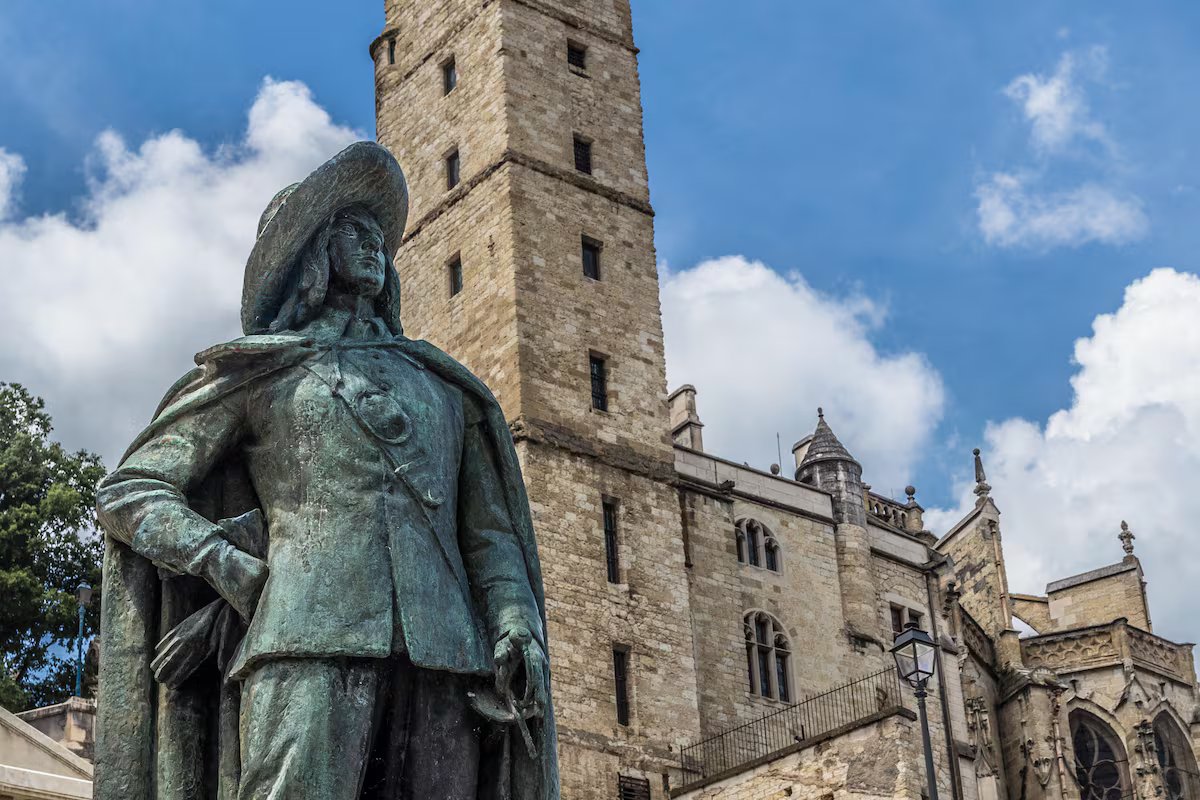
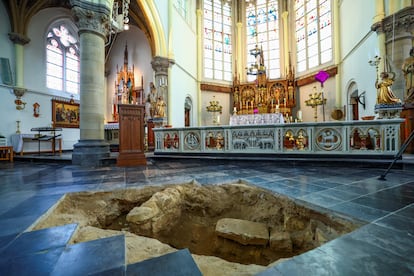
A skeleton has been discovered in the Church of St. Peter and St. Paul in Maastricht, and a German laboratory is analyzing the DNA from the teeth to determine if it belongs to Charles de Batz de Castelmore, Count d’Artagnan, the famous leader of the musketeers in the service of Kings Louis XIII and Louis XIV, who fell in battle on June 25, 1673, during the siege and capture of Maastricht by the French army during the Franco-Dutch War. Having become a legendary figure in the 19th century thanks to Alexandre Dumas’s novel The Three Musketeers, the fate of his body has never been clarified. The collapse of part of the church floor has now facilitated the discovery of the remains, which were found alongside a French coin and a musket ball lodged in the chest area. D’Artagnan died from a musket ball to the throat.
In Avignon, a paternal line of D’Artagnan — the De Batz family — remains, and scientists will compare the DNA obtained with that of a descendant. The results are expected shortly, and in the meantime, caution prevails because this research could lead to a historic discovery.
More than 350 years after his death, this past February, repair work on part of the floor of the Church of St. Peter and St. Paul, located in what is now the Wolder district of Maastricht, led to the discovery of the remains. They were found beneath where the altar table had stood two centuries earlier. The siege of the city in 1673 was part of the Franco-Dutch War, which pitted France against an alliance of European countries. The attack, carried out between June 13 and 26 of that year, aimed to seize control of a strategically valuable fortified town. D’Artagnan led one of the French regiments, which attacked from the rear with its musketeers. He managed to penetrate the fortifications but was struck in the throat by a musket ball. According to city records, a sergeant named Saint-Léger inspected the area with some men and found d’Artagnan dead with his throat shattered by a musket ball.
The body was carried to the rear as the fighting continued, and what happened next is unknown. The French army had set up camp near the church in what was then the village of Wolder, and it is assumed that they buried him there. But there is no proof. According to Deacon Jos Valke, at that time “only royalty or other important figures were buried under the altar.” Five days after his death, the French captured the town and remained there until the Peace of Nijmegen was signed in 1678 between Spain and the then-United Provinces of the Netherlands, on one side, and Great Britain and France on the other, ending the conflict.
Being part of the Royal Guard’s mounted musketeers was considered an honor, and Louis XIII and Louis XIV entrusted d’Artagnan with the most delicate missions of their time. He was an elite officer, and according to French historian Odile Bordaz, a specialist on the musketeer, in her book D’Artagnan, un personage historique meconnu, “he is the only one of the captain-lieutenants of the famous company who died in combat.” Considered a national hero of France, if the discovery of his remains is confirmed, the diplomatic approach required to decide his fate remains to be seen.
Formed in 1622 as a regiment of the Royal Guard, the musketeers were mostly nobles and typically began their service around the age of 16 or 17. The recruits, mainly from Gascony — such as d’Artagnan, who was born in 1613 or 1615 — or Béarn, were skilled in the use of swords and firearms. There were infantry and cavalry units, and in times of peace they served as the king’s escort. As British historian Josephine Wilkinson explains in one of her blogs, Cardinal Richelieu, Louis XIII’s chief minister, had his own guard. “His policy was to deny the nobility high-ranking positions, thereby limiting their power and making them dependent on the king for his favor.” Since most of the musketeers were indeed nobles, “this caused a great deal of resentment, and there was rivalry between the two regiments.”
From a noble family
Everyone knew d’Artagnan by that name; he was born into a noble family in southern France with a military tradition. He inherited the title of count upon his brother’s death and enlisted in the musketeers around 1640. Over time, he became a confidant of Cardinal Mazarin, who served as France’s chief minister from 1642 to 1661 and succeeded Cardinal Richelieu. The famous musketeer traveled throughout France, was appointed governor of Lille, and carried out secret missions and state assignments. He married Charlotte-Anne de Chanlecy, a widow, in 1659, and they had two children. The marriage ended in 1665. If his date of birth is correct, he was in his fifties at the time of his death.
Already renowned in their time, the French writer Dumas brought the musketeers to popular glory with his novel, first published in serial form in 1844, with the help of Auguste Maquet, who worked as his ghostwriter. The adventures of d’Artagnan and his three comrades-in-arms (Athos, Porthos, and Aramis) and the motto “All for one and one for all” have endured. Above the miseries of the wars and plagues of the era, the quartet is remembered for their bravery and romantic escapades, and it was inevitable that cinema would fall under their spell.
Hollywood has produced several films about them since the first silent version in 1921. Among these, the 1948 version, directed by George Sidney, stands out, as it gave actor and dancer Gene Kelly the opportunity to combine his agility with the charm of the lead role. In 1973 and 1974, British director Richard Lester made two films about the musketeers. One of the most recent French adaptations is from 2023, directed by Martin Bourboulon. And there was even a Spanish animated version, first as a television series and decades later as a film, titled Dogtanian and the Three Muskehounds. Each has its own style, but the image of the musketeers that inspired them is that of the characters created by Dumas. D’Artagnan is a legend based on a real figure. We will now find out if he was buried in a church in the Netherlands.
Sign up for our weekly newsletter to get more English-language news coverage from EL PAÍS USA Edition
