
The Montreal Alouettes are continuing their mission to reach fans from across the province by hosting training camp in Quebec City this year. However, if Danny Maciocia had his way, loyalties would be considerably more divided.
On Wednesday, the Alouettes’ senior vice-president of football operations and general manager stated that he is a staunch proponent of CFL expansion to the provincial capital, believing it to be the league’s best chance at a 10th franchise.
“I don’t know what’s going on at the league level. I don’t know what level of interest, if there’s a group or if there’s an individual who wants to bring a team to Quebec City. But it would be, by far, in my opinion, the best option that’s available,” Maciocia told the media via videoconference.
“It’s a market that supports their sports teams, and I think it would be a great fit for the CFL. It’s just a question of whether there’s enough interest there to bring a team, but I would think it would be a huge success, in my opinion.”
This isn’t the first time that Maciocia has backed the viability of the Quebec market, but his comments come at a point when the idea of expanding there has never been more popular. After a proposed Atlantic Schooners franchise fell through in Halifax, former CFL commissioner Randy Ambrosie began to float Quebec City as an alternative, and his successor, Stewart Johnston, has continued to cite it as a possibility, despite taking a longer-term approach to expansion.
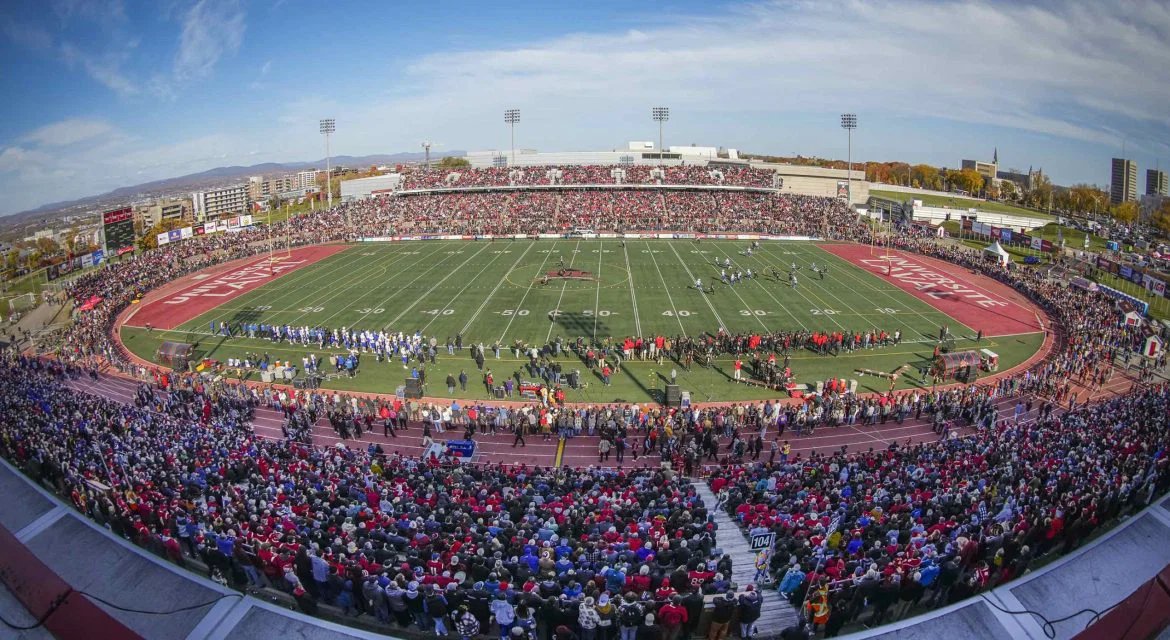
Cooperation with the Université Laval and its powerhouse Rouge et Or football program, backed by reclusive investor Jacques Tanguay, has long been viewed as a prerequisite for any meaningful exploration of Quebec expansion. As recently as 2023, Tanguay told local media outlets that there was “no appetite” for a CFL team in the city from either the private or public sector. However, the new training camp agreement, which will see the Alouettes utilize Laval’s Pavillon de l’éducation physique et des sports, better known as PEPS, this summer, has been viewed as a step in the right direction on that front.
Despite repeated trips to Quebec City while making arrangements, Maciocia admitted that he has not spoken with Tanguay in a long time and does not know if his opinion on the CFL has changed. What he does know is that the province’s current football culture can be traced directly to his investment in the Rouge et Or.
“Him and his group, what they’ve been able to do in Quebec City has been unbelievable,” Maciocia said. “If Quebec football is where it’s at today, it’s not the return of the Montreal Alouettes in 1996. It’s what the Rouge et Or have been able to put in place. I think they’ve been the driving force behind the success of football in the province of Quebec.”
The Rouge et Or’s fanbase stands head and shoulders above any other in Canadian university football, regularly selling out Stade Telus at PEPS and setting an attendance record of 20,903 in 2024. They are also far from the only successful sports franchise in the city. The Quebec Remparts lead the Quebec Maritimes Junior Hockey League in average attendance, as do the Quebec Capitales in baseball’s Frontier League.
Previous forays into the market by the CFL have been less well-received. A 2015 exhibition game between the Alouettes and Ottawa Redblacks drew just 4,778 fans at Laval. In 2003, a crowd of 10,358 attended a preseason clash between Montreal and the Ottawa Renegades. Still, Maciocia believes those disappointments were a product of a different era.
“You look at the Montreal Alouettes the last three years, we’ve participated in Grey Cups. We’re a team that wins games, that has had success on the field,” he said in French, beautifully illustrating his next point.
“We are also a team that has a different face than the one that last played in Quebec. You look at the number of players from Quebec who are part of our roster, as well as the number of Quebecois decision-makers who are part of our organization. I think people in Quebec can identify with this team, not just the players who wish to one day play professionally for the Alouettes, but also the people who wish to one day work for the organization. It is really two different teams, two different organizations, and I think it speaks to Quebecers.”
Any Quebec expansion franchise would need to follow a similar homegrown model, but standing in its path is the absence of a long-term stadium. While PEPS may offer “pro-quality” facilities for a CFL training camp, Stade Telus officially seats only 12,750 fans, partly on bleacher-style benches. Attendance above that number is standing room only, which doesn’t fit the needs of a professional football team.
However, Maciocia believes the facility could accommodate a CFL tenant with the use of temporary bleachers in the short term, before they hopefully transferred to a new venue. That could be a boost for the area’s entire sports scene, potentially hosting a soccer team or other field sports.
“I would hope that the stadium would be multidimensional. It wouldn’t just be a football stadium, the whole community would benefit from it, and if it’s the whole community that benefits from it, it makes it a little bit more of a valid argument to build one,” he said. “Instead of it becoming a stadium that holds maybe 10 events, it could be a stadium that holds many more events. I’ll leave that to the politicians, whether it’s the city, the municipal government or the provincial government. That’s above my pay grade.”
“As far as the infrastructure is concerned, I don’t know about all of that. As far as the level of interest, I think it would be a huge success. There’s no question in my mind that that’s a football market.”
For now, Maciocia’s ideas remain purely hypothetical, but few understand football in the province as he does. As head coach of the Montreal Carabins for nearly a decade, he got frequent up-close looks at Laval’s rabid fan base, and believes a CFL version of that storied inter-city rivalry could be something special.
Considering all the different factors, he’s certain that a Quebec City team would work.
“It’s the Rouge et Or. It’s all the amateur teams. It’s all the people on the business side that I think would involve themselves in a 10th team, particularly in Quebec,” Maciocia said. “With that type of support, I don’t know how they couldn’t have success.”
