
Any adaptation of Enid Blyton seems a questionable prospect in the 21st century. Like Roald Dahl, her work has gone through re-evaluations in recent years, and even if the frequently xenophobic, sexist, and classist attitudes of her books weren’t an issue, her stories are so rooted in the past that any adaptation would face an uphill battle in order to remain faithful and still appeal to modern audiences, especially children. That The Magic Faraway Tree manages to feel both warmly nostalgic and contemporary is no mean feat, and even if the results are occasionally uneven and very cheesy, there is a real heart to it that is undeniably moving.
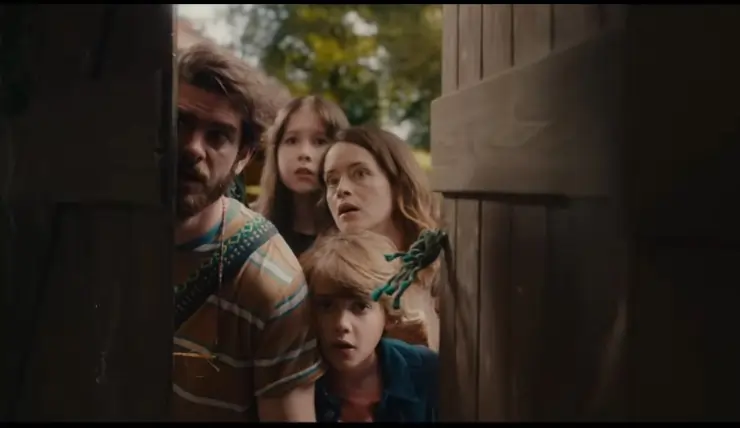
When the Thompson family find themselves suddenly without an income, parents Tim and Polly (Andrew Garfield and Claire Foy) decide to revisit their old Dream Diary to relocate from the city to the countryside. Much to the horror of their children, they start anew – without Wi-Fi, mobile devices, or even electricity – by launching a tomato sauce business. It’s a premise that initially leans heavily into a familiar “technology bad” message, and veers dangerously close to being more a film that parents want their children to watch than one for the children themselves.
Things improve dramatically once the children discover the tree of the title. Ignoring warnings to stay out of the woods, youngest daughter Fran (Billie Gadsdon) stumbles into a hidden world populated by all manner of magical beings, including friendly fairy Silky (Nicola Coughlan), the hard-of-hearing Saucepan Man (Dustin Demri Burns), and the perenially grumpy Moonface (Nonso Anozie). From here, the film opens up into a series of episodic adventures, as the children journey through a succession of ever-changing, beautifully realised lands.
To his credit, Simon Farnaby’s script handles a substantial amount of world-building with efficiency. The whimsical nature of the story could easily have grown tiresome, but in his hands, it becomes something playful and genuinely charming. There’s more than a hint of Farnaby’s previous work – the irreverent, impish humour recalls that of the criminally underseen Yonderland (especially the depiction of the ironically named Know-Alls) and the quietly emotional ending feels cut from the same cloth as Paddington 2 and Wonka.
The final moments of The Magic Faraway Tree are unexpectedly affecting without being cloying, tapping into something universal and painfully heartfelt. That feeling of growing up and forgetting the child you’ve left behind. It’s less overtly sad than gently wistful, capturing those intangible aspects of growing up that slip away without you quite noticing.
It’s clear that both Farnaby and director Ben Gregor are much more interested in the fantasy worlds and supernatural characters than the real world. The various magical locations each have a clearly defined look, in a way that recalls Terry Gilliam. Nicola Coughlan is delightful as the endlessly optimistic Silky, while Dustin Demri-Burns channels Norman Wisdom and Count Arthur Strong as the hard-of-hearing Saucepan Man. Even better is Oliver Chris as Mr Watsisname, who takes his sole character trait (he can’t remember his name) and spins it into a genuinely funny recurring gag. Best of all, though, is Nonso Anozie as Moonface – or Moonhair, really, given the updated character design. He deftly reconciles his character’s very contradictory traits: his pomposity, self-importance, and vulnerability, and is the focus of the film’s most affecting moment, which he sells beautifully.
Mark Heap is another comic standout as Mr Oom Boom Boom (those names!), making him both eccentric and menacing – the joke about knocking seven times on his door is one of the best throwaway jokes in the film (“in a row!”). And it’s nice to see him really sinking his comedy chops into something again. Rebecca Ferguson is also effective as the erstwhile villain of the film, Dame Snap, although she could have benefitted from more screentime – as it is, she is a great presence, and her uncanny shriek is genuinely unnerving, but she’s introduced too late in the proceedings to really make an impact on the plot.
Among the cast from the real world, Garfield seems to be fully embracing his cheesy side, leaning into the eccentricities of his well-meaning but feckless character. You like him because he’s Andrew Garfield, but the character is infuriating. Even as a child, I think I’d be watching this, thinking how irresponsible and ill-thought-through his plans are. Foy is a little underserved by the script as his long-suffering wife. She has some personality and character traits (she builds things), but is given little to do, and it’s a bit of a thankless role. The child performances are also all decent, with Delilah Bennett-Cardy doing particularly well in the difficult role of the sceptical eldest sibling.
The film also makes a quiet effort to correct some of the more archaic attitudes of Blyton’s work, both tacitly and overtly. The renaming of Dame Slap to Dame Snap in the books is acknowledged by the character herself, and Silky’s insecurity about her appearance is roundly rubbished by the children. These are thoughtful, unobtrusive updates rather than the kind of self-conscious course correction seen in other modern adaptations. The film isn’t embarrassed by its origins; in fact, it’s clear from the fun script and detailed characterisation that Farnaby has a genuine warmth and fondness for the original story.
Crucially, the film avoids the trap of overloading itself with contemporary references or hyperactive pacing. There are none of the zeitgeisty, dated-as-soon-as-it’s-mentioned references that plague films aimed at children. It’s a measured, thoughtful adaptation that brings the story into the present day while retaining the traits of the magical characters that made them so appealing in the first place.
More Christopher Robin than Paddington, for good and for ill, The Magic Faraway Tree doesn’t have the same consistent, easily identifiable visual identity as the film with the loveable bear, but the story is genuinely touching, with a quietly understated, bittersweet coda that appeals to the child in all of us. It’s not without its missteps – there are some unbearably cheesy moments, and a couple of jokes you can see coming from a mile away, but it has an irrepressible charm, and is a refreshing corrective to the cynical self-awareness and sensory overload of most recent kids’ films. It’s corny, overly sentimental, sometimes cringeworthy, and kind of wonderful.
★★★
In cinemas on March 27th / Andrew Garfield, Claire Foy, Rebecca Ferguson, Nicola Coughlan, Delilah Bennett-Cardy, Billie Gadsdon, Phoenix Laroche, Nonso Anozie / Dir: Ben Gregor / Entertainment Film Distributors / U
Related
Discover more from
Subscribe to get the latest posts sent to your email.
