
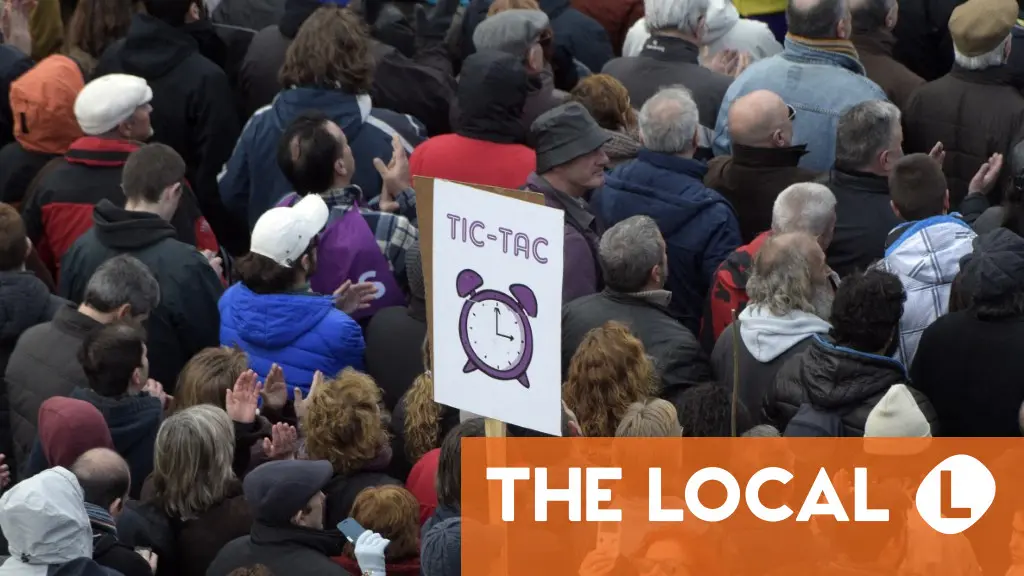
The clocks are changing again at the end of March in Spain, and the endless debate over scrapping daylight saving rages on.
A new cambio de hora (time change) is coming up in Spain, the first of 2026.
On the night of March 28th-29th, from Saturday to Sunday, the clocks will move forward from 2am to 3am in mainland Spain.
In the Canary Islands, which are an hour behind the rest of Spain, the clocks will move forward from 1am to 2am.
Digital devices connected to the internet such as mobile phones, TV and laptops will usually carry out the time change automatically, whereas for analogue clocks you’ll have to change the time manually.
Advertisement
This time change will mark the start of the summer time period in Spain, which starts on Sunday March 29th and ends on Sunday October 25th, when the clocks will change again to winter time.
Although both the European Parliament and the European Commission have expressed support for eliminating clock changes in the near future, a final decision has not yet been made.
The measure is currently justified by energy savings, which aim to synchronise daylight hours with the workday to reduce electricity consumption, both in Spain and in the rest of the European Union.
But the ongoing debate about the effectiveness of daylight saving will continue rumbling on in Spain, Europe and the US.
Last year, researchers at Stanford University found that changing the clocks doesn’t just have a negative impact on our sleeping patterns, it can also lead to an increase in obesity and strokes.
Advertisement
There’s also an interesting historical quirk when it comes to Spanish timekeeping, which makes the case for leaving the clocks alone in Spain even stronger.
Spain is on Central European Time, the same as 17 different EU member states, but in reality it should be in the same zone as the UK and Portugal, one hour behind. This is because the country has been in the wrong time zone for the last 85 years.
In 1940, dictator Francisco Franco decided to show his support for Hitler by agreeing to put Spain’s clocks forward by an hour in an act of solidarity with Nazi Germany.
Spain has remained in the Central European Time zone ever since, in line with countries as far east as Poland. This means that Madrid currently has the same time as Warsaw in Poland 2,290km away but is one hour ahead of Lisbon which is only 502 km away.
READ ALSO: Why Spain is still in the wrong time zone because of Hitler
Last year, British neuroscientist Julia Ravey filmed a video for the BBC explaining how this misalignment with sunlight can have detrimental effects on our digestion, as it influences people’s biological rhythms.
“When alarm clocks go off in Spain at 7 am, it’s actually only around 5 or 6 am in terms of solar time,” Ravey stated.
