
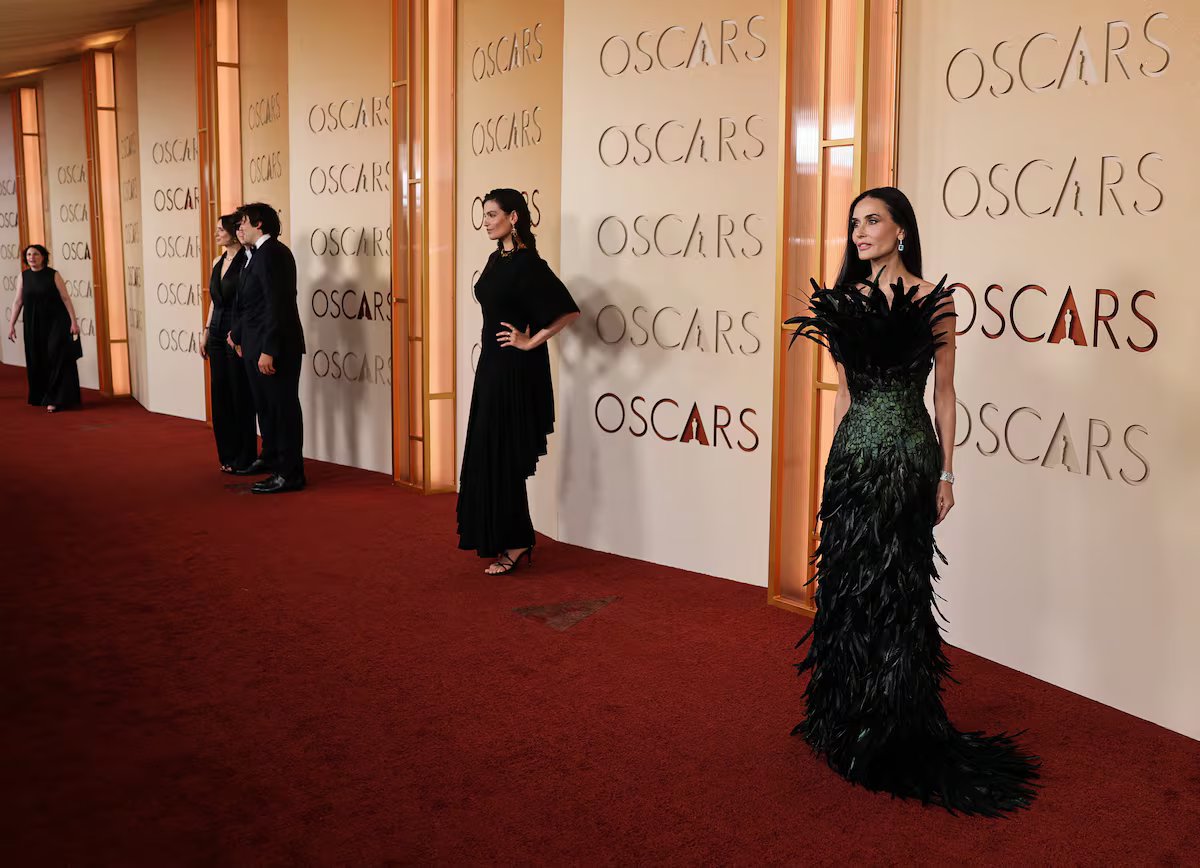
Director and screenwriter Chloé Wallace stirred up a hornet’s nest on social media a few days ago: in an Instagram post following the Oscars, she expressed her “rage” at the return of extreme thinness as a beauty ideal. “Every red carpet, every event, every time I open Instagram, there they are, thinner than last week (…), thinner and thinner, as if there were a competition that no one names, but everyone’s playing,” she stated. It was the elephant in the room. “Before, it was about not eating, counting calories, restricting. Now it’s a weekly injection that suppresses hunger. It’s the return of thinness as capital. It’s not aesthetic, it’s political. And the most perverse thing is that it comes disguised as health, as well-being,” she warned.
Wallace hit a nerve. Her message went viral immediately: 72,000 likes; over a thousand comments; 12,000 shares. The director had shouted what other expert voices have also been warning about for some time, and what the algorithm constantly feeds: the return of the “heroin chic” model of extreme thinness from the 1990s, but magnified today by social media and coated with a dangerous veneer of supposed health and well-being.
“We had a period of ‘body neutrality,’ where the body wasn’t viewed so much through an aesthetic lens, and we were more at ease. But now we’ve returned to that late-nineties ‘heroin chic’ era. Extreme thinness is making a comeback, and it’s being disguised as health,” warns the nutritionist Azahara Nieto emphatically. It’s the same old story, but with new variables that amplify the phenomenon: the bombardment on social media and the aesthetic pressure disguised as self-care. “The ‘heroin chic’ of the nineties was explicitly aesthetic, even transgressive. Today it’s more sophisticated: it’s presented as well-being, discipline, or body optimization. The key difference is that now it’s medicalized and legitimized. It relies on health rhetoric, biometric data, and, in some cases, pharmacological interventions. This makes it harder to detect and question,” points out Violeta Moizé, a dietitian and nutritionist at the Hospital Clínic in Barcelona.
The obsession with body control is back, and social media is both its megaphone and its fuel. It amplifies the message and the comparisons. This makes it “a trigger, a risk factor” for the development of eating disorders and body image issues, explain the experts consulted. “Recovering from an eating disorder and having a healthy relationship with food in a society that rewards extreme thinness is very difficult,” emphasizes Nieto, who is also a contributor to EL PAÍS and founder of the online consultation service You Eat as You Live.
Philosopher Magdalena Piñeyro, who has written on the issue, believes that this “rebirth of the thin body ideal” is a counterattack being “promoted by the media, culture, fashion shows…”. “It’s a response to the entire anti-fatphobia and body-positive movement that had made enormous progress in the last decade in terms of rights and acceptance of body diversity,” she notes.
For Piñeyro, “the health excuse” is nothing new —“Thinness has always been linked to beauty and health,” she argues—, but Nieto does attribute importance to the resurgence of extreme thinness as a beauty ideal to the introduction of anti-obesity drugs like Ozempic: “Medications can be helpful and useful, but they aren’t being sold as a health product. It’s an aesthetic sale,” she criticizes.
The ‘Ozempic effect’ on the slimness wave
These treatments, which mimic the effect of hormones that naturally generate a feeling of satiety and help patients lose between 15% and 25% of their weight, have revolutionized obesity treatments. But they have also become a dangerous tool in the wrong hands and without medical supervision. “They are being marketed as if they were harmless,” Nieto criticizes.
These drugs, the nutritionist writes, have become “an aspirational panacea for thinness.” And the industry’s behavior in increasingly positioning them as a consumer good testifies to this. One example was the campaign starring tennis player Serena Williams to promote these medications. She said she had used them after a pregnancy to return to her previous weight, but it wasn’t clear whether she had any health problems, which shifts the focus to an aesthetic scenario that encourages the standardization of bodies and undermines the essence of body diversity.
Andreea Ciudin, head of the Comprehensive Obesity Treatment Unit at Vall d’Hebron Hospital in Barcelona, admits that they are already seeing a “trivialization” of these obesity drugs, disregarding the complexity of the condition and the risk of side effects. The endocrinologist warns of the widespread prescription of these medications without prior assessment or follow-up, and without knowledge of how to escalate the dosage: “Some people start with a very high dose, leading to such severe food restriction that it can cause malnutrition.”
With patents beginning to expire and these products becoming cheaper, the doctor fears that over-the-counter sales will bring many more risks, starting with eating disorders. “These drugs are already being used for weight loss. The authorities should control prescriptions because it could become a public health problem. Obesity will be trivialized, seen again as a cosmetic issue, and people will start this treatment when it’s not necessary, just to get rid of a few extra pounds,” she warns.
Anti-obesity medications fuel the narrative linking thinness and health, but an entire narrative has also been built around food that promotes this message. For example, in the form of advertising for new restrictive diets, such as intermittent fasting, or with language that evokes well-being: they talk about superfoods, nutritional supplements, vitamin supplements, energy balance… “They used to tell you you were fat; now they tell you you have inflammation,” Nieto explains.
Underlying this is the idea of body control. “Under the guise of health and sports, in our practice we see this dichotomous relationship where people monitor what they eat, what they don’t eat, what’s good, what’s bad… It’s a very rigid behavior. Self-care is laden with self-imposed demands,” reflects Lucía Ugarte, a clinical psychologist and collaborator at the clinic You eat as you live.
Discipline. Control. Wallace pointed out that behind this aesthetic pressure towards extreme thinness there is also an ideology. “The return of thinness as capital, currency, a marker of class,” he said.
The ultraconservative influence
The idea of thinness as a symbol of status and power. This isn’t new either, Moizé agrees: “Body ideals often reflect social values: control, discipline, productivity, conformity.” And now, she adds, we also see a revaluation of traditional ideals that align with this. “In certain environments (like the so-called ‘manosphere’), the body becomes a symbol of status, success, or moral superiority. This can promote unhealthy relationships with exercise, food, and body image. The problem isn’t exercise or self-care itself, but when they become tools for validation or exclusion.”
For Piñeyiro, this whole narrative is closely related to the misconception that the body is malleable: “We are buying the neoliberal myth that everything depends on us and it is a trap, because we lose sight of the fact that the material and cultural conditions in which we live determine our health and our body.”
In the end, all that remains in this pursuit of the beauty ideal is frustration and health problems, experts warn. “We are heading towards a trend of unhealthy relationships with food and bodies, and an increase in eating disorders at increasingly younger ages,” Nieto cautions.
Piñeyro calls for “questioning this whole concept of health that revolves around pharmacology, sacrifice and going hungry”: “Equating thinness with health is a mistake, especially when many people get sick from trying to reach that imposed ideal of beauty.”
Sign up for our weekly newsletter to get more English-language news coverage from EL PAÍS USA Edition
