
Over the past year, the Canada–U.S. trade relationship has shifted in ways few businesses expected. What began as tariff disputes has evolved into a more complex and uncertain cross-border environment. February 1st marked one year since tariffs escalated between the two countries, and for many Canadian businesses, that year has required adaptation, recalibration, and resilience.
At a national level, Canada has not “collapsed” under trade pressure. But survival at the macroeconomic level does not automatically translate to stability for small businesses operating on tight margins. The real question isn’t just whether Canada can survive a trade war with the U.S. It’s how Canadian businesses, especially small and mid-sized ones, navigate the operational impact.
To better understand what’s happening on the ground, Merchant Growth surveyed 103 Canadian small businesses in January 2026. The results offer a clear picture: resilience exists, but it comes with cost pressure and cautious decision-making.
In this article, we’ll explain what a trade war means, why Canada is particularly exposed, what the data says about small business resilience, and what business owners can do next.
Key Takeaways
- A trade war increases costs through tariffs and retaliatory measures.
- 41% of surveyed small businesses report margin declines due to tariffs.
- Nearly half absorbed added costs instead of raising prices.
- Trade uncertainty delays investment, hiring, and expansion.
- Survival depends on adaptation, fiscal policy, and business-level cash flow management.
What Is a Trade War? (In Simple Terms)
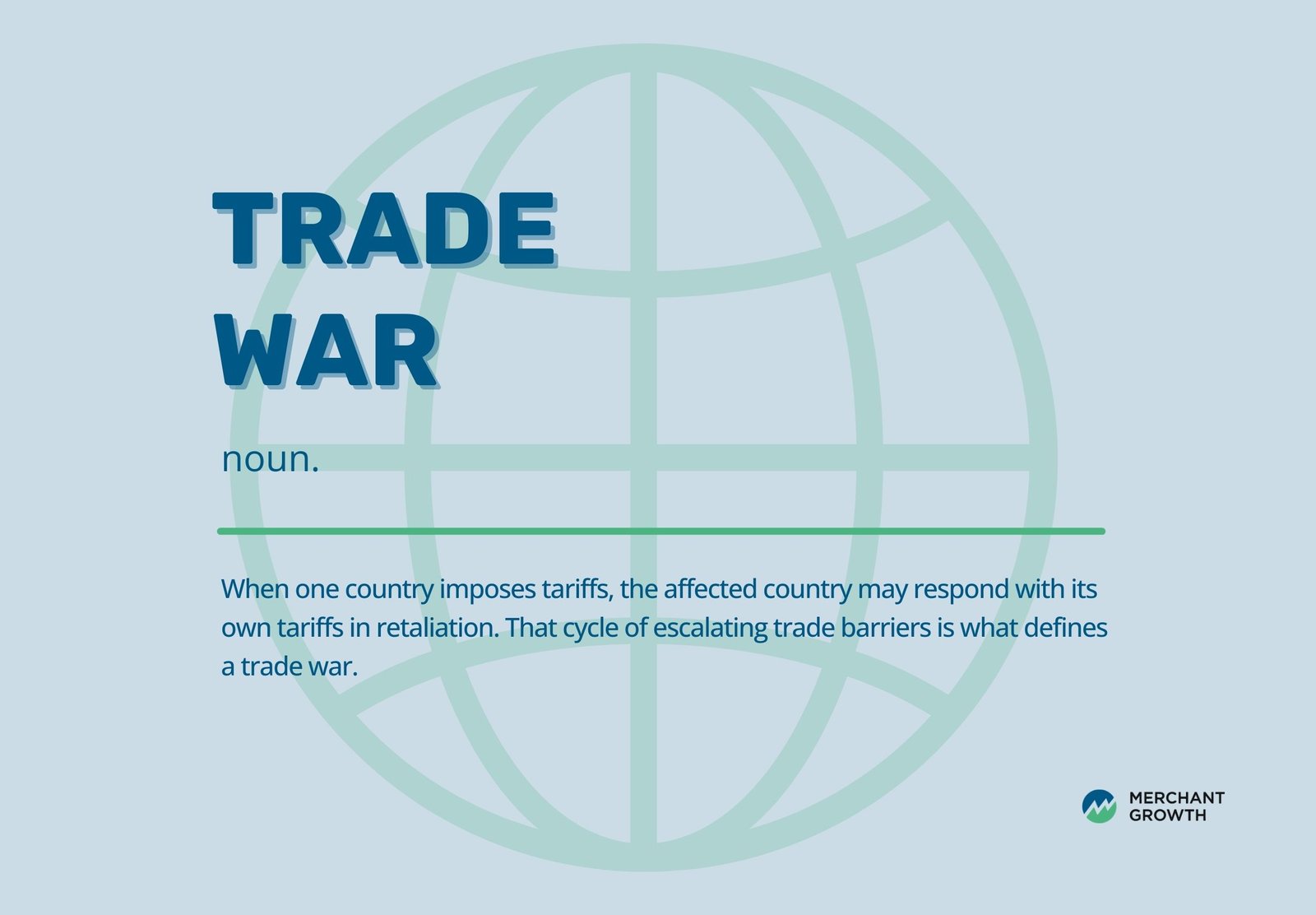
A tariff is a tax placed on imported goods. When one country imposes tariffs, the affected country may respond with its own tariffs in retaliation. That cycle of escalating trade barriers is what defines a trade war.
The impact goes beyond the tax itself. Tariffs raise the cost of goods crossing borders, which increases input costs for manufacturers, retailers, and distributors. Over time, businesses adjust supply chains, pricing strategies, and sourcing decisions. Consumers may face higher prices, and investment decisions become more cautious.
The economic effect isn’t limited to the tariff percentage. The real cost often lies in uncertainty and unpredictability around policy shifts, negotiations, and future restrictions. That uncertainty influences hiring, capital investment, and long-term planning.

Why Is Canada So Exposed to a U.S. Trade War?
The United States is Canada’s largest trading partner, and the scale of that relationship is significant. In 2024 alone, nearly $3.6 billion (US$2.6 billion) worth of goods and services crossed the Canada–U.S. border every single day. Cross-border trade is deeply integrated across industries, including manufacturing, energy, automotive production, steel, and aluminum. Supply chains often operate seamlessly across provincial and state lines, with products and components moving back and forth multiple times before reaching consumers.
Because these industries are highly interconnected, even modest tariffs can ripple across multiple sectors. For example, an auto part manufactured in Ontario may cross the border several times before final assembly. Each tariff layer compounds cost.
The impact is also regionally uneven. Provinces with stronger exposure to manufacturing and resource exports may feel pressure more acutely than service-driven economies. This interconnected structure makes “Canada vs U.S. trade war” effects highly sector-specific.
How Will a Trade War Affect Canada?
The effects of a trade war don’t show up in just one headline number. They ripple through the economy in layered and sometimes subtle ways. While the national economy may continue functioning, individual industries, regions, and businesses can feel pressure differently depending on their exposure to cross-border trade. Understanding these channels of impact helps clarify why even targeted tariffs can create broader economic consequences.

At a high level, trade conflict affects Canada in several key ways:
- Higher input costs for imported components
- Margin compression for exporters
- Delayed investment decisions
- Consumer price sensitivity
For businesses, higher input costs are often absorbed initially to protect customer relationships and maintain market share. Many companies hesitate to raise prices immediately, especially in competitive sectors. But sustained cost pressure eventually forces difficult decisions around pricing, hiring, and expansion.
Uncertainty acts as an economic tax. Even if tariffs themselves are modest, unpredictability reduces confidence. When business owners hesitate to invest in equipment, inventory, or new hires, growth slows. The effects may not be dramatic in a single quarter, but they accumulate over time, influencing both business momentum and broader economic performance.

What the Data Says: How Canadian Small Businesses Are Responding
National economic indicators tell one story. Small businesses tell another. To understand how the trade war is affecting Canadian companies on the ground, Merchant Growth conducted its own Trade War Survey in January 2026, gathering insights from 103 small businesses across the country. The findings provide direct visibility into how owners are adjusting operations, managing margins, and planning for the months ahead.
The data reveals not panic, but pressure. And that pressure is shaping real business decisions.

Key findings include:
- 57% scaled back U.S.-related activity
- 14% cut ties with U.S. activity entirely
- 41% reported profit margin decreases
- 32% spent $5,000–$25,000 in added trade costs
- 9% spent $26,000–$100,000
- 48% did not pass on increased costs to customers
- 43% plan to raise prices in the next six months
The pattern is clear: many businesses are absorbing higher costs to protect customer demand. Nearly half chose not to immediately pass tariff-related increases on to buyers. While this strategy preserves relationships and competitiveness in the short term, it places sustained pressure on profitability.

Operational adjustments further illustrate how businesses are adapting:
- 55% are cutting discretionary spending
- 45% plan to take on additional financing
- 29% are negotiating supplier terms
- 25% are reducing inventory
- 53% report headcount has remained steady, reflecting cautious resilience
Taken together, the findings suggest something important. Canada may appear stable at the macro level, but small businesses are making deliberate trade-offs behind the scenes, protecting demand, preserving jobs, and carefully managing cash flow in the face of rising uncertainty.

Why Didn’t 2025 Tariffs “Break” Canada?
Despite the disruption, Canada’s economy has not collapsed under tariff pressure. Several factors contributed to resilience.
CUSMA (formerly USMCA) protections limited full exposure in certain sectors. Businesses adapted supply chains and diversified sourcing. Currency movements partially offset tariff costs for exporters. Consumer “buy local” behaviour provided some support to domestic producers.
Additionally, federal fiscal capacity remains a buffer. Targeted support measures and government programs can help stabilize affected industries.
The outcome is nuanced: Canada didn’t break, but it didn’t escape impact either. The pressure has been uneven, concentrated in trade-dependent sectors rather than across the entire economy.

Can Canadian Federal Finances Withstand a Prolonged Trade War?
Fiscal resilience matters in prolonged trade disputes. In simple terms, fiscal resilience refers to the federal government’s ability to respond to economic stress through spending, tax relief, or targeted support programs without destabilizing public finances. During trade disruptions, that can mean sector-specific aid, temporary tax measures, wage subsidies, or credit programs designed to help affected industries stay afloat.
The federal government’s capacity to deploy targeted stimulus, meaning temporary spending or financial support intended to stabilize the economy, plays an important stabilizing role. If exporters, manufacturers, or regional industries face sudden tariff pressure, timely government support can cushion the immediate impact and prevent broader job losses or business closures.
However, sustained trade conflict would test fiscal limits. Government support is funded through public revenues and borrowing, and those resources are not unlimited. A short-term dispute may be manageable, but a prolonged or escalating trade war could strain budgets, increase deficits, and reduce the government’s flexibility to respond to future shocks.
Fiscal policy acts as a stabilizer, not a shield. It can soften the blow of external disruption, but it cannot eliminate structural exposure to cross-border trade risk. For small businesses, confidence in government stability and policy support influences real decisions around hiring, capital investment, and expansion. When that confidence weakens, businesses often shift into preservation mode rather than growth mode

A Structural Shift, Not Just a Short-Term Dispute
While it’s tempting to frame trade tensions as a temporary flare-up, many analysts suggest something more fundamental may be unfolding. The current environment may represent a structural shift in global trade dynamics rather than a one-off policy dispute. If that’s the case, the implications extend beyond tariffs and into how Canada positions itself economically over the long term.
Canada’s deep reliance on a single trading partner has historically delivered efficiency and scale. However, concentration also creates vulnerability. Diversifying export markets, strengthening domestic supply chains, and reducing dependency on specific cross-border inputs could help mitigate future exposure. These adjustments take time, but they build resilience into the system.
There is also a strategic opportunity embedded in this shift. Canada’s role in critical minerals, energy development, advanced manufacturing, and reshoring initiatives could become more central in a more fragmented global trade environment. If global supply chains become more regionalized, Canada may benefit from its resource base, political stability, and proximity to major markets.
Trade tensions may therefore signal a longer-term recalibration of global commerce. Businesses that recognize this possibility and plan for continued volatility rather than a quick return to stability may be better positioned to adapt, diversify, and compete over time.
How Small Businesses Can Build Resilience During a Trade War
National policy decisions and trade negotiations unfold over months, sometimes years. Small businesses don’t have that luxury. When costs rise or uncertainty increases, owners need to respond in real time. The ability to adapt quickly often determines whether pressure becomes temporary or structural.

While macro policy evolves slowly, small businesses can act immediately. Practical steps include:
- Diversifying suppliers where feasible
- Reviewing pricing strategy and margin buffers
- Negotiating supplier payment terms
- Improving working capital management
- Using financing strategically to smooth volatility
The Merchant Growth survey shows that many businesses are already taking these steps. With 45% turning to financing and 29% renegotiating supplier terms, the focus is clearly on preserving cash flow and maintaining flexibility.
At the small business level, resilience often comes down to liquidity. When margins compress, even profitable companies can feel strain. Strong cash flow management provides breathing room, allowing businesses to make strategic decisions rather than reactive ones.
How Long Will It Take the Canadian Economy to Recover?
There isn’t a fixed timeline for economic recovery in a trade dispute. The pace of improvement depends largely on policy stability, the direction of trade negotiations, and how quickly businesses adapt to shifting conditions.
If negotiations stabilize and tariff uncertainty eases, investment confidence could return relatively quickly. Businesses tend to respond fast when predictability improves. However, if tensions persist or escalate, the adjustment period may stretch longer, requiring continued cost discipline and strategic flexibility.
For small businesses, the priority isn’t predicting exactly when macroeconomic recovery will arrive. It’s building operational resilience, the kind that allows growth and stability even when external conditions remain uncertain.

From Surviving a Trade War to Strengthening Your Business
Uncertainty is increasingly part of doing business. Survival is not just about national GDP resilience, it is about small business stability.
The Merchant Growth survey highlights real operational pressure: margin compression, cautious hiring, and increased financing demand. These are not signs of collapse, but they do signal strain.
Managing cash flow under pressure, absorbing cost shocks, and financing growth strategically are essential during periods of volatility. Financing should create flexibility, not risk.
Trade wars create uncertainty. Resilient businesses create options.
If rising costs or cross-border disruptions are affecting your cash flow, talk to Merchant Growth about financing solutions built to support Canadian small businesses through change.
