
For many, Returnal ranks among the PS5’s very best games.
With its mix of tight, challenging “bullet hell ballet” combat, haunting atmosphere and intriguingly ambiguous narrative, developer Housemarque‘s 2021 sci-fi shooter quickly cemented itself as a PlayStation classic. Now, five years later, the Finnish studio is poised to release a spiritual successor, Saros, which retains the same balletic combat but takes players to the all-new hellish alien world of Caracosa. It’s also more narrative-driven this time around, focusing on a cast of characters led by Soltari Enforcer Arjun Devraj as they investigate a mysterious, lost, off-world colony under the ominous Eclipse.
Earlier this month, I got to visit Housemarque in Helsinki, Finland, to play three hours of Saros. (You can read my glowing impressions in a separate preview.) But I also had the pleasure of sitting down with Simone Silvestri, the art director on Saros. He gave fascinating insight into the contrasting mix of neoclassicism and Italian futurism influenced art direction, how all of the different departments collaborate on “bullet ballet” design, the various biomes of Saros and more.
Once Housemarque decided that it wanted to make Saros a spiritual successor to Returnal, how did you approach taking this sort of sci-fi setting to the next level in terms of the art direction? What did you want to do differently or expand upon this time around?
Simone Silvestri: I’m a huge fan of Returnal. The atmosphere that they built there was incredible. So I was like, “Okay, I do want to change, but I also want to preserve some of the good side of this.” And so we really tried to still make this a very atmospherical game. And the soundtrack [from] Sam Slater is a masterpiece, and I really love how it just brings you into that world. And one of the missions that we gave ourselves — Returnal is a beautiful game, but it happens to be very enclosed. There’s a few biomes that are more open, but you cannot describe a continuous geography. Instead, what we wanted to do here is like, “Let’s expand that — let’s actually make you feel like you’re going through this journey you can keep track of where you are, and if you see a thing in the distance, you’re like, ‘I know I’ll get there.’”
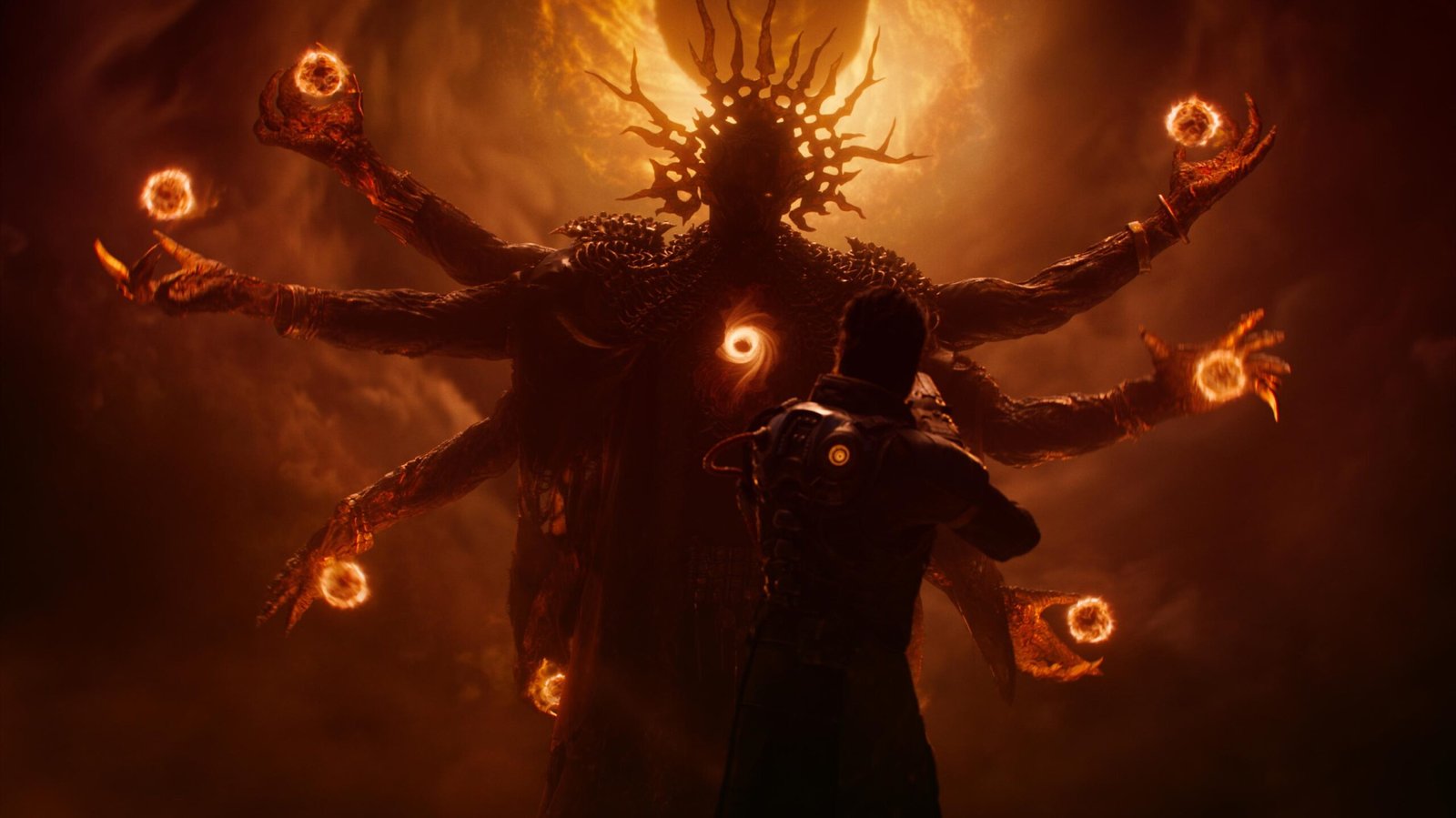
And so we really wanted to world-build more. This now feels like a real place, like a real planet. And so how do we then go about building its own story, its own civilization, and how do we create those visual accents for it? To me, very good world-building is the world-building that you want to spend time in after the game in your head. You’re like, “Ah, I really want to visit Carcosa again.” So we went about understanding how to translate the atmospherical aspect of the previous game, and then in Saros, how do we expand that with the world being so present — the world-building of it, the civilization that we build on it. And then how do we turn that upside down once you have the Eclipse? Sometimes literally.
That’s such a cool challenge. It’s not easy to always, constantly plan for visual escalation on everything, but it brought us into a visual design space that is quite unique. So I was very happy to take that on. But in essence, it’s preserving the atmosphere and then really engaging with the world-building, really translating the narrative themes to everything around you, so that as you go through the story, the world also escalates with you. And that psychological framing is something we really love at Housemarque as well. So we definitely wanted to preserve that and put it into Saros as much as possible.
The Eclipse, specifically, I wanted to ask about. Once you knew that was the larger overarching narrative for the game, how did you sort of decide what the little granular changes were going to be between pre-Eclipse and the Eclipse itself?
Silvestri: I’m actually really happy about the fact that you played Forgotten Depths [a sweltering, factory-esque underground cavern], because now I can talk about it, because that was my first piece of art direction. When I arrived, I was like, “Guys, we’re gonna make an underground cave. How do we make this interesting machinery, extreme stuff?” And then for the Eclipse, to me, the point was always, “Let’s bring the place alive.” You feel like you’re walking on the bones of this previous civilization, and then it snaps, and now it’s alive. Now it’s moving. Now there’s fire. And of course, flipping the colour palette is always cool and interesting, but I always wanted that to also have an effect on the player experience.
So of course, we have our enhanced gameplay in the Eclipse; corruption becomes a part of the gameplay loop, which is quite fun to play around first and then actually engage with it after when you learn it. But for each level, we planned some changes into the player experience, and the first two you’ve seen are a good example of it, but it’s throughout the game. We always were like, “How do we one-up the biome when you put it in Eclipse?” And it’s a really cool collaboration with level design as well. You arrive and you tell them your ideas, and they’re like, “Man, that’s, that’s difficult to do.” I’m like, “No, no, we gotta try. We’re gonna try.” And then, through execution and iterations, you get to the point that we have now in the build. It’s just being able to change the world, and then changing the rules of the way that you traverse the space that’s impacting the player experience now. So it’s no longer just a visual change. You actually feel like you need to move differently and you need to do different things. So I’m pretty happy of how it came together in the end.
I saw in one of the previous blog posts that was put out that you mentioned that you were very inspired by neoclassicism and Italian futurism. What is it about those that spoke to you and what feeling did you hope that the player would take away with that?
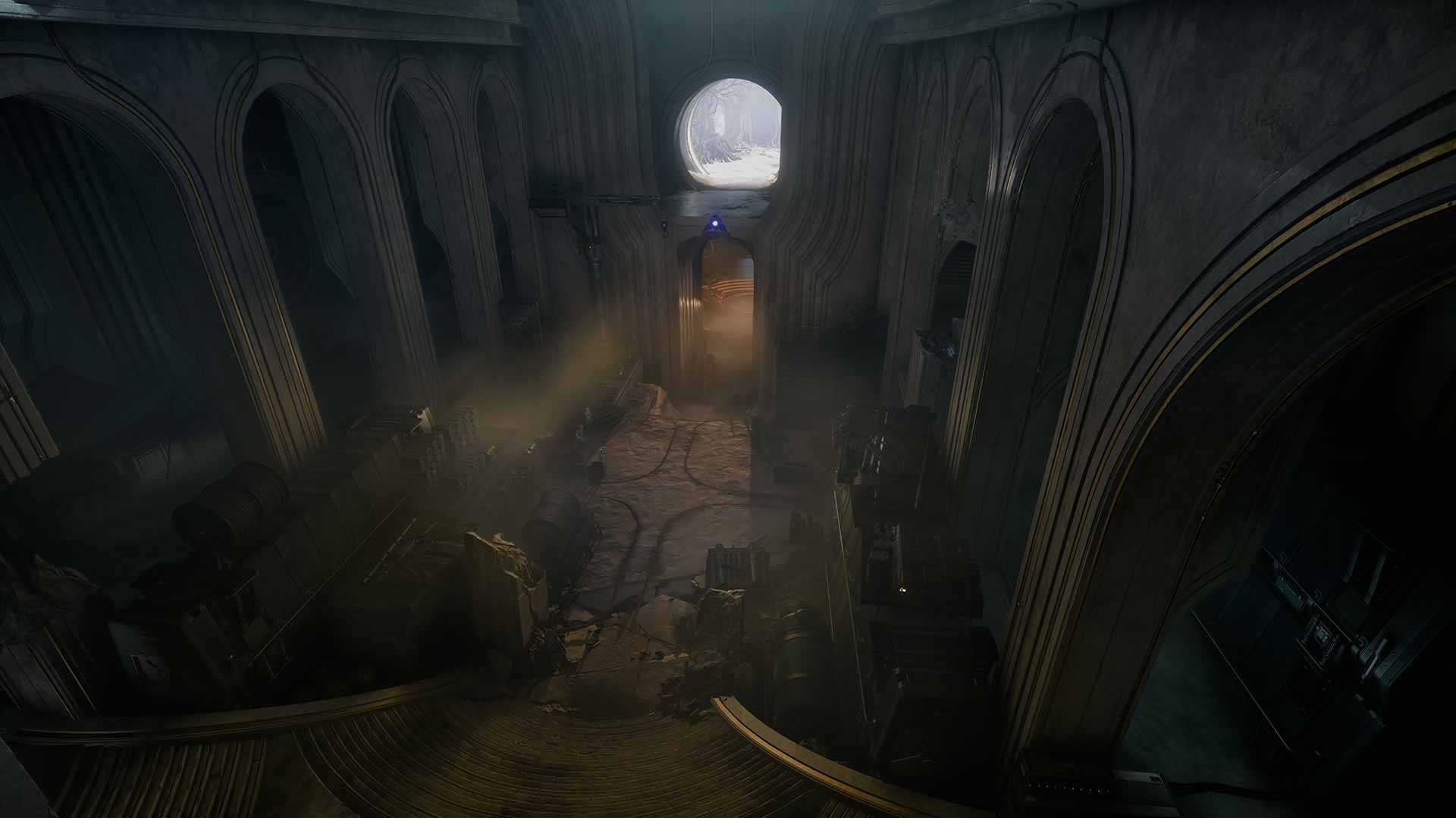
Silvestri: I’m from Rome, so for me, neoclassicism, I’m a national border Classicist. [laughs] So everything in that sphere is a very easy reference to draw upon. But if you just get that, it’s going to be a bit boring, and you’ve seen it before. Any city that has this classical history, you will be familiar. And for me, we wanted to describe this alien civilization, and I really wanted to have epic scale, which is not easy to do in an assembled world with smaller rooms. And I really wanted this world to feel like, “Oh, this is gigantic! This is a place made for gods and monsters, and Arjun is this stranger in a strange land. And then make it alien, and then make it tortured.”
So it is about worship, which means that neoclassical is the right example of it, because the roots are in classicism, which is all about the Greek mythology. But neoclassical has a very soft form. It has very big domes in it, and that wasn’t the right fit, because we had this pillar of “violent beauty.” And the moment that you make rounded shapes, they become too friendly to the player. I love contrasts. I love clashes. And Italian futurism at the beginning of the 1900s was developed to actually rebel against neoclassical; they are complete opposite movements. You have the neoclassical, which is all about permanence and structure. Futurism is all about impermanence and dynamism. And I was like, “What if we combine these two things? How does this change the style, especially if we remove the domes and we add these very dynamic lines and this constant aggressive rhythm of shapes and sharpness to it?”
And turns out that it works. [laughs] It took a long time to let it mature through the game. And I worked a lot with our artists, and without them, it wouldn’t have panned out. It was awesome to have that discovery together of how we make these two things clash. But I would say neoclassical is there for all the mystical part of it — all the really big, epic scale, and then the Italian futurism is there for the violence, there for the rhythm. And also one really important aspect of neoclassical is that it’s full of arches. And arches are very inviting for the player. You kind of want to race in there. So I’m sort of treating the character as this Formula One car, because you’re going so fast through the game. So if I keep putting arches, it just immediately gives you this instinct of forward momentum. And that was the right fit. And then on top, we just needed something sharp and a bit more violent to describe this civilization. So that’s how it came to be.
You mentioned in the [introductory media] presentation before how you always had Rahul Kohli in mind when you were envisioning the character. And I think that’s really fascinating and noteworthy, because there’s not a lot of South Asian characters in video games, especially in the lead role in these sorts of big games. How did you ultimately decide that’s the character design you wanted to go for, and once you had officially cast him, how did that process work of further developing the character with Rahul?
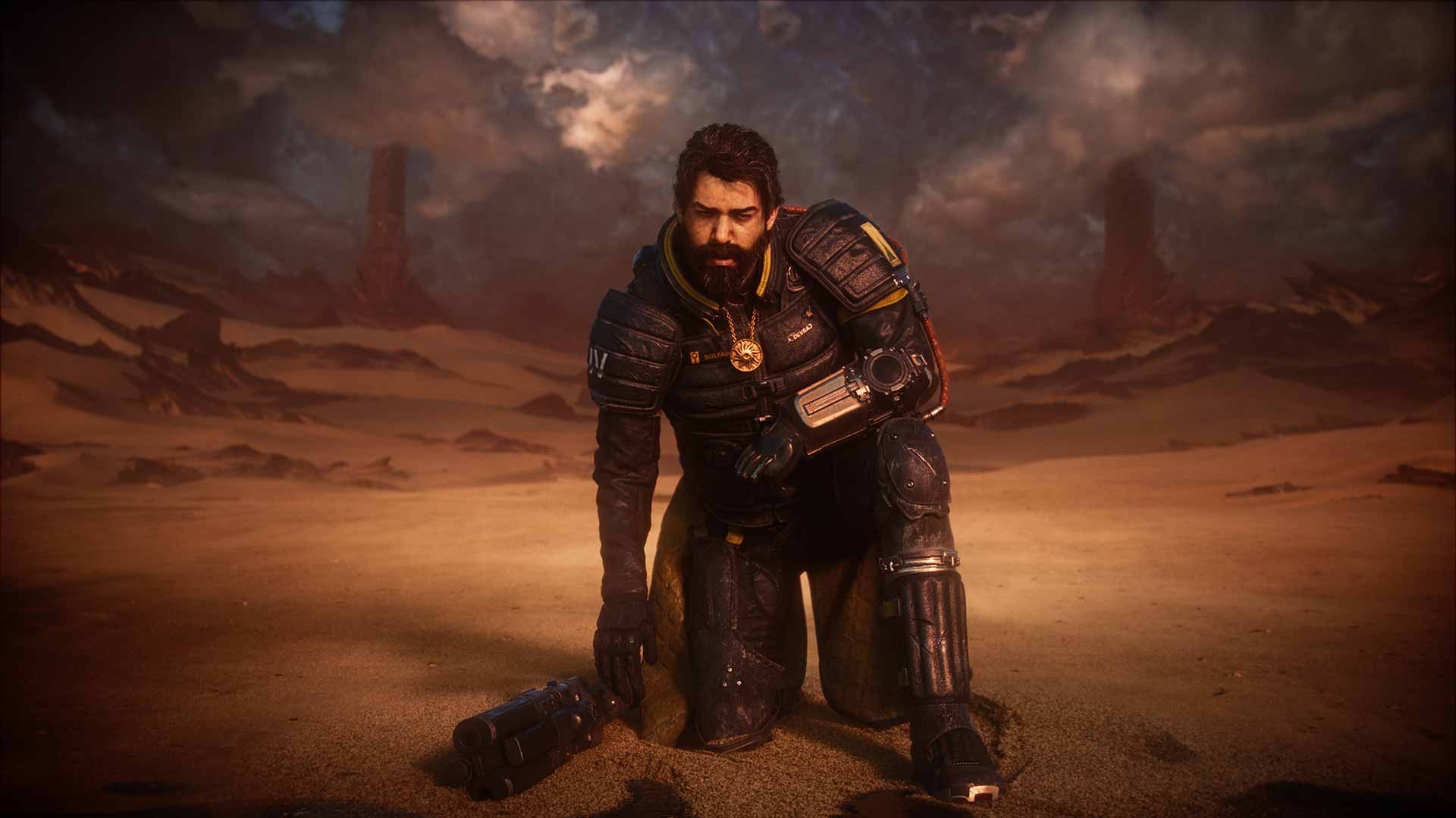
Silvestri: So Arjun has always been this flawed character to us. We really wanted to treat this story in a very serious and mature way. And we’re talking about someone who’s flawed, hunted by his inner demons, and is on this journey of transformation through the game. And this was before my time here, but when we looked at the possible actors and references for all of these characters that we wanted, when we saw Midnight Mass, especially with Rahul, he just jumped out as the right face for this character. It was an immediate, “Yeah, he can give this justice. He can elevate this.” And then we tried it on a concept, and it just fit like a glove. And of course, then we went about casting him. And I think he also said in one of his interviews that when we did the call, “Before you even say anything, it’s yes!” [laughs]
So it’s the perfect fit, not just because of who he is as an actor, but also for his taste in games. He loves our games, and it was just like a perfect match. Then, when we had the official casting, I think we started developing the CGI before, and so working on the CGI, that influenced the design a little bit more because he can have quite the presence. So we changed some parts of the front of the costume, and we still wanted that suit to be, “You are one of many. You’re not necessarily a superhero that is unique. You’re not the chosen one. What makes you unique is the attitude, the journey that you go through, the things that happen to Arjun and the things that Arjun actually makes happen himself.”
And Rahul has brought a different dimension to it that when we got the first [voice overs], it was so intense. And when I was listening to it, and I was looking at the CGI, I was like, “Wow, yeah, we can do a lot with this character.” We need to refine Soltari to match the tone. If anything, it wasn’t just elevating the character. It was like, “Oh, this needs to fit within this world that we’re creating.” Because there was so much passion from him that we really wanted to match with the rest of the stuff that we were doing.
I’m always fascinated by how different departments work with one another. So I’m curious, when you talk bullet ballet… Something that I don’t normally pay that much attention to is when an enemy is attacking me, but in this game, you not only have to pay attention because it’s dangerous, but there’s a beauty to it with the colour schemes and the patterning of all the bullets. When you’re designing these enemies, how does that whole process work? Like, “this enemy is going to have these coloured bullets that come out in this pattern” — does that start at concept art? How does that whole process go about to design those?
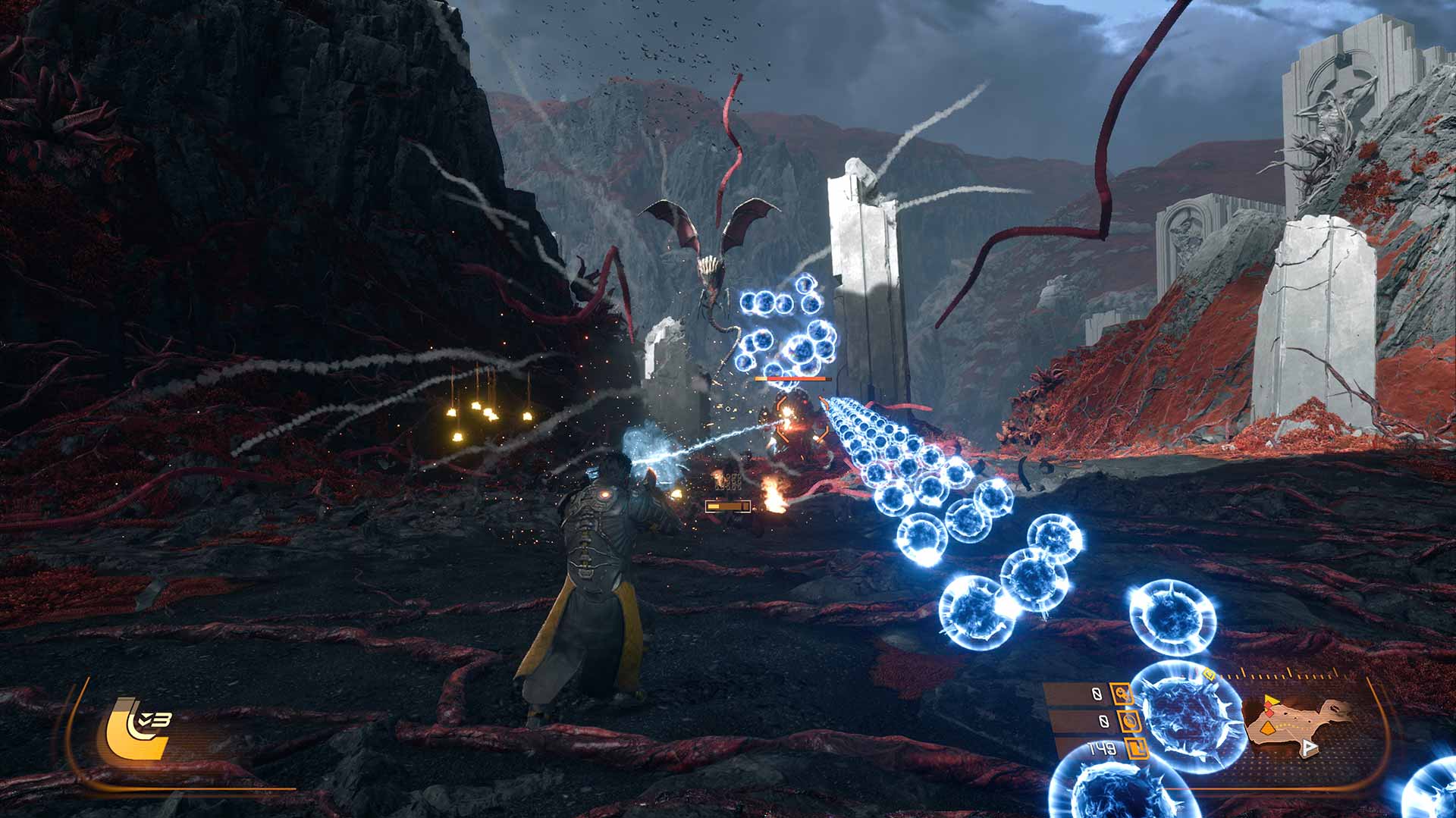
Silvestri: That’s actually a really cool question because it’s very unique to Housemarque. [laughs] The process is sometimes like collaborative chaos, and the designers are cooking, and then you go and you play the game, and you’re like, “Ah, this feels amazing, but that pattern, I wish it could be more like this, I wish it could be like that.” And it starts from this type of conversation. I then did a presentation on bullets, because we wanted to contextualize them in the world a little bit more and make them more reactive. I don’t know if you’ve noticed, but the bullets actually become more active as they get close to you, and that’s a system that we designed where they are much more simple when they are far away, because that way you can perceive them faster. You can read the pattern. Your split-second instincts are intact. But when they get close, we can add more detail, because now it’s close enough that it does not inform your decision-making space anymore.
And so the collaboration with gameplay is absolute. We are gameplay first. And to me, that’s really exciting, because I love gameplay. So, as an art director, I get to collaborate so deeply with gameplay. And with this presentation, I put in a lot of references of hypnotic patterns. And we started working with the game designers, and they did 90 per cent of the job. I just got to go there at the end and say, “Can you move this? Can you move that?” So my contribution was not as meaningful. But then, you start engaging with an enemy designer, you start sending messages with patterns. You’re like, “Oh yeah, this is cool, what if we make it rotate this way?” And it’s always about preserving the gameplay, and the visuals should never infer on the gameplay experience. So that’s always the contract. I can come in and comment, but it needs to work for gameplay first. But definitely, the collaboration there gave us some additional spectacle. And again, it’s maybe the only company I can think of where this would be such an in-depth collaboration between art and gameplay, and it’s very precious to me.
In terms of the biomes, I know you can’t talk about all of them, but you mentioned, for instance, the Forgotten Depths was the first one you had the concept for, and then you worked off of from there, “Let’s make a whole biome off of that.” So with Saros, what were some of the overarching goals you wanted to hit with in terms of designing these biomes?
Silvestri: So we are describing a journey through a place and through a narrative, and there is a psychological journey in there, because we have this very mature story attached to it. And to me, the idea with the biomes has always been, “Where do we start from, and where do we want to end up, and how do we constantly keep you engaged? Where do we add enough mystery, but also add enough spectacle so that you know you want to keep discovering.” Because this game can be hard at times. You have other systems to support that friction, but you need to punch through it sometimes, and I really want to have that visual bait waiting for you. Every time you succeed, you get to see a new thing. So we really wanted to add a lot of variance in the language of it, and then it’s more about how you scale that to a full production. You need to make smart choices in the way that you use assets and in the way that you progress that visual storyline.
But the main thinking behind it has always been, “How do we escalate? And how do we escalate in a way that then you can escalate again once the Eclipse is there?” It’s a really awesome challenge, because you can’t go to 100 right away, because you need room to go deeper. When you start in the Shattered Bridge, it’s quite grounded, quite simple, and then you go to the Forgotten Depths, and now you have already an escalation. What happens after that? Where am I going towards the end of the game? That’s what I want you to be focused on as you push through the adventure. I really want to inspire the curiosity.
And there are at least two times that I love in the future of the game that you didn’t get to play today, where it’s a complete 180, and it’s a complete surprise of how this looks totally different. So I can’t wait for you to play that and tell me if we achieved it. [laughs] But it’s always been about having fun with the theme, having fun with the narrative, and then keep escalating, keep surprising, keep finding new ways of expressing this twisted enlightenment, this journey through Carcosa. And also, [we] try to keep it cohesive and give it its own soul and its own unique flavour, so that it stands out as its own planet in the history of video games.
This interview has been edited for language, clarity and length.
Saros will launch exclusively on PS5 on April 30.
Image credit: PlayStation
