
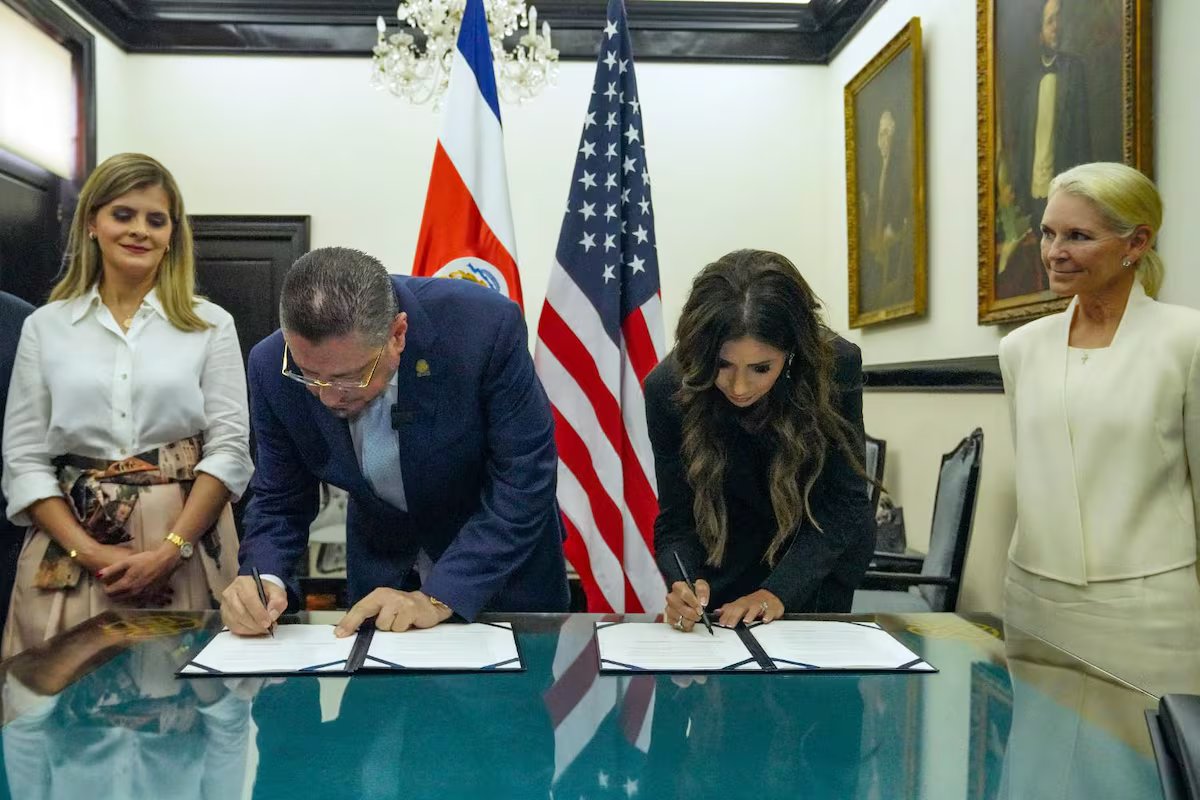
The government of Rodrigo Chaves seems determined to eliminate any doubt about its intention to finish its term by placing Costa Rica as close as possible to U.S. President Donald Trump. The numerous friendly gestures and signs of goodwill from the Central American nation’s leader over the past year now have an additional element: the acceptance of Costa Rica’s offer to receive groups of migrants from third countries whom the United States deports as part of its ongoing anti-immigrant policies.
Although 72 hours have passed since Chaves enthusiastically signed the new agreement, and neither the document nor details of its implementation are yet public, Costa Rican authorities consider it a binding commitment, adding to the nearly 200 migrants sent against their will in 2025. The opposition and critical sectors of society point to it as yet another step in the current government’s history of flattering concessions to the Trump administration, in line with the “one good turn deserves another” principle uttered by the president when he announced the opening of Costa Rica’s borders to deportees from the United States amid speculation about new trade tariffs.
Chaves, who is due to hand over power in May to his successor Laura Fernández, is proof that the term “favorite partner” encompasses every possible area. Now it’s the realm of immigration, but just a week ago, in front of the U.S. ambassador, Melinda Hildebrand, he announced the closure of the Costa Rican embassy in Cuba, only days after participating in Miami in the founding summit of “Shield of the Americas,” the new alliance led by Trump with the aim of combating continental drug trafficking.
But the rapprochement extends further back. The Chaves government has launched explicit messages against Beijing that have provoked numerous reactions from the Chinese embassy in San José; first by excluding Chinese companies from the local development of 5G technology, as Washington has requested, and then by announcing an alleged cyberattack on the state electricity and telecommunications agency by an agent of presumed Chinese origin. “We are reducing that country’s interference,” Chaves said in an interview hours before his trip to the summit with Trump.
Prepared for US intervention
Costa Rica’s rapprochement with Israel, Nayib Bukele’s El Salvador, and other international allies of the White House is also noted, as is its openness to discussing potential U.S. military action against drug trafficking on Costa Rican soil, similar to what has occurred in Ecuador. While rejecting the idea of including it in the “Shield of the Americas” plan, Chaves did not express opposition either, stating that a possible U.S. incursion would be feasible if the Legislative Assembly approves it by a sufficient majority — a possibility that seems likely given that the ruling party will hold 31 of the 57 seats starting in May. Furthermore, an advisor appointed by Laura Fernández mentioned on television the proposal to establish U.S. military bases in Costa Rica, which lacks an army of its own and whose Constitution establishes the principles of disarmament and neutrality.
It was Kristi Noem, the U.S. government’s envoy for the “Shield of the Americas” initiative, who signed the agreement with Chaves, sparking immediate criticism from the opposition, which had previously accused him of subservience. “Lapdog,” a left-wing congresswoman called the president. On Monday Chaves announced the new protocol “so that Costa Rica once again acts as an ally of the United States on issues that matter in the hemisphere,” standing next to Noem, while still referring to her as Secretary of Homeland Security, the position from which she was removed by Trump this month after numerous questions in the Senate.
Chaves felt compelled to clarify that the new agreement allows Costa Rica to decide whom to accept and whom to reject, at a rate of up to 25 people per week, according to an official press release. “It is about collaborating within the framework of human rights,” Chaves said, aware of the criticism he received in 2025 regarding the conditions in which dozens of people deported on two special flights from the United States, including children, were held in a shelter.
Human rights organizations view the new agreement with skepticism. “It has been demonstrated that there are no conditions in place to guarantee the rights of these people,” states a joint declaration from 40 organizations, noting that those deported in 2025, primarily from Russia, Armenia, Yemen, Afghanistan, and Uzbekistan, were deprived of their liberty for months, temporarily lost access to their documents, and lacked sufficient information and medical assistance. “There are indications that a significant number of them were returned to their countries of origin, where their lives and safety are at risk,” the document, distributed this Thursday, states, after Fernández asserted that both countries benefit from the agreement, without explaining what Costa Rica receives in return.
Sign up for our weekly newsletter to get more English-language news coverage from EL PAÍS USA Edition
