
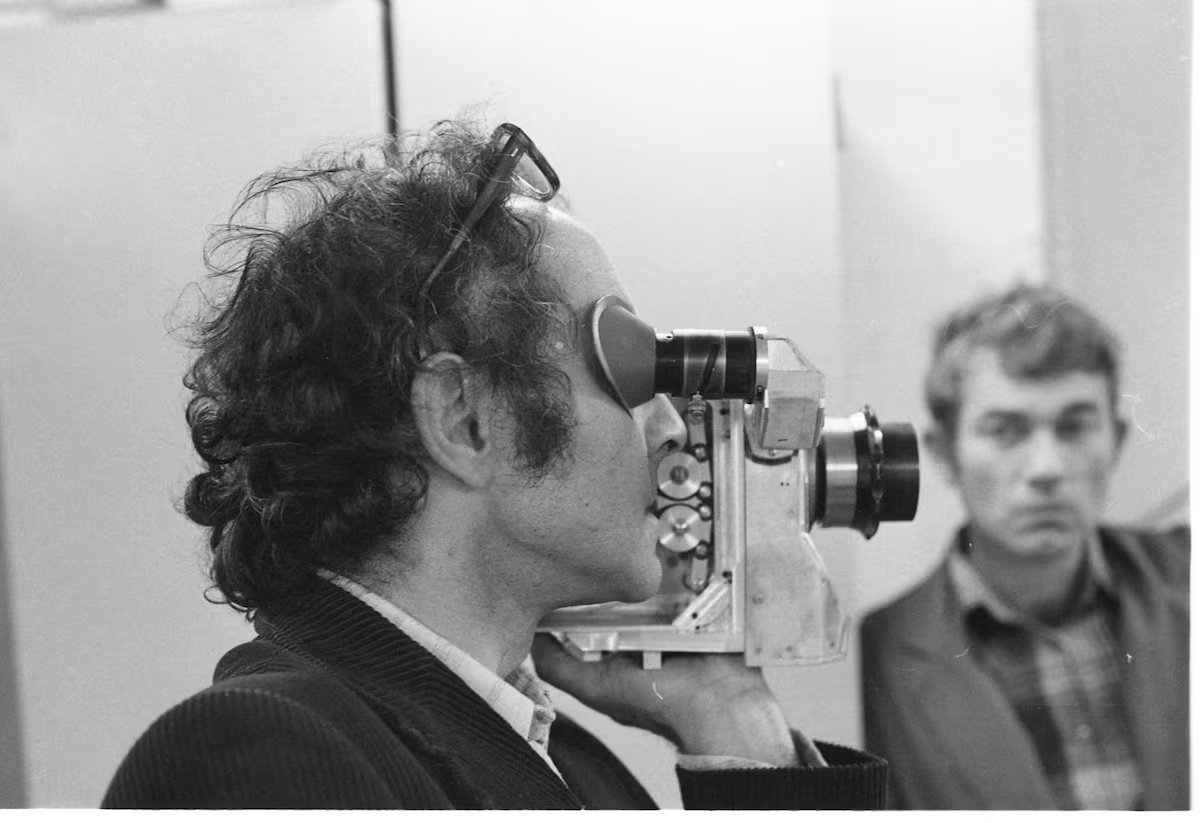
War runs through the work of Jean-Luc Godard (1930-2022) like an ungovernable and traumatic force driving through the artistic trenches of the 20th century. Sometimes, it is as an iconographic theme or motif. On other occasions, it is as something semantic, conceptual and emotional that forms the backbone of the relationship that the French-Swiss filmmaker maintained with images and the history of cinema.
It is an influence that can be felt from the beginning to the end of his career: from his first short film, Opération Béton (1954-55), to his last work from beyond the grave, Trailer of a Film That Will Never Exist: “Phony Wars” (2023). “A film is a theoretical rifle and a rifle a practical film,” Godard declared in an interview in the seventies, paraphrasing a dialogue from La Chinoise (1967), before adding: “Fortunately I don’t have any gun for I am so short-sighted that I would probably kill all my friends. I have the impression I’m less myopic in a film.”
From the Spanish Civil War — an obsession for Godard’s generation — to the Second World War, Indochina, Algeria, Vietnam, Bosnia and Palestine, the heat of battle is evident in the more than 200 works, including feature films, short films, advertising, television, film-collage, that reflect the ideas of one of the most influential filmmakers of the 20thcentury. The Fraternity of Metaphors is the title of the exhibition spread across 15 rooms of La Virreina in Barcelona from March 27: 300 exhibits that are the backbone of a fascinating and exhaustive investigation into how war brought about a revolution in cinema.
Manuel Asín, curator of the exhibition that was put together with the collaboration of the fledgling Jean-Luc Godard Foundation, says that he has taken the title of the exhibition from a quote from Godard’s History(s) of Cinema (1987-1998), in which the director writes about the moment in which Henri Langlois, a major influence on French cinema, screened Sierra de Teruel, the only film by the influential French intellectual André Malraux, who shot it during the Spanish Civil War. “Godard says that it was not only what happened in Spain that shook them, but ‘the fraternity of metaphors’, which is a phrase that he takes from the review that Bazin wrote about Sierra de Teruel and that, for him, explains how Malraux’s images connect with the two colonial wars that France was fighting at that time – Indochina and Algeria,” Asín explains.
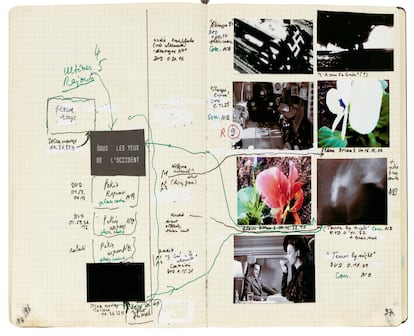
The exhibition reflects Godard’s predilection for visual collage through associated images supported by all kinds of documents, from unpublished scripts to sound recordings, books, magazines, posters, photographs, paintings and drawings. The exhibition takes us from the preparation for Film socialisme (2010), which offers a nod to Barcelona, to a voice recording of the filmmaker himself telling a story related to the Spanish Republic’s “Moscow Gold” bank reserves. Also noteworthy is the discovery of an audio of Roberto Rossellini telling the antimilitarist fable of another of Godard’s first films, The Carabinieri (1963).
The exhibition focuses on more unknown figures, such as Adrien Porchet, a war documentary filmmaker and member of the Durruti column (an anarchist militia column that fought on the side of the Spanish Republic during the Civil War). Porchet was director of photography of Godard’s first short film, Opération Béton – a title which already carries military overtones. Among the exhibits on display are photographs of Godard’s conflictive adolescence and his maternal family, as well as a copy of Albert Camus’ The Myth of Sisyphus that had a major influence on the 15-year-old Godard and contains quotes from Malraux, Paul Éluard and another that he attributes to Hitler: “The war, it is me.”
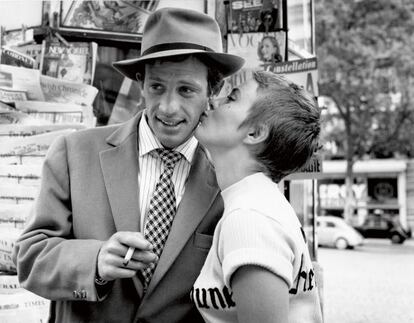
On the wall of The Little Soldier (1963), with the tortures of Algiers in the background, the Führer appears again in an image from the film. Also featuring is the figure of the war photographer Raoul Coutard, Godard’s head camera operator since At the End of the Getaway (1960). As Coutard himself would later recount, it was Godard who asked him to film the famous love story of his debut film as if it were a “war report.”
Halfway through the exhibition, Léo Ferré’s voice joins Godard’s journalistic activity: the battles of May ‘68 and other protest movements that culminate in the era of the Dziga Vertov collective. The figure of Anne-Marie Miéville, his companion for half a century, comes into focus. “People who don’t love the same films can’t be together,” Godard once said. But then she became his main collaborator. Together they embarked on dozens of adventures, from Sarajevo to Mozambique and Palestine, which came to be “the great metaphor” in Godard’s view. During that period, his projects incorporated a new camera, the Aäton 8-35, which aimed to combine 35-millimeter film with the lightness of a Super-8, and which is on show in the exhibition.
A critic of the army and military service in France and Switzerland, Godard’s reflections on cinema and war seem timeless. “The great national cinemas, with the exception of Germany, have always had great war films and in particular civil war films,” Godard said in reference to The Birth of a Nation (1915) in the United States, Battleship Potemkin (1925) in Russia, and Rome, Open City (1945) in Italy.
“For Godard, the image is social, scientific and political research,” says Asín. “He always maintained that the greatest cinema was that of the silent era and that in some way sound ‘occupied’ or ‘invaded.’ He said it using this military terminology, the imaginative power of words, which for him added discourse and ideology. In that sense, television was the peak of that occupation.”
In an era flooded with image, “Godard’s deluge in the face of those who ask for restraint is revolutionary,” adds Valentín Roma. “The exhibitions on the moving image that we have done over the years, from Chantal Akerman to Marguerite Duras, quoted Godard. So it was almost obligatory to have one on him.”
Perhaps for this reason, Godard’s Historie(s) of Cinema occupy the final rooms of the exhibition space. They are, as Asín says, his “great meditation on the history of the 20th century and the historiographical capacity of film.” With their repeated references to the Holocaust and World War II, they represent the distilled thought of a creator who defended cinema as the greatest contemporary artistic expression and at the same time warned of the oblivion that threatens the masters of the past. Just as everyone remembers that Mozart has existed, Godard wrote, no one should forget that “Murnau also existed.”
Sign up for our weekly newsletter to get more English-language news coverage from EL PAÍS USA Edition
