
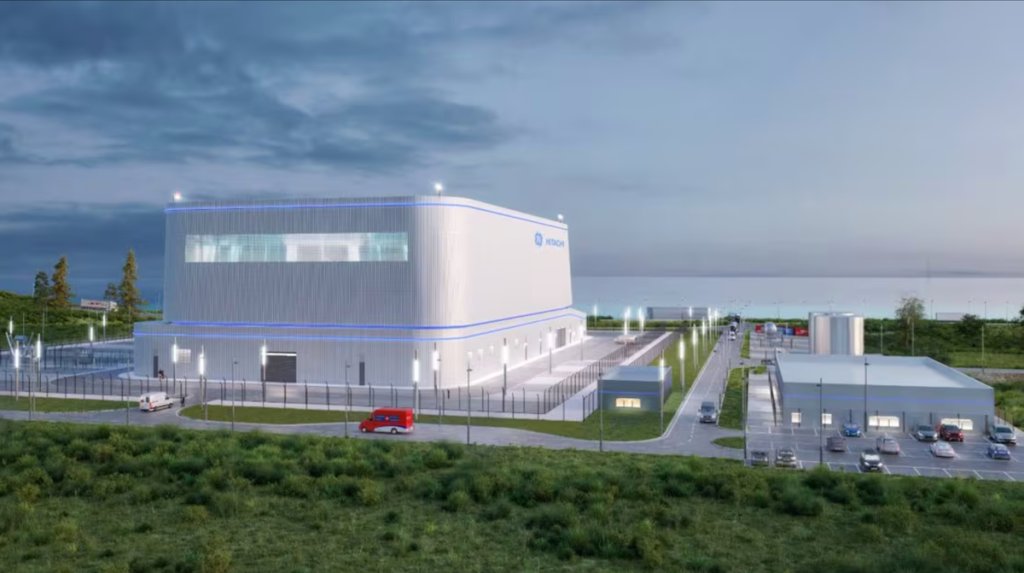
Despite getting a much-ballyhooed $7-million in start-up costs from the Alberta Government in 2023, a year later Cenovus Energy Inc. pulled the plug on its study of the potential for so-called small modular reactors to generate power to wring oil from Alberta’s oilsands.

To the company’s credit, it only spent $555,000 of the public’s money on the project before losing interest.
The termination of the study was done so quietly, no one seems to have noticed. At least, there appear to have been no news reports about the project’s cancellation.
As recently as last year, though, new references could still be found to the tale told in the Sept. 19, 2023, press release published by Emissions Reduction Alberta (ERA), the Alberta Government office set up in 2009 to fund “Alberta-based technologies that lower emissions and costs for industries.”
That press release enthusiastically announced that the province would provide $7 million through ERA “for Cenovus Energy to conduct a preliminary, multi-year study on whether small modular nuclear reactors (SMR) can be safely, technically, and economically deployed in Alberta’s oil sands operations. Funding will be provided through the Technology Innovation and Emissions Reduction (TIER) fund.”
The release quoted then Environment Minister Rebecca Schulz, who announced the funding at the at the World Petroleum Congress in Calgary, rhapsodizing, “a few years ago, the idea of expanding nuclear energy use was on the back burner – that is no longer the case.

“In Alberta, small modular nuclear reactors have the potential to supply heat and power to the oil sands, simultaneously reducing emissions and supporting Alberta’s energy future,” Ms. Schulz’s canned quote continued. “This funding is the foundation for that promising future. I want to thank Cenovus Energy and Emissions Reduction Alberta for their leadership in this work.”
“We are optimistic about the opportunities ahead and will continue working with industry to explore and enable small modular reactor development in this province,” said Energy Minister Brian Jean, playing second fiddle as he so often did when Ms. Schulz was involved, in the same release.
A CBC News report at the time quoted Ms. Schulz saying, “this is just another example of how industry dollars are being reinvested back into industry to support innovation in emissions reduction.” The CBC story also noted that that the study was “actually a four-year series of studies being lumped into one” with a total estimated cost of $26.7 million.
It would appear, however, that Cenovus quickly reconsidered that kind of spending on that particular topic. Presumably sometime in early 2025, ERA updated a statement on its website revealing that Cenovus had ended the SMR FEED Study ahead of schedule. (FEED stands for “Front End Engineering Design.”)
The undated statement, presumably unchanged from whenever it was first published, devotes 665 words to describing the project and its potential benefits. A line at the top summarizing the project’s status lists it without further comment as “terminated” and indicates that only $555,000 of the promised $7 million from the province was spent.

That page in turn provides a link to Cenovus’s SMR FEED Study Final Outcomes Report, which was published on New Year’s Eve 2024.
A report last week assessing the success of Canada’s 2018 strategic plan to develop SMRs across the country published by researchers Susan O’Donnell and M.V. Ramana for the CEDAR Project (Contesting Energy Discourses through Action Research) cited the Cenovus Final Outcomes Report.
Cenovus’s assessment of the potential for SMRs in Alberta’s oilsands was not enthusiastic.
“Cenovus decided in 2024 (during the execution of phase 1 work) not to continue with the Program beyond the end of 2024,” the company’s report says under the heading Lessons Learned.
“The phase 1 evaluation of nuclear from a business perspective showed SMRs are not economic or commercially feasible at present or in the near future,” the section continued. “The capital costs are high, the timelines are long and uncertain, and technology and supply chains lack maturity. While there is a potential application for industrial heat needs, significant progress in these areas is required, which may not happen for several years.”
Under the heading economic evaluation, the report reaches the conclusion that while it may be technically possible to use SMRs to provide steam for the Steam-Assisted Gravity Drainage oilsands recovery technique, “they are not viable under current market conditions.”

Quite possibly cutting to the fundamental basis of the company’s decision, that section continues: “While existing government support programs are beneficial, they do not provide sufficient financial and risk management support to appropriately improve SMR feasibility.”
In other words, if the government isn’t going to pay for it, we can forget about it.
As for SMRs, despite the relentless effort by Alberta’s United Conservative Party Government to generate enthusiasm for their potential in the Athabasca oilsands, they’re not ready for prime time and quite possibly never will be.
Remember, as has been said here before, SMRs may be nuclear reactors, but they’re not small and they’re not really modular. They are multi-billion-dollar megaprojects, just not mega enough to justify their cost. The initials could stand for “Spending Money Recklessly,” Dr. O’Donnell and Dr. Ramana wrote last Monday.
Like other carbon reduction schemes pushed by the UCP Government, such as its failed hydrogen-powered truck fantasy and high-risk carbon capture and underground storage schemes that are now stirring up opposition in northern Alberta, they serve mainly as a way to to greenwash high-carbon oilsands activities.
