
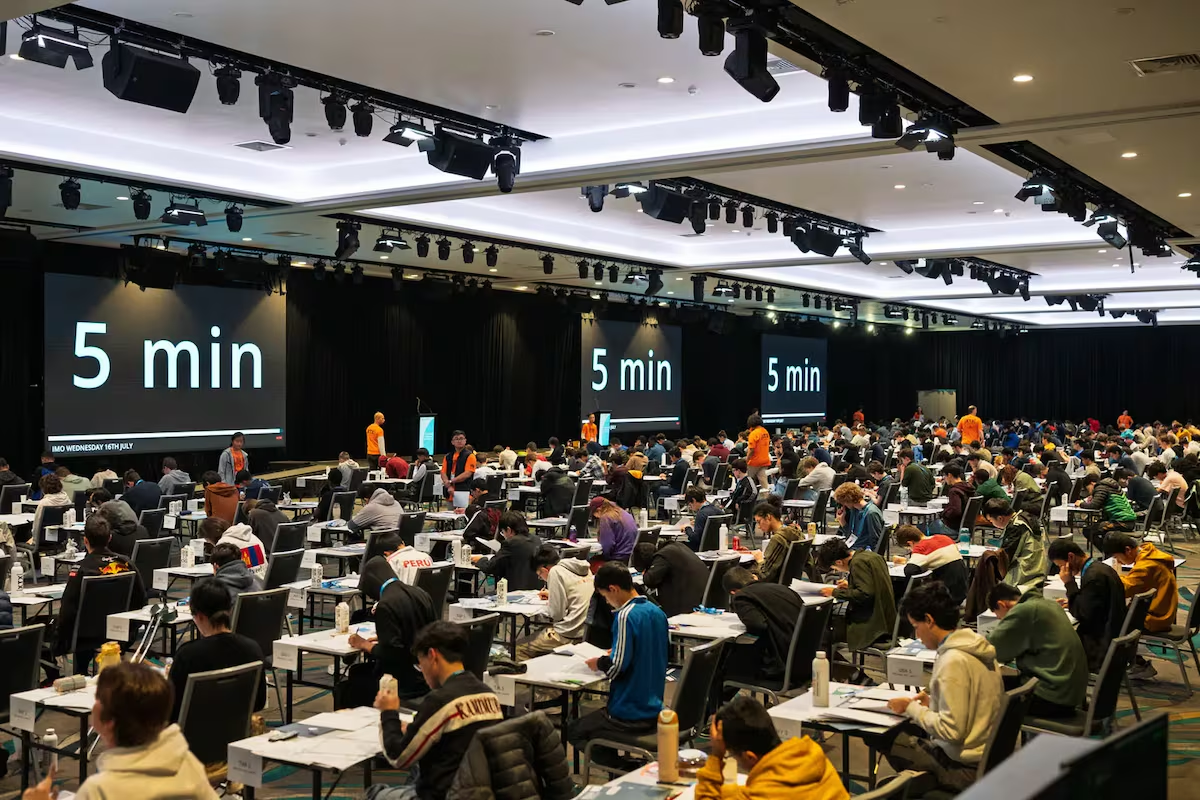
The news spread around the world in minutes. Artificial intelligence (AI) had won a medal for the first time at the prestigious International Mathematical Olympiad (IMO), a competition in which the world’s 600 brightest young mathematicians tackle six problems secretly designed over the course of a year, which they must solve using only pencil, paper, and their brains. It’s much more than a competition. It’s the breeding ground for the mathematical minds that will later solve impossible problems and lead the tech companies that rule the world. The news of the AI’s medal win was published by thousands of media outlets and chosen as one of the year’s biggest scientific breakthroughs by the journal Science. And this is where the story starts to get complicated. Because the news is a lie.
Over the past four months, EL PAÍS has spoken with a dozen people about what happened on the Sunshine Coast in Australia between July 10 and 20, 2025. The accounts vary and contradict each other, but one thing is clear: those involved would have preferred the headlines to focus on the young people, like Ivan Chasovskikh, the Russian-American genius who competed under a neutral flag and achieved a perfect score while seated at a table for four hours and 30 minutes. But the headlines were stolen by multi-billion-dollar corporations and their machines, which operate using top-secret algorithms, and whose time, energy, and computing power remain unknown, all to “win” medals they didn’t actually earn.
To understand the complexity of this story, and the shockwaves it has caused in the mathematical community, one must first understand why the International Mathematical Olympiad is so important. Held annually since 1959, it attracts six students from around 100 countries (the number varies each year). These pre-university students face six extremely difficult problems spread over two days and have 4.5 hours to solve them, armed only with paper and pencil. These problems cover areas such as algebra, combinatorics, geometry, and number theory, and require not university-level knowledge, but rather creativity, ingenuity, and logic. They are designed and discussed throughout the year by a group of former Olympians and are kept under strict secrecy.
The Olympiad is important because it brings together the most talented young mathematicians on the planet and has become the benchmark for identifying and training future leaders in science and technology. Among the most famous winners is Terence Tao, who won a gold medal at age 13 (one of the youngest ever to achieve this) and later a Fields Medal, the “Nobel Prize” of mathematics. Another medalist was the most enigmatic figure in mathematics, Grigori Perelman, known for proving the Poincaré Conjecture, forgoing the one million dollars on offer to solve it, and disappearing from public life. And two famous technology entrepreneurs: Sergey Brin, co-founder of Google, and Demis Hassabis, co-founder of Google DeepMind, Google’s AI division, and a Nobel laureate in Chemistry.
The youngsters who compete in the Olympiad train rigorously throughout the year. Diego, Fernando, and Miguel are three of the Spaniards who traveled to Australia in 2025 to compete. They are aged between 17 and 19. They studied between six and eight hours a day, coached by other former Spanish Olympians. A legend, María Gaspar, has led the Spanish team since 1984. She trains, mentors, and cares for her “chicks,” as she calls them, from the moment they are selected until long after their return. Among her students is Elisa Lorenzo, a former Olympian and now coordinator and grader for the Olympiad. A crucial detail in this story: neither Gaspar nor Lorenzo nor any of the adults who participate in this competition are paid for it. They do it out of love for mathematics and to open the doors that were opened for them to other young people.
For the 2025 competition, proofreaders like Lorenzo received 250 problem proposals from participating countries. And that’s where a brutal workload begins, which they must tackle in their free time: studying them, checking if they meet IMO standards, and fixing them if they’re “ugly,” as she puts it. They choose about 30, and then, about 10 days before the kids arrive, the two dozen people working for the organization meet for 10 to 12 hours a day to decide on the six problems. They choose them for their “beauty and difficulty,” the coordinator explains.
The problems are the best-kept secret of the year in mathematics. The jury is isolated during that time. Gaspar recalls: “When I started, I would leave home and say, ‘I’m going to Warsaw, but you won’t hear from me for 10 days.’” The event is sponsored each year by various companies and, sometimes, by governments. It costs around €3 million to cover airfare and accommodation costs for organizers and children.
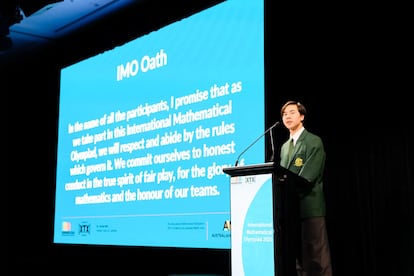
At the opening ceremony, the 600 young participants took an oath pledging to be honest and respect the rules of the game. What they didn’t know then was that some multinational corporations weren’t going to respect the same rules.
AI companies have been participating in the IMO in some way for several years. Their interest is clear: they want to train their models on the problems, meet the students, and raise their profile. In fact, these companies and the world’s most prestigious universities, which are also present, compete fiercely to recruit the students. Many of them, especially those from the most disadvantaged countries, see their futures at stake at the IMO. But this year, the multinationals didn’t just want to recruit talent. They wanted to win medals.
Gregor Dolinar, president of the IMO board, explains that the organization invited representatives from interested companies to Australia. These included Google, OpenAI, Harmonic, Huawei, Numina, and ByteDance, the Chinese company behind TikTok. “We organized a roundtable discussion and some talks; it’s a topic of enormous interest to students,” he says.
The students took their tests on July 15 and 16. And that’s when a grueling race against time began, according to Lorenzo, for the evaluators to decide who would win the medals. It wasn’t easy; many problems could be solved in different ways, and the jury rewarded “elegance and simplicity,” a point many team leaders later disputed. But on July 17, Dolinar sent them an email. He explained that AI companies had also completed the exercises and were asking them to evaluate their projects as well.
The proofreaders, Lorenzo recounts, were surprised. “We were sleep-deprived, under a lot of pressure, and with a ton of work, and we do it without pay, for the kids. But that email was asking us to work for free for those corporations.”
The examiners decided to refuse and wrote to the president. They said they were concerned that the AI “might distract from the importance of the IMO for students” and requested that any results related to it be made public “at least one week after the closing ceremony.” Their second concern was financial: “If this work is going to provide benefits to commercial companies, they should contribute financially to the IMO.” And their third was technical: “We have scientific concerns. The AI models should be treated scientifically, with full transparency and scientific integrity.” However, the examiners didn’t know how the AIs would compete. “What information do the models use? What kinds of algorithms are applied? Applying grading schemes to AI models is problematic when they are designed for tests written by humans, to whom we can attribute intention and understanding,” they said in an email.
“The problem was that the decision to invite representatives from AI companies was made quite late,” Dolinar explains. “It was assumed that evaluating the solutions from six AI companies, in addition to the solutions from 600 students, shouldn’t be a problem — it could be considered grading six more students. I sent an email asking who would be willing to volunteer to grade those solutions if they had free time. I suspect some coordinators, who were already under a lot of pressure, received that email as an added burden.”
The organization did accept the first point. “We asked the representatives of the invited AI companies not to publish the results until a week later. Everyone agreed,” says the president. Actually, almost everyone did. Because OpenAI didn’t respond.
On closing night, as the students nervously received their awards and medals, they, their coordinators, and the examiners were astonished by unexpected news: OpenAI had posted on social media that their model had “achieved a gold medal-level performance.” They didn’t say what they couldn’t say — that they had won a medal — because, first, they hadn’t even participated, and second, their model had never been evaluated by the IMO examiners.
“We achieved gold medal-level performance on the 2025 International Mathematical Olympiad with a general-purpose reasoning LLM! Our model solved world-class math problems — at the level of top human contestants. A major milestone for AI and mathematics,” OpenAI announced on X. The post received thousands of retweets and likes. The media interpreted this as a real medal win over their human competitors, and many outlets headlined their articles accordingly. No one contradicted them.
We achieved gold medal-level performance 🥇on the 2025 International Mathematical Olympiad with a general-purpose reasoning LLM!
Our model solved world-class math problems—at the level of top human contestants. A major milestone for AI and mathematics. https://t.co/u2RlFFavyT
— OpenAI (@OpenAI) July 19, 2025
The news landed like a ton of bricks on the normally lively closing ceremony of the competition. “What bastards, how shameful,” Lorenzo recalls thinking. “They’re writing on X, they’ve put out a press release, they’ve got the media… It was a bombshell.” “It was a bit unfair that they tried to steal the spotlight from us,” agrees Miguel, one of the Spanish students.
Then chaos erupted. Google realized that OpenAI had broken the embargo and tried to get its results validated. Some of the proofreaders denounced the “harassment” they were subjected to by Google. “I was having a drink, and then the team leader of Belarus, I think, came up to me and said, ‘Hey, Google is looking for you.’ And then these three guys were there, wearing their Google DeepMind jackets, and they were saying, ‘Are you responsible for problem five?’ I said yes. They literally opened the laptop and said, ‘This is our solution. Can you fix it?’” recalls Arnaud Maret, a Swiss proofreader. “The guy from Google told me that every hour that passed between OpenAI’s press release and his was an embarrassment to Google.” With a touch of humor, he now reflects: “When will I ever have that much negotiating power again in my life to say no to Google?”
OpenAI has not responded to this newspaper’s inquiries. Google has. “Google DeepMind’s participation in IMO 2025 was planned several months before the event. Technically, it didn’t compete against the students: it didn’t receive a gold medal, but it was intentionally stated [in its note] that we had reached a level equivalent to a gold medal,” says Thang Luong, the senior scientist who led the company’s collaboration with the IMO. Regarding the “harassment” of the graders, he explains: “During the event, the IMO officially confirmed that it would award an official rating to AI companies. All interactions, during and after the event, were directed and facilitated by members of the IMO advisory board, including the president.”
According to Dolinar, however, Google “got an unpleasant surprise when it discovered that OpenAI had acted on its own. They adjusted their plans, but some were not happy with how they handled it.”
Beyond the circus, there were real technical problems. A coordinator who evaluated the AI solution for problem five said that it “could guess the final result, but couldn’t prove any part correctly” and that, had it been submitted by a student, he would have given it zero marks and reported it to the Ethics Committee.
The president of the IMO flatly rejects the criticism from some of the coordinators that AI stole attention from the competitors. Moreover, he believes that the opposite happened: “Thanks to the success of these companies in solving problems, the IMO appeared in major media outlets around the world. Many more people became aware of its existence. From a visibility standpoint, it was very positive.” Furthermore, Dolinar points out that Google, for example, has already donated $1 million to the Olympiad and helped organize the first competition in Africa. Gaspar disagrees: “They [the AIs] can say whatever they want. But they aren’t competing on a level playing field.”
While the young mathematicians only needed paper and pencil, some sources estimate that the computational cost of similar AI tests could exceed $1 million in energy requirements. And months after all that happened, the story took an unexpected turn: the Chinese giant DeepSeek claimed the same “gold” on its own, without coordinating with anyone. Headlines declared that DeepSeek “swept” the Olympiad, and the prestigious journal Nature proclaimed that it had performed “as well as humans,” in a competition it didn’t even enter, and in which AI never actually competed against any human.
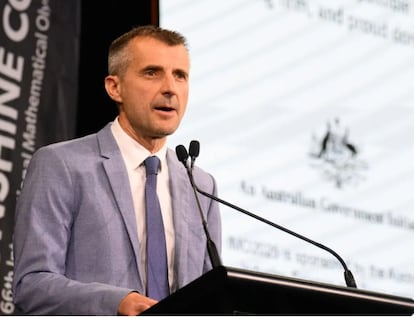
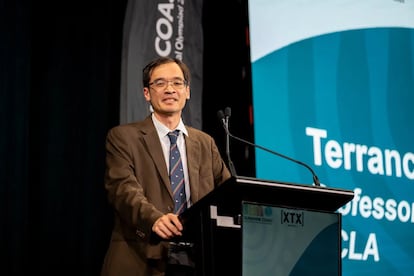
The precedent has been set: there’s no need to even knock on the door anymore. IMO 2026 is being held in Shanghai. And much of the attention will once again be focused on AI. Dolinar and Google acknowledge being “in talks” to determine the role of these companies in the competition and discuss their potential funding. Some experts believe that AI should participate in its own competition, with its own rules. One of them is Terence Tao, who was also present in Australia and is arguably the most influential mathematician in the world. “Although many AI companies do excellent work, one of my main criticisms of the sector is that they are often very secretive about their research and tend to publish only their positive results, without disclosing the negative ones, which goes against the principles of science,” Tao explained to EL PAÍS.
According to his argument, the Olympiad format is carefully designed for human students without access to notes or any kind of support, “who can only rely on their memory.” It’s not a fair comparison: “The AI agent may actually be made up of multiple sub-agents communicating with each other, and would have access to a far greater amount of information than any human.” Tao explains that, just as there are separate competitions for Olympic sprinters and race car drivers, “we will eventually adopt a different format for AI competitions.” He sits on the advisory board of AIMO, “perhaps the most promising experiment in that direction,” he says.
All the protagonists in this complicated story feel a touch of sadness and melancholy. Sadness because what has come to light from the IMO are the squabbles between AI companies, when what is truly amazing is the work of thousands of volunteer mathematicians to help hundreds of kids from hundreds of countries shine, youngsters who “communicate in the universal language of mathematics,” says Gaspar: “They are teenagers who, perhaps, have had a hard time in school for being too smart. It’s a competition, but a healthy one, and the kids make lifelong friends.”
The melancholy stems from the fact that, perhaps, they are defending a world that is about to end. It is the world of the human mind, paper, pencil, stopwatch, and a difficult problem to solve, one that can be resolved in elegant and beautiful ways — ways that, until now, only the human mind has been able to imagine. Dolinar is optimistic: “There will always be brilliant people around the world who want to challenge themselves with problems that require only pure thought.” He recounts that the researchers at AI companies themselves told him something “nice”: mathematicians are the last guardians of the human mind against AI, with their “precise thinking and attention to detail.”
Miguel, Fernando, and Diego are the ones who will have to live in that world. They will all study mathematics. They also demand that these Olympiads be recognized for what they are, “an incredible feat of merit,” and that participants be able to access university under special conditions, like athletes. “It’s a shame that someone who trains so hard for this can’t get into university to study mathematics because they got an eight in another subject,” says Diego. Regarding their future, none of them are particularly interested, initially, in working for a multinational AI company. They all love the beauty of mathematics, its “absolute truths,” but also “its creative freedom,” and they defend the power of the human mind: “When I face a problem and spend eight hours on it and finally solve it, I feel a joy I can’t explain,” says Miguel. “And the moment I can no longer feel that will be the day I die.”
Sign up for our weekly newsletter to get more English-language news coverage from EL PAÍS USA Edition
