
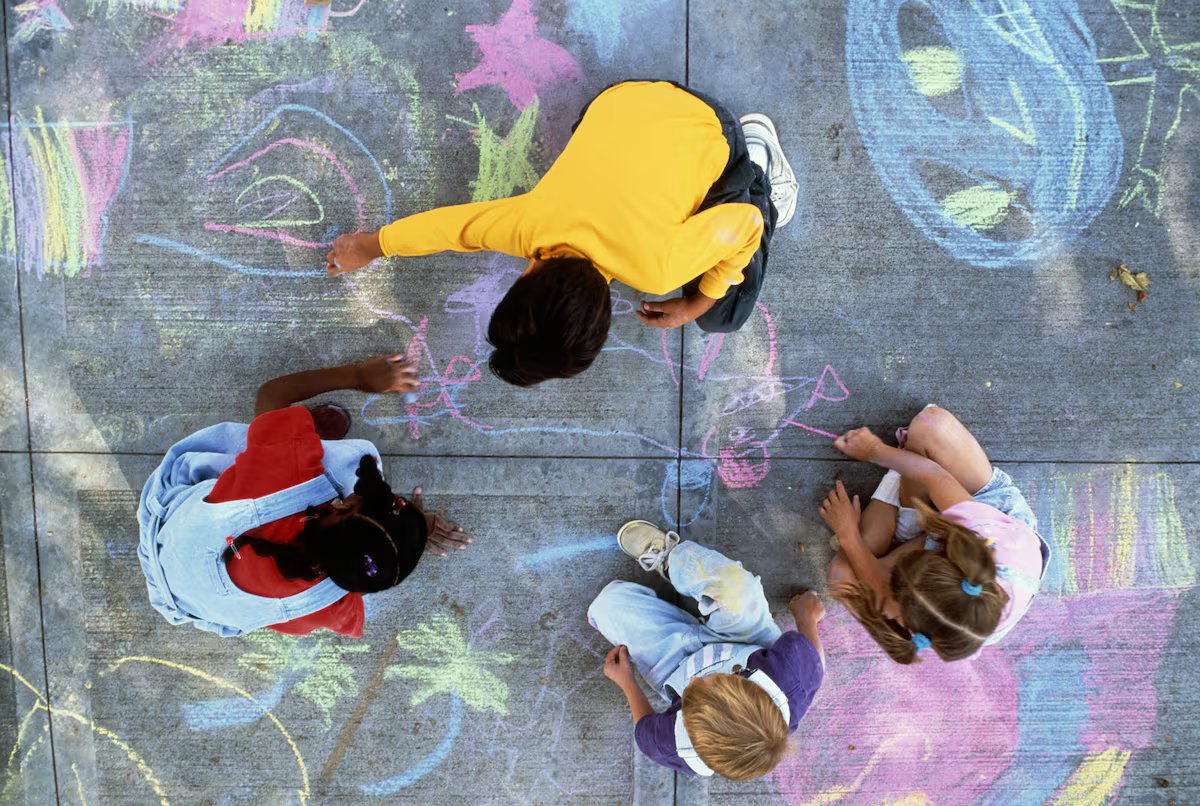
Fran Pérez, a 30-year-old journalist, remembers clearly the moment his friends grew bored with kids’ games. “A terrifying day,” he says. He was accused of being childish for declining to participate in their new activities of choice, which largely consisted of sitting around, talking in a room, or watching other groups of girls and boys. To defend himself from these accusations, he told his friends something that he repeats today with pride: “What’s wrong with you is that you have no imagination.”
These words, stated by a little boy more than 20 years ago, are not too far from the truth: imagination, the ability that allows us to mentally represent things that are not directly perceived by our senses, is on the decline. It’s one of the effects that new technologies have had on our minds, and public discourse appears to have all but forgotten it as a key cognitive resource.
Much is said about our declining attention spans, memory and even our ability to locate ourselves on a map, but we spend less time discussing our imaginative atrophy. “It’s very easy not to speak about it, because we all regard ourselves as being able to imagine. It’s in the background, like air — one assumes it will always be there,” says Begoña Quesada, journalist and author of the Spanish-language book En defensa de la imaginación (In defense of imagination).
Another factor is that, in contrast with memory (which can be measured, for example, by counting the number of dates that someone can remember) or attention (the number of continuous pages of a book that someone can read), it’s no easy task to empirically measure the state of a person’s imagination. It is possible, however, to analyze one’s imagination in the creative space.
In 2011, a study at The College of William & Mary analyzed the results of 300,000 Torrance Tests of Creative Thinking, and concluded that this particular human ability had diminished since 1990. Our creative asphyxia has also been commented on in publications like The New York Times, in connection to the current cultural dominance of remakes, sequels and reboots.
We are also consuming more and more products that come pre-imagined by others. In Spain, according to a study carried out by ElectronicsHub, people spend close to 35% of their daily lives looking at a screen. That’s nearly six hours. During this time, there is little need to imagine. Short, fast and highly visual videos require only our passive attention, leaving no need to complete, project and sustain a mental image of one’s own. This is in stark contrast to reading a book, or sitting in silence, in a total absence of stimulation. The consequences of imaginative atrophy range from generalized creative asphyxia, dependence on exterior stimuli to activate the mind, and even a decline in empathy.
In one of her book’s chapters, Quesada explains that the brain is a highly adaptive organ, which transforms through the use and disuse of its various areas. Psychiatrist Gary Small, according to Quesada, has studied the frontal lobe, site of our memory, imagination and complex reasoning. Such work has demonstrated that repeated use of screens leaves this part of our brains fallow, like the interior of an abandoned house, rusty and dusty.
The singer Irenegarry reflected on her Spanish-language Substack — a platform used by writers, journalists and content creators to publish their work — as to the imaginative loss caused by an increase in audiovisual consumption. “I don’t imagine the temperature of raindrops as they fall. Generally speaking. I can’t imagine the feel of shoes or that of a latex pencil skirt or the skin of a pony or the smell of a bathtub full of rose petals. Maybe that’s the thing? Have I been seeing things with my eyes on my cell phone so much that it has crippled my ability to invoke the rest of my senses in my imagination? Do I imagine less now that I see more? Do I see so much that there is less to imagine?”
Quesada, who spoke to EL PAÍS by phone from Brazil, realized how important imagination is during the COVID-19 pandemic, while watching her children. “We had to be very creative people to stay in contact with those who were far away, or to keep our kids busy for another hour,” she remembers.
She was also struck by the danger threatening this human faculty when she saw how her children’s relationship with school and their friends had become entirely digital. “I thought that, if the primary material of imagination, the reality we perceive, depends more and more on technology, imagination itself, as we understand it today, is changing. Even, that it is threatened,” she says.
Maturity is often associated with that moment when children, among other things, stop imagining that an army of monsters is chasing them around the schoolyard, or that a handful of sand is a valuable commodity. Reality becomes homogenized and ceases to be shaped by imagination. In many cases, that moment arrives too early if children replace imaginative play with constant screen time.
In July, Mattel, the company behind the Barbie, signed an agreement with OpenAI to make a product. No further details about the initiative have been made available, but it is logical to expect that soon, kids will be able to speak with ChatGPT through a Barbie doll.
Among other consequences, this will mean that kids who have always given voice and personality to their toys, be it a doll or a piece of cloth atop a stick, will no longer have to use their imagination to do so. “They have not understood anything,” says Quesada, in reference to the executives behind the Mattel deal. “Kids have never needed their toys to speak for them to come alive.”
Imagination for empathy
Poet and professor Fernando Valverde, whose latest Spanish-language book is Los hombres que mataron a mi madre (The Men Who Killed My Mother), has thoroughly studied imagination in his work in romantic literature at the University of Virginia. He came to the subject through penning a biography of the poet Percy Shelley. Reviewing the bard’s work, Valverde came across a line that aroused his curiosity: “The great instrument of moral good is the imagination.”
That quote, recalls Valverde on a video call, forced him to ask questions. “Shelley explained that only when we are capable of imagining the pain that our actions will cause in others, which is known today as empathy, can we freely decide to do or not do. That is to say, make a moral decision about our actions. This gives imagination a primordial role in the human condition,” he says.
Valverde, who supports creating a department dedicated to imagination in universities, has carried out an experiment with his own students with the goal, among others, of reactivating their imagination. No one can enter his class with technology that was created after the 19th century. That includes cell phones and computers, and even pens. His reasoning for this seemingly exaggerated prohibition has a touch of performance to it, like a small symbolic ritual that helps students to break their technological dependence. “Society’s problem with imagination is the result of living in a screen, having renounced the real world. Even when they walk in groups, they are looking at a screen,” says Valverde. He clarifies that, “I am not a Luddite. Technology has many positive uses.”
According to the poet, this experiment, which he has carried out for several years, has had a “very positive” impact on his students. “There is no clock, we have to imagine time. Sometimes we end 10 minutes early, or 20 minutes late. We let ourselves go,” he says. At first, many students say it makes them anxious to be without a phone for an entire class, but as the semester goes on, they get accustomed and the dependency becomes less severe. Another consequence is that socializing increases. “They go from knowing five classmates’ names to 18,” says Valverde.
Quesada and Valverde agree that recovering our imaginative capabilities must involve good reading habits. It’s no coincidence that the Wikipedia entry on imagination includes an image of Don Quijote, the ambulatory knight who lives in an imaginary world. “Reading a book takes effort, you have to get involved. It’s active consumption and requires patience as the story takes shape and the text becomes a kind of landscape. It requires faith, but once you’re there, it’s all yours,” says Quesada.
Sign up for our weekly newsletter to get more English-language news coverage from EL PAÍS USA Edition
