
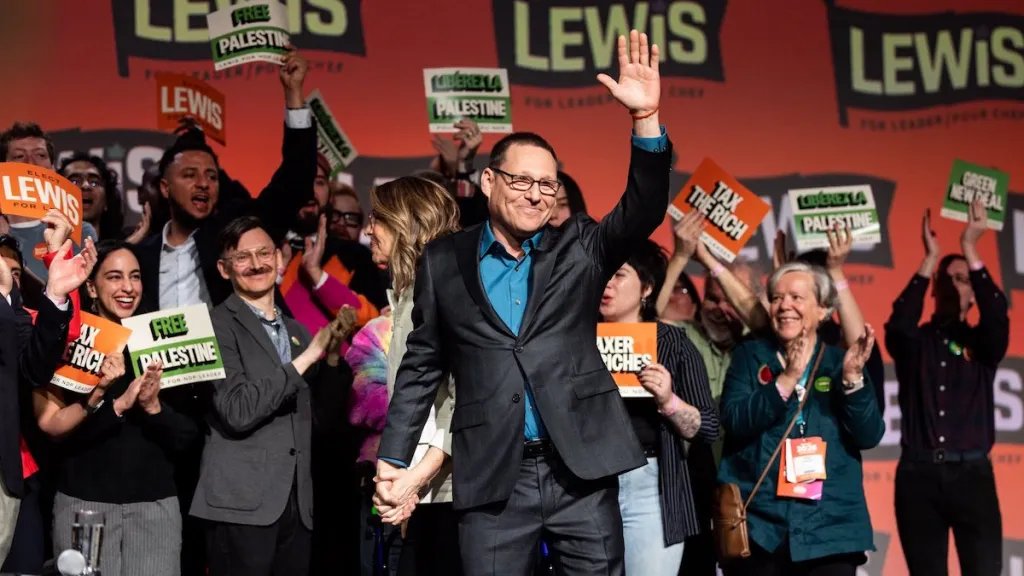
Avi Lewis has decisively won the leadership of Canada’s New Democratic Party, so the Greek chorus of doomsaying commentators predicting the bleakest of bleak futures for the party will be cranking up the volume immediately.

Promising a new day for the battered Parliamentary fourth party by advocating government that “works for the many, not the money,” Mr. Lewis overwhelmed his four opponents with 56 per cent of the vote announced at the party convention in Winnipeg this morning.
Mr. Lewis’s closest rival, Edmonton Strathcona MP Heather McPherson, received 20,899 votes to his 39,734. None of the others even came close.
As a result, the prevailing wisdom of the Canadian commentariat in the next weeks and months is bound to be that Mr. Lewis’s election means the swift end of Canada’s social democratic party because its membership elected a social democrat on the first ballot with 56 per cent of their votes.
Who could have imagined that social democrats, democratic socialists and their ilk wouldn’t want Conservative policies rebranded as Liberal policies from their own party as well? And who would have thought they’d vote for an unambiguous social democrat to make that point?
Aren’t we all supposed to be neoliberals now, with the NDP merely representing the “woke” neoliberalism-with-a-human-face fringe of the narrow spectrum of economic policy positions permitted nowadays in Canadian political discourse?

Apparently not!
A hint of what was about to happen could have been found in the results of Jagmeet Singh’s seven and a half years leading the NDP, during which the party chased away many of the social democrats who were assumed to be its base by being as much like the Liberals as possible, and propping up the Liberals in Parliament when it wasn’t possible through the so-called Supply and Confidence Agreement.
And like almost all Western parties of labour, the NDP had already pushed many working class voters into the arms of MAGA right by ignoring their aspirations and refusing to acknowledge the role of the economic policies the party supported in crushing working families.
If the only reason the NDP existed was to prop up the Liberals and feel good about it – as indeed seemed to be the perception of a growing number of voters throughout Mr. Singh’s blundering tenure – why not just vote Liberal? Back on April 28 last year, a hell of a lot of them did.
Much of the lost working class – including many union members – went over to the increasingly MAGAfied Conservatives.

So who says a guy who advocates state intervention to support tenants’ rights, lower grocery prices, assured access to reproductive rights, fair taxes, and free post-secondary education won’t do better than the branch of the party that wanted to continue Mr. Singh’s approach, only more competently?
Well, who knows? The NDP is in such bad shape today that it might be hard for any leader to pull the party out of the muck. But who’s to say that a leader who proposes real change won’t do better at keeping the NDP in play than one who wanted to remain closer to the mushy middle of Canada’s political Overton window?
A couple of provincial New Democrat leaders on the oil-drenched Prairies kickstarted the inevitable the-party-is-over trope with churlish commentaries on Mr. Lewis’s victory as soon as it was known.

“It is clear that the direction of the federal party under this new leader, someone who openly cheered for the defeat of the Alberta NDP government, is not in the interests of Alberta,” grumped Alberta Opposition Leader Naheed Nenshi in a statement emailed to media at 9:25 a.m.
“Last year, Alberta’s New Democrats voted overwhelmingly to make membership in the federal party optional,” continued Mr. Nenshi, who is clearly part of the camp who thinks the NDP should be more like Liberals. “Many thousands of our provincial members, including myself, are not members of the federal party. We are a big tent and welcome the support of people who vote for every federal party.
“We believe in Alberta and we believe in Canadian energy and the good jobs it creates. We believe in more pipelines and in reducing emissions. We believe in strong public services and a strong jobs-driven economy to help pay for them.”

About the nicest thing that can be said about Mr. Nenshi’s screed is that it’s ill-timed and clearly a reaction to United Conservative Party Premier Danielle Smith’s inevitable effort to tie the Alberta NDP to its federal counterpart.
It has the potential, though, to turn into a spectacular own goal, driving away many in the party’s traditional base – already fed up with Mr. Nenshi’s passive approach to Ms. Smith’s ideologically driven misrule – in the next provincial election.
For her part, Ms. Smith’s mid-morning reference to Mr. Lewis’s victory was entirely predictable: “The UCP will never stop fighting against radical forces, including the Alberta NDP, who want to shut down our economy and keep our resources in the ground.” Yadda-yadda.
Saskatchewan Opposition leader Carla Beck took a similar tack to Mr. Nenshi, focusing on Mr. Lewis’s environmental positions in an “open letter” to the new national leader.
“The positions that you have expressed publicly in this leadership race, and in your prior interactions with the New Democratic Party, are antithetical to the values of a party built with and for working people,” she said. “You have repeatedly claimed you’re laser-focused on affordability; however, the policy positions you have taken don’t reflect that.”

Well, that’s a position that can be defended, at least in the context of the Prairie economy. Although it sure didn’t help that she ended her missive by telling the new federal leader that “when you publicly reverse your position on these matters and show a willingness to try to understand the realities of our province and the thousands of proud Saskatchewan workers who rely on our industries to feed their families, I will meet with you.”
No meeting then, I guess.
The likelihood Mr. Lewis suffering a fate like that of U.K. Labour Party leader Jeremy Corbyn in 2020 was significantly reduced during the weekend convention by the election of a slate of elected officers who support Mr. Lewis’s program.
Two conclusions can be drawn immediately from what happened in Winnipeg:
1. Financial contributions to leadership candidates really are a good way to forecast the outcome of a party leadership vote, especially in a grassroots-driven party like the NDP.
2. The base of the national NDP remains dominated by social democrats, no matter what the party establishment thinks or wishes.
