
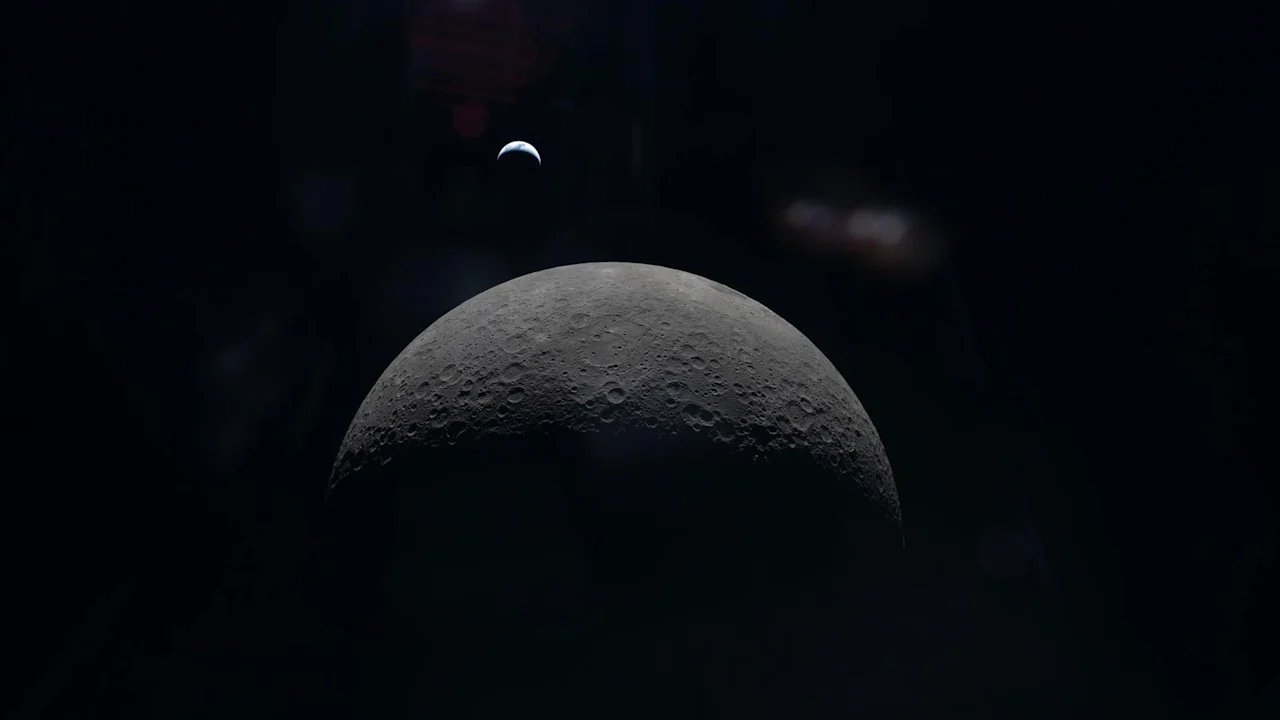
In case you didn’t hear, we just went back to the moon.
NASA has been heavily promoting the Artemis II mission for months, which concluded on April 10 after its four astronauts splashed down off the coast of California. No doubt, this venture was an objectively awe-inducing feat. The space agency successfully demonstrated the most powerful rocket it’s ever built, the Space Transportation System, and tested Orion, its crew vehicle, with a crew for the first time. NASA’s astronauts also traveled farther into space than ever before, and humans saw the dark side of the lunar surface with their own eyes (another major first).
But how excited did the rest of humanity get? Social media analytics companies that Fast Company reached out to shared the numbers. Muck Rack found that between April 1 and 13, there were more than 42 million engagements on major platforms. On April 6 and 7, around the time the crew passed by the moon, there were about 1.3 million mentions of terms related to Artemis II, according to media intelligence platform Cision. Analytics tool Sprout Social says that overall there were more than 100 million engagements on both TikTok and Instagram related to the mission throughout that week.
NASA’s YouTube Live coverage saw 61% growth in views from 2022, during the first Artemis I launch, up from 11.4 million to 18.4 million, again according to Sprout. Most of the streaming platforms that aired the lunar mission didn’t respond to Fast Company’s request for comment, but during the 6 p.m. hour on the day of the launch, NBC News Now saw its fourth-largest audience on record, according to Adobe Analytics and CloudFront. The rocket ship emoji was—unsurprisingly—the most popular emoji used in Artemis-related posts, according to the SaaS platform Sprinklr.
NASA, meanwhile, plans to release its own calculations soon.
While there certainly was excitement about Artemis and the return to the moon, the viewing numbers came nowhere near those of the Apollo 11 moon landing in 1969, which roughly 500 million people watched on television. To some, this comparatively more limited engagement with Artemis is evidence that space has lost its shine and is no longer as galvanizing as it once was. For others, the attention Artemis II did attract is evidence that space can still be a major global news story, even a positive one, despite an increasingly bifurcated media environment chock-full of serious and often depressing headlines.
Consider some other numbers: Nielsen, which tracks networks like Fox News and CNN, reports that about 18.1 million people in the U.S. watched live coverage of the Artemis II launch on the evening of April 1. That’s a lot, but also notably fewer than the Super Bowl on February 8 (125.6 million), or even the president’s State of the Union address later that month (32 million). Muck Rack found that the number of articles written about the Iran war far exceeded coverage of the Artemis mission from launch day on April 1 to splashdown 10 days later. Even NASA administrator Jared Isaacman, before the launch, seemed to acknowledge that Artemis would be competing with other stories.
“Space captivates everyone,” Isaacman told Politico. “Now, I understand there’s a lot going on in our lives these days. As I tell a lot of folks, when they’re like, ‘Do people realize that we’re about to send astronauts farther into space than ever before, around the moon, to set up for subsequent lunar landing events—do enough people realize that’s happening right now?’ There’s a lot more than the three channels on the television set than there was in the 1960s.”
window.addEventListener(“message”,function(a){if(void 0!==a.data[“datawrapper-height”]){var e=document.querySelectorAll(“iframe”);for(var t in a.data[“datawrapper-height”])for(var r,i=0;r=e[i];i++)if(r.contentWindow===a.source){var d=a.data[“datawrapper-height”][t]+”px”;r.style.height=d}}});
This is not to say that NASA didn’t plan an impressive publicity operation, which included plenty of social media posts and media engagements. NASA promoted a playlist with songs the crew listened to during the mission, and has continued investing in an astronauts-as-influencers approach. The space agency also partnered with streaming companies like Netflix and HBO Max, and provided coverage on its own streaming service. In fact, NASA has a legal obligation to promote and share its content, per the terms of the 1958 Space Act, to the “widest practicable audience.”
“Our goal is to reach as many people as possible, whether that is via NASA+ directly, or through other streaming platforms,” Lauren Low, a NASA spokesperson, tells Fast Company. “We are open to working with all platforms and would like to make sure that NASA is available on the platform of your choice.”
This largely paid off. A liftoff post on Instagram picked up more than 6 million likes, nearly as many as NASA’s most popular post ever: a shot of the Carina Nebula, captured by the James Webb telescope. TikTok drove the most engagement, with 121 million interactions, which included likes and reposts, according to Sprout Social. That’s despite NASA employees, including astronauts, not being allowed to use TikTok themselves, due to government regulations on some entities associated with China.
The mission got a healthy showing in pop culture, too, though some of the earlier efforts—like interviews with Time—ended up coming far ahead of the actual launch, which was delayed several weeks. There were canonical brand replies to NASA tweets, Pop Base coverage, and Saturday Night Live even put on a playful skit about the mission.
But for all that effort, it was hard not to get the feeling that a lot of people simply didn’t care. I, admittedly, have the “space bug” and watched the Artemis II launch alongside my father, who remembers seeing the original moon landing. The rest of my family, however, tuned in for a bit, but seemed mostly uninterested. At a party over the weekend, a friend confessed she wasn’t even sure what this mission was about. At a professional meeting, someone told me they found it objectionable that the media was spending so much time covering something that seemed unconnected to the problems on Earth.
The attention we did—and didn’t—pay to the mission is a reflection of how much our media environment has changed since the Apollo era. Space activity is always notable, but audiences are far more used to seeing people, even space tourists, bouncing around in orbit than they were in the 1960s. People increasingly get their news from social media, not cable, a transition that favors short-term videos, not weeklong coverage. Today, audiences are segmented via algorithm, which means people are seeing increasingly personalized, and often radically different, feeds. This makes it very hard to galvanize an entire species to tune in to a singular event.
Jack Kiraly, director of government relations at the nonprofit Planetary Society, says it’s remarkable that Artemis received the attention that it did, given the crowded news environment. People are genuinely invested in space exploration and want to see progress toward those goals, he says, adding, “The challenge is making sure we bring them along for the full journey of discovery, not just the headline moments.”
Asheley Landrum, a professor at Arizona State University who focuses on science engagement, argues, “This administration is really good at thinking about things in terms of ‘Made for TV.’ They’re really thinking about an audience-first approach . . . making sure people know who the astronauts are, talking about it, having it on streaming as well as on television.” Overall, she says, Artemis II was a rare positive news story.
As we settle into the next space age, whatever we’re doing up there might just be in the eye of the beholder. Landrum notes that we may refract our memories of prior space missions onto the milestones of the present. For the Apollo generation, the Artemis program evokes nostalgia. For the generation that witnessed the Challenger and Columbia disasters, this potentially provides some catharsis—a moment to see a major manned space launch actually go well.
Meanwhile, for even younger generations it’s difficult to disentangle human missions to space from the tech billionaire class building rockets and going on their own joyrides in low Earth orbit.
