
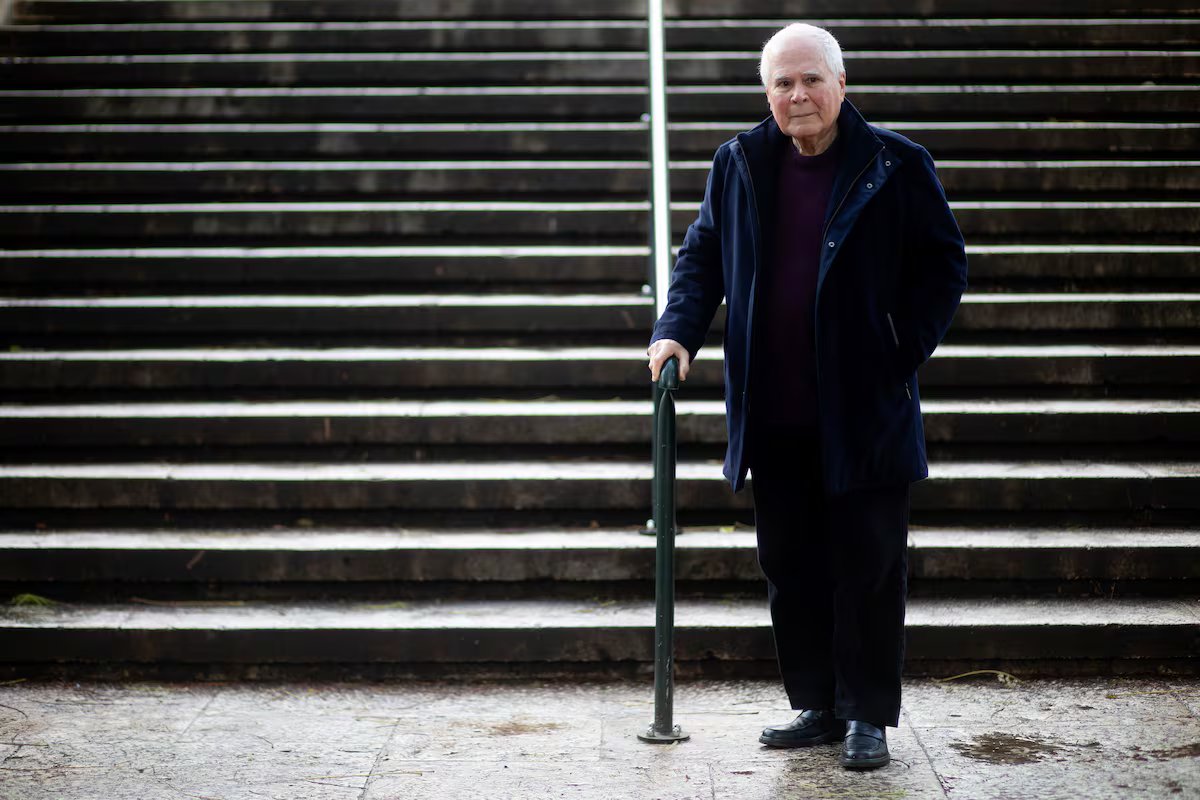
Perhaps because he grew up near the Indian Ocean, Portugal’s foremost thinker José Gil has always looked at his country from several forms of distance. The first was geographical: Gil was born in 1939 in Quelimane, Mozambique, where Vasco da Gama’s landing centuries earlier set in motion a colonial project that endured until the Carnation Revolution swept it away in one stroke.
The distance widened when Gil took refuge in France to escape the dark night of the regime Salazar inaugurated in 1933. He traded mathematics for philosophy at the Sorbonne in Paris, where he became a disciple of Gilles Deleuze, lived through the widespread protests of May 1968, and published his first books in French.
And this led to the linguistic distance, in which he remained until 2004, when he wrote in Portuguese a landmark book on the existential paralysis of a society shaped by five decades of repression, Portugal Hoje: O Medo de Existir (or, Portugal, Today: The Fear of Existing). Gil has been a professor at the International College of Philosophy in Paris and a chair of Aesthetics at the Universidade Nova de Lisboa, where he gave his final lecture in 2010. Across more than 30 books, he has reflected on the philosophy of the body, aesthetics in art, and Fernando Pessoa’s poetry.
He has always avoided media overexposure in a country that produces commentators en masse, yet without shying away from political reflection on the present. After picking him up at the entrance of his home — a modest building in Alcântara, the neighborhood where Portuguese singer Amália Rodrigues grew up and which still resists the ravages of tourism — we talk in a small, noisy café. He foresees a bleak, even totalitarian future if democracy is not reinvented and the climate struggle is not made a priority.
Question. You were born in Mozambique, when it was still under Portuguese rule. Why is colonialism making a strong comeback?
Answer. Independent African nations failed to create a power strong enough to serve as a barrier to a new form of exploitation. It is a very different kind of colonialism. It is no longer about possessing territory; it is a capitalist colonialism focused on natural resources. Economic exploitation that ends in cultural exploitation.
Q. Is fascism also making a comeback? It is debated whether current authoritarian movements are equivalent to 20th-century fascism.
A. We must ask ourselves whether we can generalize and speak of a single fascism or several. In the U.S., there is an attempt to establish a dictatorial-type power that has similarities and differences with Italian fascism or Nazism. Control over the press or the creation of militias would be the similarities. The essential difference is cultural.
Current fascism is ideologically impoverished. The kidnapping of Maduro and the war in Iran imply another system of values. There we have a far-right proto-dictator who attacks repressive regimes, presenting himself as a liberator. A new fascist culture is emerging. Our reality does not allow for discourses on spiritual values or appeals to another reality to justify political power. It is a digital, double reality, what Naomi Klein calls a “doppelganger.” We no longer need a god.
Q. Does Trump represent a stage towards something new?
A. If this new power wins, it will be a totalitarianism unlike anything we’ve ever seen. It’s based on AI, as we see in China. And it’s being designed with our consent. It’s serious because we don’t see how to free ourselves. Trump is just a phase; he’s already outdated in the face of this.
Q. Do technology entrepreneurs present a greater danger to democracy?
A. Yes, although the most dangerous people are those who hold power right now. There is a trend in the U.S. toward the establishment of fascism, but it hasn’t been completed yet, and it may not happen. We are living through a critical moment. But those who will have the power in the future to impose totalitarianism are those tech billionaires.
Q. You believe that democracy can only be saved if it is rebuilt. How can this be done?
A. It involves a whole process of thought. If democracy is being questioned, it’s because it has allowed injustice and inequality. What amazes me is seeing that democracies are on the defensive. All of them. Let’s look at the democratic left-wing and right-wing forces in Europe — what do they propose for democracy? Nothing. Their lack of thought is enormous.
Q. Europe is emerging as a solitary island, adrift. Will it survive?
A. Achieving the cohesion that will make the EU a superpower capable of autonomy from the U.S., Russia, and China implies that we must end the reality of the nation-state and the notion of legal sovereignty. We must create a new notion of federation and make the populations aware of it, which they are not.
Q. Do you still think we are a society sleepwalking toward its own extinction, or has that view softened?
Q. Populist movements use immigration to gain support. You believe the issue hasn’t been handled well.
A. In Portugal, certainly. And in France, the left hasn’t known how to handle the issue. We need to think about how to integrate immigrants, what is acceptable or not in their culture. Politically, it’s a lure for the far right, a point of convergence between old and new fascisms. They need a negative pole to oppose us, the ones who supposedly have the good genes. The Jews were that for Hitler, and immigrants are that for Trump.
Q. There are responsibilities that fall to governments in saving democracy, but what can increasingly isolated individuals do?
A. The dangers of fascism are profound and affect the most intimate aspects of our being. The danger of AI is that it affects individual lives immediately, not in 10 years. I have friends in France, educated people, who spend hours asking AI questions. They tell me they are unable to see it as a machine. One of the dangers we don’t talk about is this addiction.
Q. António José Seguro, a moderate socialist, recently won the presidency in Portugal against a far-right candidate. How do you read these results?
A. We’ve bought ourselves some time. I voted for Seguro, in the face of the threat. [André] Ventura [from the far-right party Chega] isn’t just threatening because of what he says; there are forces that go beyond him. If he wins, or if the far right gains power in Europe, there will be a shift toward a technofascist society. Seguro’s victory shows that there is still popular opposition to Chega’s tendencies. What I regret is that it’s just a postponement. There’s no thought being given to reformulating democracy and a new way of doing politics.
Sign up for our weekly newsletter to get more English-language news coverage from EL PAÍS USA Edition
