
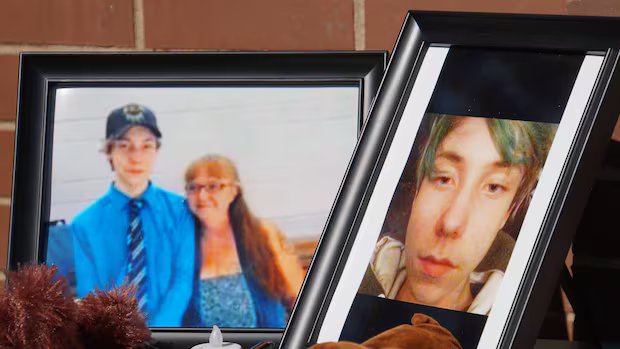
Over six years since her son Devan was murdered outside his Hamilton high school, Shari-Ann Selvey says not enough has changed to protect kids.
“Youth are still hurting youth,” she said in an interview with CBC Hamilton. “I don’t know how to keep them safe but I know I need more voices. Maybe that is what it will take.”
To raise awareness about issues including bullying and youth crime, Selvey is working with Hamilton filmmaker Tyrone Greenidge on a documentary about Devan.
The idea, Greenidge told CBC, is to show audiences who Devan was and ask if kids feel safer today than they did when Devan died.
“I think the answer would be a resounding ‘no,'” Greenidge said. “We have to come together.”
Devan was stabbed to death outside Sir Winston Churchill Secondary School on Oct. 7, 2019. He was 14 and so was his killer, who pleaded guilty to second-degree murder in 2021 and received a seven-year sentence.
The murder trial heard that before the stabbing, Devan did not know the boy who ended his life. He stabbed Devan in the back after they were involved in a group confrontation.
Devan’s death sparked conversations around bullying after his mother shared he was bullied leading up to his death.
Greenidge said he’s heard stories that Devan was a tough guy or involved in crime but found that he wasn’t. A trailer for the documentary shows a clip from Devan’s YouTube channel encouraging anyone watching to “Go make people’s days great.”
“There’s a lot of Devan Selveys out there,” Greenidge said. “That means people who are shy who don’t always fit in and who are just trying to be heard.”
Filmmaker doesn’t want people to become ‘desensitized’ to problems facing youth
Greenidge, who grew up in Hamilton and has experience working with young offenders, said he got in touch with Selvey through work on his series Dear Grandpa, It’s Me Michael. That project follows a young man with autism, whose mother told him she wanted to help support the Selvey family. Greenidge said that inspired him to reach out.
The pair spoke for about a year before starting to work together, Selvey said, because she wanted to make sure Greenidge would take the right approach.
She said she didn’t want to “exploit the story,” and had already turned down an American company seeking to tell a version of it because it didn’t feel right.
Since starting work, Greenidge said he’s collected “hundreds” of stories about bullying, and paid close attention to the news, where he said he sees sad stories about young people almost daily.
“I don’t want us to become desensitized to it,” he said.
1:05:38What questions do you have about raising boys and young men?
Adolescence is a searing 4-part series on Netflix about boys, violence, cyberbullying and social media. It has ignited a conversation among parents and guardians about how to raise boys who are happy, healthy and kind to others. To answer your questions about raising boys, we spoke to two guests. Jonathan Reed is the director of programs for Next Gen Men, and Michael Kehler is a research professor of Masculinities Studies in Education at the Werklund School of Education at the University of Calgary.
Youth crime has been a hot topic in Ontario for the past few years amid headline-making incidents of bear-spray attacks, smash-and-grab robberies, drug trafficking and murder.
In January 2025, Statistics Canada reported that according to police-reported youth crime data, the youth crime rate was increasing after generally trending downwards for 20 years.
From 2022 to 2023, the youth crime rate increased 13 per cent, from 2,571 per 100,000 youth population to 2,898 per 100,000, Statistics Canada said.
At a Hamilton public safety summit in November, police officer Candace Culp told attendees that overall, Hamilton kids between 12 and 17 years old were committing slightly more crimes compared to the five-year average. However, police noted, the severity of crime in the city overall was trending downward.
Both Selvey and Greenidge say they want legal reform to prevent repeat offences. Selvey said she’d advocated for changes including mandatory minimum sentences of 10 to 20 years for serious offenses, as well as education and mental health supports for offenders.
In October, the federal government said it would target violent repeat offenders with changes to bail and this week, the Ontario government defended a plan to expand jails, saying it would help make communities safer.
Selvey said communities need to step up alongside police and politicians. She feels young people don’t have the same oversight and support she did when she was growing up. In her community, she said, if a neighbour saw a kid getting into trouble, they were likely to let that kid’s parents know, or intervene themselves. Now, she thinks, people are less likely to get involved, sometimes out of fear.
Greenidge said he worries social media has isolated and overstimulated children, as well as subjected them to bullying and negativity. “We need to get back to a community helping each other every day.”

Documentary release planned for 2027
The filmmaker said he’s also been inspired by Selvey and people like her, who he describes as “ordinary people in extraordinary situations that we have a choice. Do we lie down or do we keep fighting?”
Selvey says she just wants to help people like her son wanted to. “He was a very kind soul.”
Greenidge said his documentary, which he plans to release next year, has been a tough story to tell.
“Devan definitely should still be here. In a perfect world, I don’t meet Shari Ann,” he said.
