
If AI can write our emails, analyze data, and generate code, then machines outperform humans on nearly everything we currently measure: speed, productivity, and task completion.
Based on these measures, humans lose. Their jobs. Their dignity. Their worth.
A recent management study shows that AI can help people do 12% more work, 25% faster—but it gets the answers wrong 19% of the time. That’s a telling number. And helps us to understand what we’re all experiencing. We’re optimizing for throughput while quietly accepting a compounding error rate.
If we value motion and not direction, we’re like Wile E. Coyote, sprinting forward ever faster—only to realize, a beat too late, there’s no ground beneath us.
The reason this matters so much right now is that AI and humans are fundamentally different kinds of intelligence. Despite its “generative” name, AI is recursive. Similar to how “social media” isn’t at all social. AI finds patterns in what already exists, optimizes what’s already been done, and accelerates what’s already been decided. That’s genuinely powerful. It can create a song for you based on your story or code a basic website for you.
But—and this is important—it cannot imagine what doesn’t exist yet. It cannot dissent. It cannot empathize. It cannot hold tension or sense when a decision lacks integrity. Humans can. We humans don’t just process the world—we generate new versions of it. We take a problem no one has solved, sit with its contradictions, and tussle with it long enough to create something others missed to build something genuinely useful. That generative capacity—to imagine, not just replicate—is what fuels every meaningful innovation.
And it is precisely what our management measurement systems have never learned to see.
Which is to say: this isn’t a new problem.
It’s a 100-year-old one that AI’s recent emergence has suddenly turned into a crisis.
Sorted, Ranked, Rated
In the early 1900s, Frederick Taylor gave us scientific management—the idea that human work could and should be standardized, measured, and optimized like any other industrial input. People were inputs. Efficiency was the output. Shortly after, the U.S. Army formalized rating systems to rank soldiers against each other—a tool of military hierarchy designed to sort people for deployment, not develop them. When the wars ended, corporations inherited both the logic and the form. By the 1950s, the annual performance review was a fixture of corporate life. Again, not because it developed people, ideas, or innovation. But because it sorted, ranked, and rated.
Then Jack Welch locked the idea in. At GE, he made it consequential and famous: the top 20% were handsomely rewarded, and the bottom 10% were fired, every year, by design. What spread across the global business world wasn’t just a practice—it was a premise. That human beings are meant to be ranked instead of linked. And here’s what most people don’t know: the stack and rank wasn’t actually about improving performance. Welch needed a mechanism to cut people because he was managing shareholder perceptions—using it, among other tools, to make GE appear to be growing when it actually wasn’t.
A trial with no jury, no defense, and few witnesses
Performance reviews are, by design, performative.
Think about what a performance review actually is. It happens once or twice a year—far too infrequently for feedback to be useful. It documents the past rather than addressing the present or shaping the future. It’s tied to compensation, which means everyone performs for the grade rather than the work. If you’re a team leader, you’re often told in advance how many people are allowed to receive great reviews—forcing you to distort reality, ration recognition, and turn feedback into a competition among colleagues.
Performance reviews are like a trial with no jury, no defense, and few witnesses—and the prosecutor and the judge are the same person.
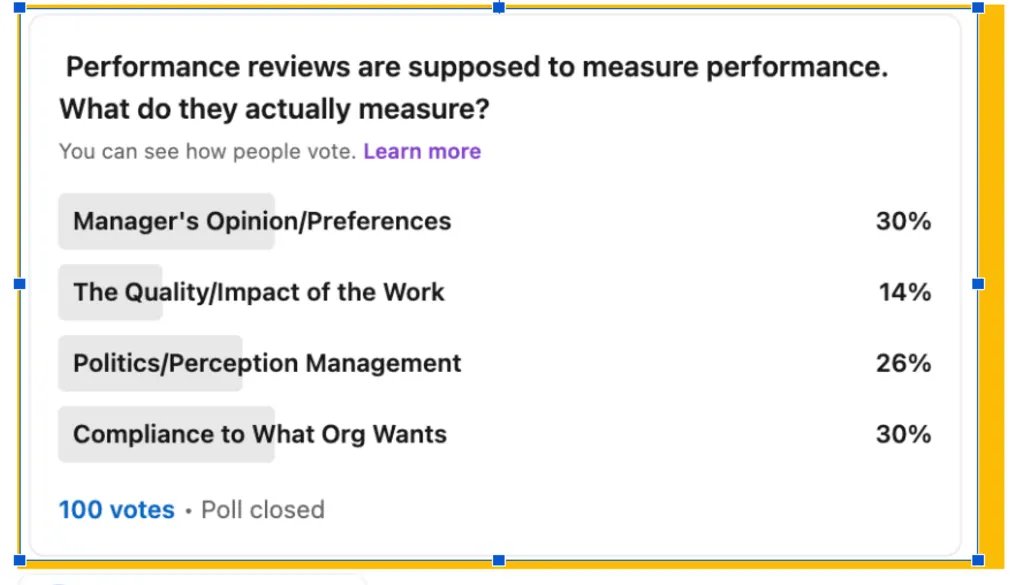
And we know it. A recent poll I did on LinkedIn shows that people truly get that performance reviews are less about the work (14%) and more about conforming to what is expected of you.
That legacy is still running our collective talent decisions today. Not because someone looked at it and thought this was a good idea, but because it’s a norm we’ve inherited and not yet interrogated.
The system is working exactly as designed. To commoditize humans.
Everything becomes a derivative
A few years ago, Adobe decided they’d had enough. “We were a company that thrived on creativity and innovation,” said Donna Morris, then Head of HR, “and the system felt like the exact opposite of that.” Rather than patch what was broken, they replaced it entirely—introducing the “check-in,” a model of ongoing, real-time conversation focused on growth rather than judgment. Managers were coached to have these exchanges as often as the work required, with an emphasis on coaching over critiquing. The shift was concrete: eliminating performance reviews freed up approximately 80,000 hours of manager time every year—the equivalent of 38 full-time employees freed from bureaucratic ritual. And that’s just managers. Countless hours of employee time were also reclaimed—time spent on self-evaluations, on rehearsing, on the sleepless nights that rolled into crappy days. Some companies have followed Adobe’s lead. Most haven’t. Because doing so requires seeing the world differently. It requires us to admit that what the world of management has been measuring isn’t actually valuable.
And that the cost is compounded into something we can’t afford.
Already, 70% of global jobs require little to no creativity. With AI, that number will only rise—accelerating a shift toward speed over substance, replication over originality, isolation over connection.
What was always a strategic blind spot is now an existential one. If we can’t see how human distinctiveness creates value, we won’t just lose sight of it. We’ll automate it away entirely. We’ll design it out. Everything becomes a derivative—a recursive loop of what’s already been done, instead of what we actually need next.
The challenges that matter most right now—in business, in society, in every organization trying to stay relevant—require ingenuity, genuine collaboration, and the willingness to work on problems that don’t have obvious answers. That’s not a soft people-y issue; It’s an economic one. The reason every valuable business is created is to produce something useful that didn’t exist before. But then we measure time saved and cost reduced.
We are standing at a fork in the road. One path automates what machines do well, freeing humans to generate what comes next—the novel ideas, the solutions we haven’t seen, the work that makes organizations worth having. The other keeps measuring humans by an outdated model they’ll always lose, and in doing so, loses the very generative capacity no machine can replace.
The speed/more/output metric is giving us the wrong answer. It tells us humans should absolutely lose our jobs if AI can replace them. But that’s only true if we keep asking the wrong question.
Performance reviews are a symptom. The deeper problem is that we never built the right metrics to value what humans actually do. And now that we live in a world where everything routine can be automated, that blindness is no longer just a management failure. It’s the defining risk of our moment. We need to see the norms we’re standing on, so we can stop wondering why the ground feels so thin.
