
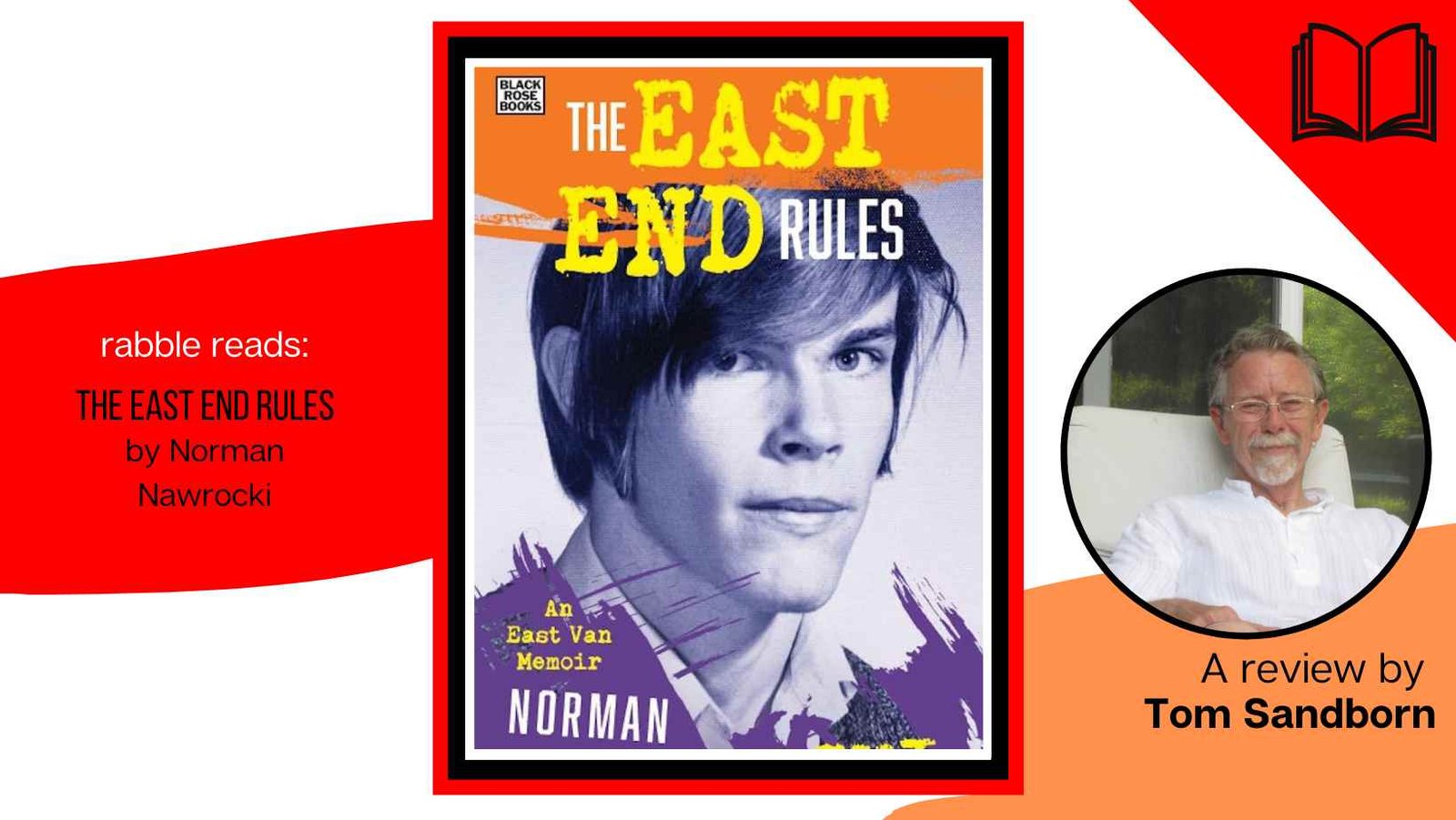
If you have ever lived in Vancouver, you probably know something about the East End of the city, a neighbourhood that was for most of its history (before its current lamentable gentrification) a scruffy, hard scrabble home for the newly arrived, the poor, the racialized, the overworked and the over policed.
If you grew up in the East End in the 1950s, 60s and 70s, like Norman Nawrocki, the author of this high spirited memoir/auto fiction, you learned that “East End Rules” had at least two meanings. It was an aspirational assertion of the value of the residents, a claim that they and their neighbourhood “ruled.” It was also a nod to the rules that governed lives there, however imperfectly, rules of solidarity, community and mutual aid. Nawrocki’s remarkable text (the first of a planned trilogy of memory writing about his home and life) covers the author’s early memories of rock throwing battles and bike rides with his friends and tender connection with both his parents, from birth up to his late adolescence, with its discovery of anarchism as a theory that made sense of his life and his community. He discovered an ability to write and organize that has served him well during a long and honourable career as an author, organizer, performer and activist here on the West Coast and later in Montreal.
Nawrocki is the anarchist as Renaissance man. He is an actor, playwright, musician and producer. His works have been translated into French, Italian and other languages. They include novels, novellas, poetry and non-fiction, plays, cabarets and musicals. He has produced diverse cultural events and toured the world. He occasionally teaches university and college courses in community organizing and creative resistance.
Full disclosure: I knew Nawrocki slightly when he lived in Vancouver, and I have reviewed two of his recent books, Squat the City and Vancouvered Out so I do not come to this review cold.
Both these earlier books are worth reading, especially for readers who enjoy The East End Rules. Squat the City is an account of the author’s experiments in creating grass roots generated performance pieces to support housing struggles in Quebec. Vancouvered Out, like The East End Rules is a slightly fictionalized memoir, this one about a housing activist who returns to Vancouver to find it much changed for the worse by real estate developers and gentrification.
How tough were the kids in Nawrocki’s East End neighbourhood? Here’s how tough: Not content with summer rock fights on the block, in winter they gave their snow ball fights extra punch by adding stones to the snow balls. At least that is the image that opens this energetic, compassionate portrait of the activist as a child, which introduces the reader to the author’s slightly fictionalized surrogate Joey.
The book proceeds from this bravura beginning to trace Joey’s early years in lovingly remembered detail, but not before a passage set a decade and a half later, when Joey takes on a neighbourhood organizing project supporting low income renters on the East End’s Pender St. who are threatened with eviction by a villainous landlord. Much of the book proceeds in this manner- a straightforward account of Joey’s early days with occasional flash forward scenes to the Pender St. organizing and the impressive working class women who teach the protagonist at least as much as the anarchist texts he discovers and devours along the way.
But before those texts appear in his life and clarify his politics, Joey muddles along in the usual adolescent hormone laced fever dream of running the streets with his friends, enduring an authoritarian school (Templeton High is name dropped) and dealing with crises like a stolen bike.
His parents are lovingly remembered- the warm supportive mother and the immigrant father who introduces him to the mixed joys of tennis and the attendant experience of class discrimination that occurs when he goes to the tennis courts in Stanley Park with his dad and is scorned by the better dressed and more privileged players. The family scenes are tender and moving, while Joey’s ongoing discoveries of class and ethnic prejudice illuminate what make him so responsive when he first encounters the iconic texts of Goldman, Kropotkin, Tolstoy and other anarchist writers. In a time when anarchism is once more demonized by the Right and the fantasized Antifa International is used to justify acts of terrible state violence, the case for anarchism as an ideal of human community and mutual aid is powerfully made in Nawrocki’s book. Highly recommended.
