
Prior authorization is a major thorn in the side of providers, adding to their administrative burden and hampering their ability to provide timely care to patients. It is also a source of frustration to people who may land in the pharmacy only to realize that they can’t pick up their needed medications because of an insurance snafu called prior authorization. Something they may never have heard of before.
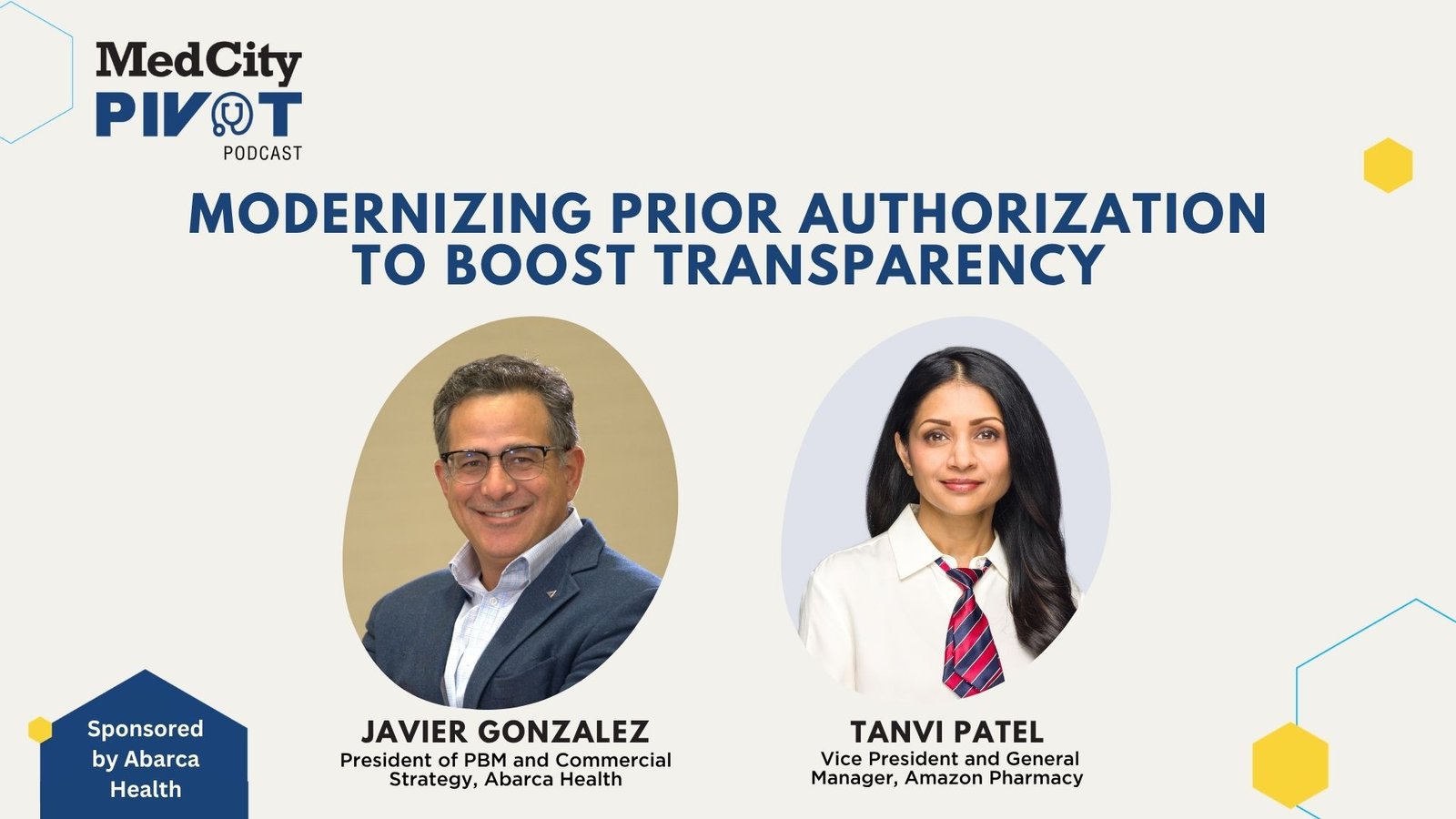
In this episode of the MedCity Pivot Podcast, we hear from Javier Gonzalez, president of PBM and commercial strategy at Abarca Health, and Tanvi Patel, vice president and general manager, Amazon Pharmacy, both of whom have unique perspectives on how prior authorizations can be modernized and scaled appropriately.
The episode was sponsored by Abarca Health.
Here is a video of our conversation:
Here is our podcast, available on all platforms.
And here is an AI-generated transcript of the episode:
Arundhati Parmar: Hello and welcome to me City’s Pivot podcast. I’m your host, Arundhati Parmar, editor-in-chief of Med City News. Now, prior authorization has been a major point of contention between providers and payers. Patients also show up at the pharmacy only to be told that their insurance hasn’t approved the drugs that their provider has prescribed.
Arundhati Parmar: All of this causes untold frustration. Now, as a result, many efforts are being made to modernize prior authorization to make it less burdensome. Today we will hear from two experts in the field about how prior authorization is being modified and how it will impact patients. Our guests are Javier Gonzalez, president of PBM and Commercial Strategy at Abarca Health.
Arundhati Parmar: Which is a tech enabled pharmacy, benefits manager, and TVI Patel, vice President and general Manager at Amazon Pharmacy. Today’s episode is sponsored by Abarca
Arundhati Parmar: So Javi, I’ll start with you. You know, from a pair perspective, what does modernizing prior authorization really mean? I mean, is it simply making electronic, and what are some of the challenges to doing this at scale?
Javier Gonzalez: Yeah, I mean, for me the, from, at least from a health plan perspective.
Javier Gonzalez: The, you know, when we talk about modernizing a prioritization experience at scale, for me it’s multi-pronged, right? I think that there’s a, you know, there’s an opportunity around, so the three things I think, and then I’ll, I’ll, I’ll expand on. Number one is I think there’s policy complexity. Two, I think there’s data quality that we need to think about.
Javier Gonzalez: And then third thing is I think that we also have to talk about. Operational risk, right? And so when I think about policy complexity, complexities, you know, there is just not one clinical drug rule, right? There’s thousands of, of, of prior authorization rules, um, maybe multiple thousands of, of, of, you know, prior authorization rules.
Javier Gonzalez: And so you really have to think about like. When we wanna modernize at scale, like obviously you gotta build decision trees, right? So there’s, there’s some, some work around that. But I think there needs to be a reevaluation of the complexity, uh, factor and which prior authorizations should, should maybe not, not be prior authorizations.
Javier Gonzalez: ’cause they’re low value, pro, um, low value prior authorizations too. You know, when we think about the data quality, you know, it’s, it’s hard sometimes. Uh, to get, uh, accurate realtime information on the entire patient, right? There’s information asymmetry, so it’s, it, the health plan can be well intended, but if, if you don’t have the right EHR connections, you don’t have the right EPAs or real-time benefit transactions.
Javier Gonzalez: You know, it, it’s difficult to be successful, um, without having full information. And then the third piece is the operational risk. And like I think that when you go at scale, especially with a lar lar large health plans, you know, I think you have to be careful about, um, going too fast and removing all the barriers because you could end up approving drugs that aren’t really not appropriate, right?
Javier Gonzalez: Uh, that, so it’s the balance, right? There’s pros and cons to, to, to moving quickly. So. I’ll leave it at that.
Arundhati Parmar: No, and that makes sense.
Arundhati Parmar: I mean, I will talk from a personal perspective, and this was a medical, uh, prior auth, not a, a drug, uh, prior auth scenario where I had an older brother who was diagnosed with stage four cancer and his doctor wanted radiation to be done, and it took. Seven days for the prior auth to come through. Mm-hmm.
Arundhati Parmar: And he’s a stage four cancer patient, and you’re like, okay, this is just, it’s spreading while we’re waiting. So it was very, it’s emotionally stressful and I cannot imagine what it must be for patients. Um, an tanami, you can wane on this when they go to the pharmacy and see that they cannot pick up medication that they.
Arundhati Parmar: They need. So where does trust breakdown? What does the current PA experience feel like, uh, for patients?
Tanvi Patel: Yeah. And you just, you just kind of nailed it. Right? And I think that all of us have an example that we can dive into to say, why didn’t they make sense from a patient’s perspective, prior authorization doesn’t show up as a.
Tanvi Patel: Safeguard. That’s why it was initially introduced as we’re hearing, and that’s what we talk about. But it shows up as a gap to your point. You know, imagine uh, a patient that’s just been diagnosed with type two diabetes and she leaves her office thinking, okay, I’m gonna start treatment. This is the start, and then there’s just nothing.
Tanvi Patel: There’s radio silence and no one explains why there. A pause, it’s excitement, and then there’s a pause, and it’s not that feeling that something is happening because something may be happening. She’s just not a part of it. You know? It’s her care and she’s not a part of that journey. That’s what it feels like from the consumer standpoint.
Tanvi Patel: So she starts asking the basic questions. Did my prescriber miss a? Death is my plan doing something on my behalf? Is the pharmacy missing something? Do I need to call someone? What’s happening? And that’s where the patient loses trust in the system, and that’s what it feels like for consumers. And most of the time, she’s not getting any clear answers from anyone not knowing where to call, and that’s where the trust breaks.
Tanvi Patel: Down so the system feels fragmented, when really, as we were hearing, it needs to be interoperable. It needs to feel coordinated on her behalf, and it doesn’t. And that’s what we’re starting to piece together here. And it starts to feel like the system is not working on behalf of patients.
Arundhati Parmar: So Tan, I’m gonna stay with you.
Arundhati Parmar: You know, medication adherence is a big issue, um, and has been for, for quite some time in not just starting the medication, but sticking with the therapy. And so when I think about Amazon as a digital pharmacy, I mean, what is your role in supporting, um, you know, uh, and managing the prior auth experience, all the way from the initial communication to the fulfillment of, of the, uh, drug being delivered.
Tanvi Patel: Right. So once again, you know, adherence doesn’t start with the first dose. It starts when the prescription is written. All of those elements that I was just mentioning where trust has been eroded because of silence or, uh, you know, a misunderstanding of what’s happening, you’re already starting to not trust the system.
Tanvi Patel: You already don’t wanna take the medications. You’ve already lost a little bit of hope, right? And so we need to build that trust because that trust means that you’re gonna trust the system and trust the treatment. And that’s where adherence. First start. So that window between getting the prescription and having that medication filled is where it, a lot of the process on medication adherence and health outcomes can go wrong.
Tanvi Patel: If the patient is waiting and they don’t understand why confidence is out the door and that’s when actually the stats show it 20 to 30% of the, of the prescription taking it, you know, drop off happens. At that point, it’s because of the prior authorization failing. The patient needs to have. That transparency.
Tanvi Patel: So that’s where Amazon Pharmacy is trying to solve that transparency question. We can work with partners like Avarca to know what’s happening and ensure that that patient that has now opted for a digital pharmacy experience has transparency to what’s happening. Patients have visibility into everything else in the world today, right when their pizza’s gonna be delivered down to where their shipments are and everything else.
Tanvi Patel: So why not also every step that’s happening behind the scenes on their behalf. Frankly, for their care, and at the end of the day, we lose them even before it starts, and that’s the problem today.
Arundhati Parmar: Yeah, I mean, you talk about, uh, you being able to track, uh, pizza delivery, certainly when your Uber is arriving or anything like that.
Arundhati Parmar: I mean, in healthcare we’re still dealing with faxes and paperwork. I don’t know if you guys know or not, but recently there was an announce from CMS announcement from CMS that in two years time they’re going to be getting rid of all faxes.
Tanvi Patel: Exciting,
Arundhati Parmar: and I know 2028, hallelujah. Um, but, uh, so Avi, the question for you is when it comes to.
Arundhati Parmar: Prior auth, what benefits comes with establishing electronic workflows?
Javier Gonzalez: I’m gonna answer that question, but I wanna go back to the comment you made. Um, first of all, it’s super exciting that CMS is, you know, we, we’ve had a chance to meet. Uh, Chris Clump. Mm-hmm. And certainly really dynamic, amazing gentleman and really smart.
Javier Gonzalez: And I think he really wants to move the needle in terms of facilitating a, a good environment for modernizing, uh, the delivery of healthcare, which I, I think is really refreshing. Um, but that particular rule right now from what I understand is specific to like medical. Like x-ray exams and certain, certain types of things.
Javier Gonzalez: It’s not really related to the pharmacy piece yet. Having said that, though, I further expect that we’re going to see more, uh, regulations, uh, uh, EE expanding that net, right? So that hopefully one day we can, we can move past the. Quote unquote eight track tape and move, you know, of the world to, to move to something more modern.
Javier Gonzalez: But like the impact for me, um, when we think about EL making things electronic and what we can expect is look, elect electronic prior authorizations, EPAs, um, are good first step, right? Like, I think that they’ve begun to make an impact. Um, I think that, you know, I’ve seen studies that show that they can save 60 to 70% of the time.
Javier Gonzalez: An effort associated with that. And when you’re thinking about these physicians who are paying 20, $30. Uh, in, in administrative costs to administer these prior authorizations. And I’m sure Tan V in her operation, she probably knows that line item as well. You know, it’s certainly refreshing right? To, to be able to have that.
Javier Gonzalez: Uh, and I think we’ll further, especially with EPA, I think that we’re gonna further see a regulations helping. We have this rule, uh, H 0 57. Which is basically, uh, more on the medical side today, uh, with medical procedures mandating fire APIs and that health plans are gonna have to be able to support that.
Javier Gonzalez: Uh, intentionally. They’ve excluded the, the, the pharmacy drugs from that today, citing that there’s different standards and, and ways to work on that. But I think that we’ll probably see an, an expansion of that because until we make it mandatory, like until, like we need regulatory, unfortunately. Uh, we’ve not been good as an industry of like rallying around and getting standardizations and frameworks.
Javier Gonzalez: So I think regulation will continue to be the, uh, a main driver. Uh, and it will, it won’t be optional. Much longer. It’ll be mandatory. And I think if we can do that and we can begin to standardize that experience throughout the, the space and stakeholders, I think we’ll all be better for it.
Arundhati Parmar: So, so you talked about standardization.
Arundhati Parmar: If you were designing prior authorization today from scratch, where would you hit the g delete button? What would we not build moving forward?
Javier Gonzalez: Yeah, I, I, I, I think that, um, not having a interop, a standardized interoperability framework from the get go.
Arundhati Parmar: Mm-hmm.
Javier Gonzalez: Uh, could, could have been a lost opportunity. Um, I mentioned earlier, low value.
Javier Gonzalez: Uh, drugs, right? That, that we, what, you’re, that, you know, it just doesn’t make sense. I think when you’re including 95% of the prior authorizations, you really need to think about the cost associated with that. Uh, and then the third thing is, um, you know, we need to figure out how to. Use the information and move from an information asymmetry to information connectivity.
Javier Gonzalez: Mm-hmm. In a way that we can clinically, intelligently approve prior authorization drugs even before they, they even have to happen. Right. So those are some of the things that if, if I, if we were to kind of have the chance to, to redo things, I think those would be things that I, I think I would think about.
Arundhati Parmar: That makes sense. Tan, we, you know, you talked about the erosion of trust from a, uh, a patient side, but there is. A lot of congressional scrutiny that’s coming on to pharmacy benefit managers. And it’s, it’s because of that lack of transparency. And, and you have obviously Congress on one side, and then you have people with really large megaphones like Mark Cuban, you know, railing against this lack of transparency.
Arundhati Parmar: And he has urged employers to scrutinize their contracts and ask more from their PBMs. And ask more questions about drug pricing. You work with employers as well, Amazon Pharmacy does, do you think they need to do more for their employees when it comes to drug pricing?
Tanvi Patel: You know, it’s a, it’s a question of not necessarily doing more, but.
Tanvi Patel: Inspecting more closely. Mm-hmm. Right. Potentially employers plan sponsors, they are out there finding an experience or a benefit and they’re designing a benefit on behalf of their employees, but this has usually been delegated to those third party PBMs to your. Point because it’s been so complicated and when it’s delegated to an outside party, that distance between what the design and the intention of the plan design was and the real world experience for their employees can vary.
Tanvi Patel: So employees start to feel that very quickly when they need that care, and that’s where employers and plan sponsors can step in to say, don’t just think about the contract. Think about what the intent. Spirit of your benefit was and ensure that that is the actual lived experience for your employees.
Tanvi Patel: Understand where the friction is showing up. Do the employees actually know what’s happening? Because then you make it more transparent, apparent as an employer, what you’ve built as a benefit on behalf of your employees, and you can react to that very quickly. It’s really kind of comes down to, you know what Amazon always says in being customer obsessed for an employer, their customer is their.
Tanvi Patel: Employee, especially for the benefit design team, and they should be thinking about, did I build the right benefit design on behalf of my employees? Where are they not getting the care that they need? Mm-hmm To trust me as their plan sponsors and did Then if I outsourced to this decision to someone else, did they actually build a benefit design that that was what I intended to do?
Tanvi Patel: Because at the end of the day, the benefit only works if the employee can actually use it, and that’s the bar that matters most.
Arundhati Parmar: So let me ask you, uh, a broader question. So, a few years ago, me, city News reported on how Blue Shield of California, you know, took a look at their entire, uh, PBM structure and decided that we’re gonna step away from the legacies.
Arundhati Parmar: PPBM. Solely and basically work with different entities. Amazon Pharmacy was one of them, and obviously Ibaka was one of them too. So it, that was sort of a notable moment, but I’m wondering whether you think that sort of feeling is percolating within other companies too, where they’re taking a closer look, as you said, inspecting more closely some of their entrenched relationships.
Tanvi Patel: Yeah, I’m happy to kick that off. And Javier, you might have some thoughts on this as well, but I think that the Blue Shield of California example is just one very visible example. A couple years ago, they kind of started the momentum on this potentially, but we’re seeing so many more plans, plan sponsors, employers, explore these modular approaches.
Tanvi Patel: It’s going to be. It’s going to take some time because at the end of the day, to move from a fully vertically integrated PBM all included model, like I was saying, that, you know, the, the historical model was to move to something more modular. There’s an operational burden that that plan is taking on, that employer’s taking on.
Tanvi Patel: And that takes time to shift some of those approaches. But another good example of that is what we just, um, started with Emblem Health in in New York this year. So Emblem Health moved away from a big three, decided what their members wanted, uh, chose a non vertically integrated PBM and, and where became their mail order pharmacy for, you know, all of their three to 4 million lives in the Northeast.
Tanvi Patel: So you’re seeing a lot more plans. Um. Pick up the phone and, and call and say, we’d like to understand what you’re doing in these modular models and understand if it works for us. But, uh, sometimes these contracts are very long and it just takes time. But at the end of the day, I do think that these plans are looking for, um, simpler.
Tanvi Patel: Benefit designs that are better fit for their members. And that’s where we are, you know, happy to have that conversation to say, how can we fit in and work with you more directly? Um, the fewer points of service layers there are between a patient and where that patient gets care. Um, the better it is for outcomes.
Tanvi Patel: And
Arundhati Parmar: I mean, I know Tan, we mentioned that it’s, it’s a, it’s a big lift. It’s not easy to, when you’ve done something for so long in a certain way to sort of review it, reviewing it, but isn’t cost, like cost savings a big part of that discussion.
Javier Gonzalez: Um, before I go there, I wanna just springboard off what Tan V was saying.
Javier Gonzalez: I think your question, you know, I, I think organizations like Blue Shield. In our experience. Right? Because I think that when you think about what you just talked about in terms of the, um, transformation, uh, in the business model that that Blue Shield, uh, brought to market, um, we’re, we’re considered pioneers of that, right?
Javier Gonzalez: We were, we were the founding, founding companies of that strategy. What I would tell you is at the core, I think companies like Blue Shield. Are when you get down to like the why, like deep, deep in the essence. It’s based on trust and transparency.
Arundhati Parmar: Mm-hmm.
Javier Gonzalez: And, and I think that a lot of these organizations that are, are working with status quo PBMs that are maybe, um, more vertically integrated.
Javier Gonzalez: I think there’s challenges around, uh, access to data, visibility of data value. Um, there’s opacity. Um, and, and there’s inflexibility sometimes. And I think that, um. It remains to be seen how it evolves, but in order for this to, to to, to be successful, it, it really rally, it rallies around and centered on you have to have a, a modern platform, right?
Javier Gonzalez: A technology platform that can be highly interoperable. And, and not only from a technology perspective, from a business practice perspective and being truly willing to partner with the best of the best. And, uh, I think that that’s unlocking doors. I know, I don’t know if, if all the health plans will go as, as, as comp, as complex as our.
Javier Gonzalez: As our partners at Blue Shield did, I certainly think that they’re, they’re, they’ve done some incredible things and I, and I think that they’ve set, they’ve set the, the bar for the market. Um, you know, cost savings is obviously very important, right? Um, you know, I think all these big health plans. Are struggling, uh, right.
Javier Gonzalez: With all the financial headwinds, pressures.
Tanvi Patel: Mm-hmm.
Javier Gonzalez: Reform is also health plan reform. Right. Uh, because they, they also manage, uh, you know, Medicare lines of businesses and commercial. So, you know, the solution also has to allow for flexibility and strategic agility to, to manage the cost of goods. Right.
Javier Gonzalez: Makes sense. Um, so I, I, I don’t, I don’t, I don’t think they’re, they’re distinct. I think that, you know, they’re all kind of. Uh, factors that have to be involved, uh, or, or evaluated as, as these plans move forward.
Arundhati Parmar: So, you know, even as insurance companies are taking at modernizing, you know, uh, prior authorization, other startups, tech enabled startups are not sitting back.
Arundhati Parmar: I’ve seen so many companies that began saying ambient ai. Now say we’re gonna create. Such a perfect physician. Note that you hospital and you dear provider, don’t have to worry about clinical documentation improvement teams. You know, all of these will be taken care of during the physician encounter and as soon as it finishes.
Arundhati Parmar: So I’m. It. I’m curious, what is your take on this, Javi? Is it a good thing that multiple heads are looking at this prior authorization problem, or is it just people with technology thinking that they can just snap their fingers and the problem will be solved?
Javier Gonzalez: No, that, it’s a great question. I mean, we just had our, our, our forward, uh, you know, um.
Javier Gonzalez: Think, think, uh, you know, uh, leadership, thought leadership meeting. And, um, we centered the entire conversation. We were about how do we, how do we modernize healthcare together? And the central theme topic was, was based on modernizing the prior authorization experience. And we had all the companies there, whether we’re surescript eds, um, Dr.
Javier Gonzalez: First Zeto, latent. Arrive health. Right. And these are all organizations that play a very important role in modernizing these experiences. And, and so I, I think that there’s, for me, I think there’s a lot of opportunity in what you just said. And I also think that, you know, when prior authorizations came out, it came out in like, let’s call it the utilization era of the mm-hmm.
Javier Gonzalez: Of time. And if utilizing, if, if prior authorizations to come out today in more of a value based era, which where I think we’re all heading to total cost of care, how would it look? Would it look different? And, and I think that one of the missing pieces as we continue to transform the prior authorization experience is I don’t think we have aligned incentives.
Javier Gonzalez: We have a health plan controlling the utilization, and then the burden is distributed along providers like physicians. Pharmacies and members, right? Mm-hmm. And no one is being incentivized to reduce the burden.
Arundhati Parmar: Right?
Javier Gonzalez: So I think that in, if I were to close my eyes and, and, and, and snap my fingers, if we could hold health plans accountable to time to therapy, right?
Javier Gonzalez: So that there’s actually metrics and maybe one day down the road it’s a star measure, right? Right. So that, so that when I’m a member and I’m trying to make a decision on a health plan. That time, the therapy is something I can look at. Mm-hmm. Two, if we can incentivize prescribers, uh, for making the right decisions, whether that is to approve the prior authorization or, or decide to choose a different therapy, that’s why it’s so important to have real time benefit transactions in EPAs.
Javier Gonzalez: That would be good if we can incentivize pharmacies like Tan, uh, like, like, uh, like Amazon and, and, and to reduce. Uh, pharmacy abandonment, medication abandonment, right? Mm-hmm. Adherence rates. That would be a good day for us, right? And so those are some of the things I think about, um, where if we can get some alignment, uh, across, across all stakeholders and rethink about how we, we deploy, um, prior authorization strategies in the future, I think we’ll all be, I think we’ll be, we’ll be pretty.
Javier Gonzalez: Excited to see the outcomes of that.
Arundhati Parmar: So let us look at, at the future, let me come to you. If we look five years ahead through the eyes of the patient, how will you know consumer expectations? And hopefully we’ll have more transparency then how will that redefine what is acceptable in terms of the timelines for.
Arundhati Parmar: Prior authorizations. Do you think that those rapidly changing expectations will force the system to evolve?
Tanvi Patel: Absolutely. I mean, and I, I have hope that it’s more, less than five years from now. Um, you know, because I think what we’re seeing right now. Is that consumer expectations are really starting to reset what’s acceptable in prior authorization, whether policy does it or not.
Tanvi Patel: This is the consumerization of healthcare, and that’s what’s going to reset those expectations. Patients, as we were talking about already track everything else in real time, so having a multi-day black box for medication access. It’s unacceptable that that silence is starting to seem like failure and that no update will feel worse than a denial, because at least a denial is actionable.
Tanvi Patel: Right? So, you know, in the future, and hopefully a few years from now, if not, five timelines are not gonna be defined by what the system can tolerate, the faxes and the prior approvals there, but by what consumers are expecting and things like. Same day delivery or transparent pricing, it becomes the norm.
Tanvi Patel: That’s the bar that will keep rising. And as Javier was saying, you know, there’s a lot of opacity in the system today, but that’s not just frustrating. It’s, it’s actually eroding trust.
Arundhati Parmar: So, um, Javier, I’ll, I’ll close with you. Uh, tan, we talked about, you know, rapidly evolving consumer expectations. So the cultural change we’re already seeing.
Arundhati Parmar: But what is the other single change, be it policy or technical, that you think would most improve prior authorization for patients?
Javier Gonzalez: I’ll say, making prior authorization workflows invisible to the, to the prescriber, um, and, and, and, and to the patient, right? So that it, it, it, it is, it is very, very straightforward and easy. There’s no friction, there’s no opacity making it very transparent. Everyone knows what’s going on. Eyes wide open. I, I think that’s, that’s one thing.
Javier Gonzalez: I think the second thing I think about is, uh, as I mentioned, is really, uh, getting this, um, framework of interoperability and standardizations, whether it be the N-C-P-D-P script standard or the fire standard. Ubiquitous across, across all stakeholders, uh, so that we can all, we can all, uh, try to standardize that experience.
Javier Gonzalez: And it’s not different in Oklahoma than it is in New York, for example, right? Um, a patient shouldn’t, shouldn’t be, uh, held liable for that. So those are some thoughts that I have
Arundhati Parmar: on that hopeful note. Thank you so much, both TVI and Javi, um, for conducting this fascinating discussion on prior authorization.
Tanvi Patel: Thank you.
Javier Gonzalez: It’s been my pleasure.
