
“You want oil to live above $60, but below $90.” This line is uttered by Tommy Norris, the character played by Billy Bob Thornton in the popular TV series Landman. One of Paramount’s most successful productions, it’s based on the adventures of oil workers in Texas. “But don’t get me wrong,” Thornton continues, “we’re still printing money at $90, but [when] gas gets up over $3.50 a gallon, it starts to pinch.”
In recent weeks, this scene has gone viral on social media. “If [a barrel of oil hits] $100, every product in America has to readjust its price. $78 a barrel — that’s about perfect. It brings enough profit to keep exploring, but doesn’t sting as much at the pump.” The dialogue — written by one of Hollywood’s best screenwriters, Taylor Sheridan — perfectly reflects the current state of the U.S. oil industry.
The confusion surrounding the status of the Strait of Hormuz — a strategic waterway that has been blocked for six weeks — is adding to the tension in the energy market. Last Saturday, Iranian authorities closed the waterway again, after agreeing to reopen it on Friday, April 18, following the ceasefire agreement between Israel and Lebanon. But the situation reversed after the U.S. insisted on maintaining the blockade of Iranian ports until a final agreement is reached.
U.S. President Donald Trump’s war in Iran has triggered a nascent energy crisis, with unprecedented disruption to the global supply of crude oil. More than 6,800 miles separate Washington from the Strait of Hormuz, but oil prices — set by the global financial markets — also govern the United States (for better or for worse). While the oil industry is profiting, energy bills — for Americans and for the rest of the world — have skyrocketed. In March, U.S. inflation had already climbed to 3.3% — the biggest monthly jump in four years — and gasoline is now at its highest price since August 2022, shortly after Russia’s invasion of Ukraine.
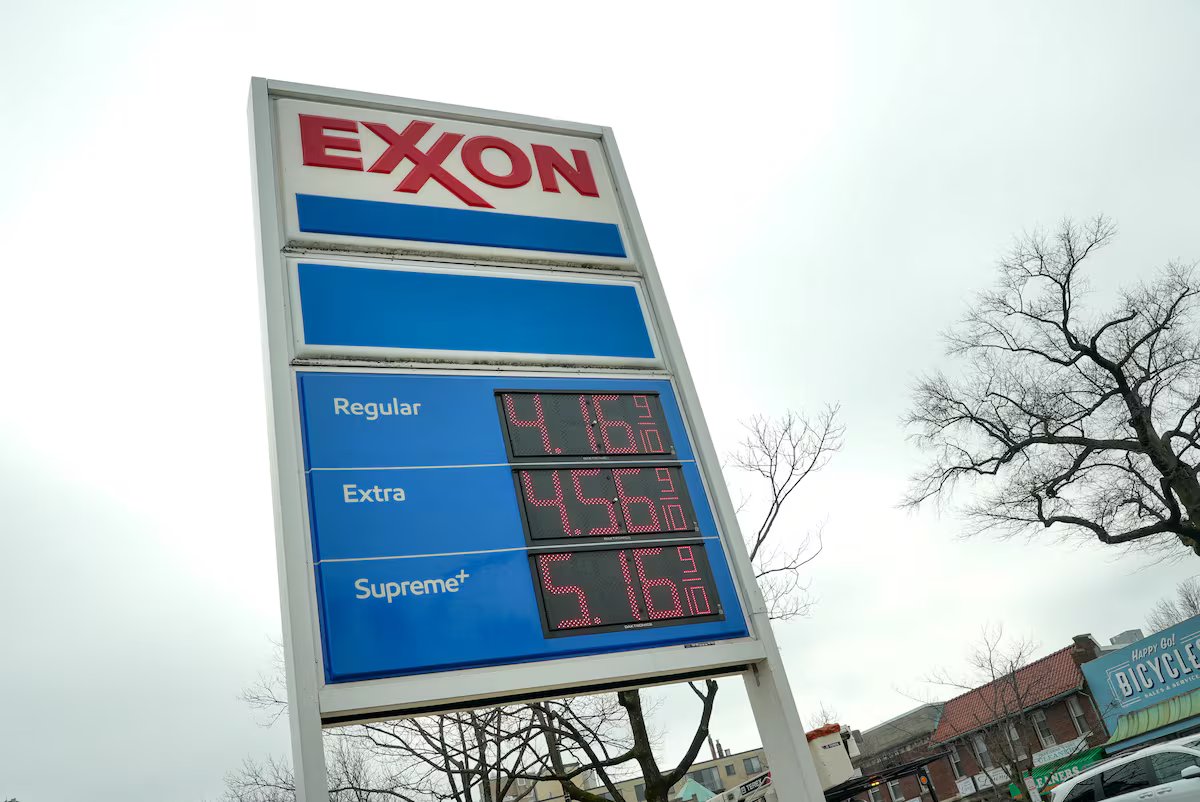
Gas currently costs more than $4 s a gallon, nearly 35% more than before the bombing in the Persian Gulf. Diesel is nearing its all‑time high from four years ago and is trading above $5.50 per gallon. The oil shortage caused by the war in the Middle East has driven a surge in fuel prices.
Could the United States — the world’s largest oil producer — go ahead and increase its production, in order to try to compensate for the loss of supply from the Strait of Hormuz? Is there anything the world’s largest crude oil producer can do to lower prices?
At the end of March, Trump boasted to the world about the United States’ oil-producing power. “Number 1, buy from the U.S., we have plenty, and Number 2, build up some delayed courage, go to the Strait, and just TAKE IT,” Trump told allies in a Truth Social media post.
The United States is the world’s largest crude oil producer: its production reached a record five billion barrels per year in 2025 — more than 13 million barrels per day — thanks to the fracking industry’s development over the last two decades. This drilling technique involves injecting a mixture of water, sand and chemicals into rock formations to extract shale, which is rich in oil and natural gas.
According to data from the International Energy Agency (IEA), if other components — such as ethanol or liquefied petroleum gases — are included, U.S. oil production rises to 21.2 million barrels per day, double that of Russia or Saudi Arabia.
However, contrary to what Trump proclaimed — using his well-known slogan “drill, baby, drill,” with which he promised Americans cheap oil — the U.S. capacity to increase production is limited. Iran announced a new closure of the Strait of Hormuz last Saturday, but even when it reopens, it will take months for energy markets to stabilize. As the IMF’s managing director, Kristalina Georgieva, explained this week: “A tanker is a slow‑moving vessel. It will take 40 days to get all the way to Fiji [from the Middle East]. So, we need to be prepared that the impact of these supply disruptions in the weeks ahead is going to deepen.” The consequences of the conflict will linger for months.
“All previous energy crises involved partial disruptions,” says Scott Modell, CEO of Rapidan Energy, a major energy consulting firm. “The 1973 Arab embargo eliminated approximately four to five million barrels per day. The 1979 Iranian Revolution eliminated four to six million barrels. The 1990 Gulf War eliminated about four million. The current crisis has eliminated around 13 million barrels per day. There’s no historical precedent for a supply shock of this magnitude,” he warns.
“The United States is producing a lot of oil right now, but of a very specific type, a very light crude,” explains Jorge León, the vice president and head of Geopolitical Analysis at the consulting firm Rystad Energy. “And most of the country’s refineries are for heavier crude, which it needs to import from countries like Venezuela. To the question of whether the U.S. can quickly increase its production with prices now so high, the answer is ‘no.’”
Certainly, U.S. production cannot be increased to the extent necessary to compensate for the loss of supply caused by the blockade of the Strait of Hormuz, which — so far — is estimated at about 10 million barrels per day, not counting petroleum derivatives.
“The United States is the world’s largest oil producer, but it can’t drill its way out of this crisis,” Modell explains. “Shale fields are already operating near their maximum capacity. And the crude oil coming from the Permian Basin is of insufficient quality for many U.S. refineries.”
The IEA estimates that the U.S. could increase its crude oil supply by about 250,000 barrels per day by the end of the year, but only if the fracking industry is willing to ramp up activity. Experts estimate that hydraulic fracturing — the technical term for “fracking” — is only profitable when prices are above $62 to $70 per barrel, according to the Federal Reserve Bank of Dallas.
“A few years ago, fracking was very sensitive to the price of oil: when the price rose, production increased significantly,” says León. “But once the wells have matured — and we’ve already had 15 years of fracking production — it’s much more inelastic.”
U.S. oil companies are rubbing their hands together, but, just like the characters in Landman, they also don’t want oil at more than $100 a barrel, which could destroy demand, wipe out investment and increase uncertainty… “realities that no energy company wants,” Modell warns.
Opening new fracking wells isn’t easy. About 15 years ago, when the fracking craze began, dozens of small U.S. companies jumped into the business. But in the years that followed prices fell and many of them disappeared; others were absorbed by oil giants such as Exxon or Chevron. Industry executives reference that era whenever they urge caution about opening new wells. And, for now, as there’s less of a profit margin, they’re in no hurry to increase oil production. Without guarantees of high prices, new investments won’t be accelerated, as they’ll take almost a year to reach full output.
According to the energy consultancy Baker Hughes, the United States has 545 active oil and gas drilling rigs, or almost 7% fewer than last year. Most are located in the Permian Basin, a large, oil-rich area stretching from Texas to New Mexico. “In the previous cycle, shale provided a rapid supply response when prices rose. But that flexibility is now more limited,” says Mark Lacey, head of Thematic Equities at Schroders.
For the IEA, “beyond infrastructure, operational and organizational constraints are also weighing on activity.” The agency further emphasizes that “the United States is the developed economy where market prices are most directly and completely passed on to [consumers].” Gasoline and diesel prices have risen by 40% and 52% respectively over the last two-and-a-half months, from mid-February — just before the start of hostilities in Iran — until Friday, April 18, according to data from the American Automobile Association (AAA). Quite a paradox for the world’s largest oil producer.
Less than two months ago, during his State of the Union address, Trump boasted about having lowered gas prices to historic lows. But now, this has become a major headache for him. Rising gas prices are a sensitive issue in the United States: the cost of filling up your tank is inversely proportional to the president’s approval rating. The price of gas galvanizes social discontent in a vast country with a high volume of commutes.
Trump is worried. With less than six months until the midterm elections — where much of his political power for the remainder of his term is at stake — his approval rating has plummeted to an all-time low. In this complicated scenario, he has sent contradictory messages about fuel prices. On the one hand, he has said that Americans will have to bear the high cost of achieving peace with Iran; and, on the other, he has indicated that gas prices will drop quickly as soon as the war ends.
The “drill, baby, drill” slogan — which Trump touted during the 2024 campaign that led to his reelection — is not playing out as promised. Nor is full oil self‑sufficiency. The U.S. needs to import heavy crude from countries like Mexico, Canada and Venezuela to supply its refineries, which predate fracking technology. Around 40% of U.S. refining capacity comes from these imports, more than half of which is Canadian crude. In this context, the heavy oil being imported from Venezuela is also significant.
In 2025, the United States produced more than 13 million barrels of crude per day but imported another 6.2 million, according to data from the U.S. Energy Information Administration (EIA). It leads the world in crude production, yet not at levels sufficient for self‑sufficiency. Its dependence on crude from Gulf countries is minimal. And the U.S. economy benefits from its overall strength and from oil consumption that is far less intensive than in the past.
Sign up for our weekly newsletter to get more English-language news coverage from EL PAÍS USA Edition
