
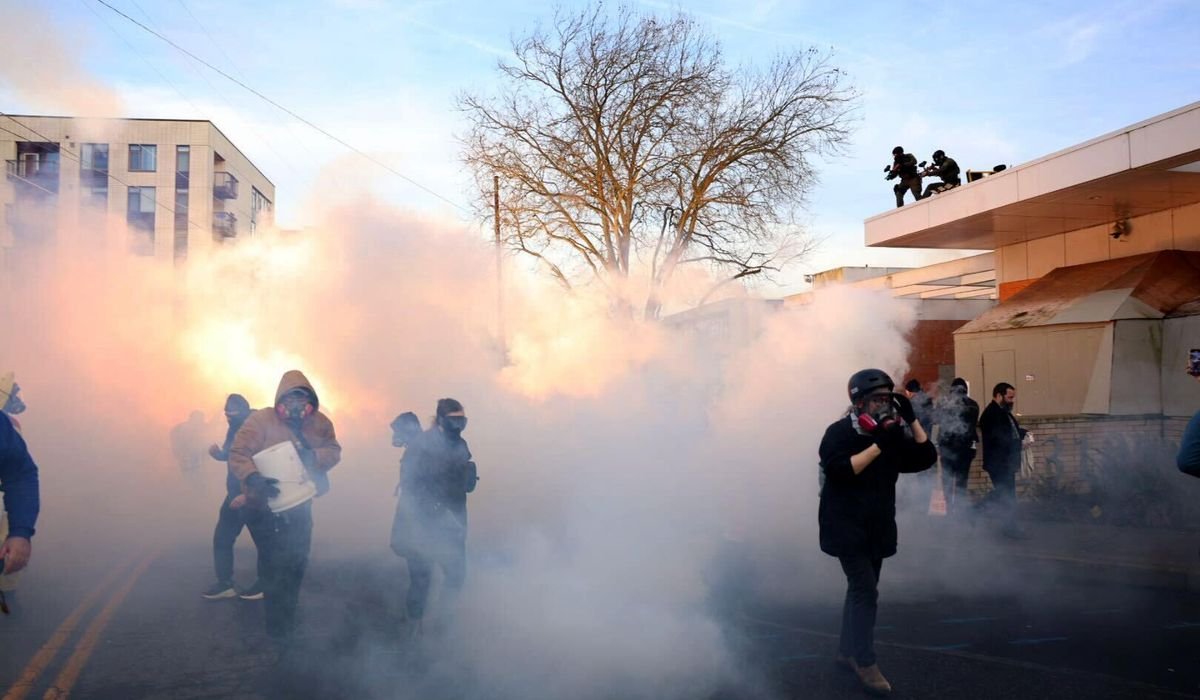
A federal appeals court blocked a lower court ruling that had found ICE went too far in suppressing riots in Portland, Oregon, saying the officers weren’t retaliating against protesters but rather trying to clear out an unruly crowd.
The 9th U.S. Circuit Court of Appeals, in a 2-1 decision Monday, said demonstrators were engaged in clearly illegal activity but state and local authorities refused to respond, due to their “sanctuary” policies.
So U.S. Immigration and Customs Enforcement had to take matters into its own hands.
The court said some of ICE’s conduct may have strayed over the line, but they said that wasn’t evidence of a broad, unwritten policy to punish protesters who were exercising their First Amendment rights.
Even if ICE had such a policy, the court said, the lower judge was wrong to bar common crowd-control tactics and order a redesign of officers’ uniforms.
“Federal courts are not the couture of law enforcement officers,” wrote Judge Kenneth Lee, a Trump appointee. He was joined by Judge Eric Tung, also a Trump pick.
Homeland Security’s crowd control tactics have come under scrutiny as anti-ICE protests erupted last year at migrant detention and processing facilities from California to New York.
Demonstrators have sought to obstruct migrant arrests and hinder access to ICE facilities, and Homeland Security has responded with force, seeking to clear paths and push back demonstrators.
Three protesters and two freelance journalists challenged ICE, saying it went too far in Portland, one of the most prominent places for anti-ICE violence.
But the 9th Circuit said that while the five said they were engaged in protected First Amendment activities, they were too close to demonstrators who crossed lines.
In one incident recounted by the court, protesters showed up with bats, shields and other improvised weapons and blocked entry, refusing to disperse despite warnings. When protesters began to take down slats from a fence, ICE responded with pepper balls.
That night, demonstrators set up a guillotine, blocking ICE’s driveway. Though that action is against the law, the court said, “sanctuary” laws meant neither state nor local police would respond. So ICE had to act alone, again firing pepper balls.
That’s when Hugo Rios, one of the plaintiffs, was hit.
Similar scenarios played out with the other plaintiffs.
The appeals court said that undercut District Judge Michael Simon, an Obama appointee, who’d ruled there was no justification for federal officers to use pepper balls or chemical sprays.
“Instead, the record reveals law enforcement’s response to a substantial degree of violence, obstruction of law enforcement, and unrest — with protesters repeatedly trespassing onto the ICE facility, blockading the facility’s gates, vandalizing federal property, and attacking federal officers,” Judge Lee wrote.
Dissenting Monday was Judge Ana de Alba, a Biden appointee.
She said it was too early in the case to conclude that ICE was justified in its response to the demonstrations.
She catalogued a series of 27 actions the lower court said supported the idea that ICE went too far.
“To me, the videos are just as the district court describes: ‘unambiguous and disturbing,’” she wrote.
