
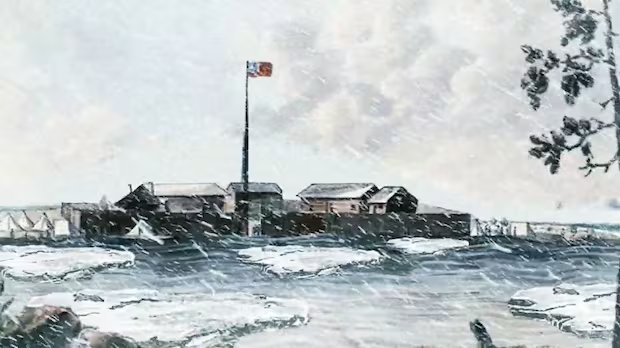
The drizzly afternoon stillness in the nascent Red River Settlement 200 years ago was detonated by explosions of ice slabs heaving and splitting and colliding.
A powerful onrush of water then sent settlers scrambling from wooden homes to higher ground.
“Far as the eye could discover, the earth was covered with water carrying on its surface the wreck of a whole colony,” pioneer John Pritchard wrote on Aug. 2, 1826, just a few months after the flood began.
“It presented a scene of devastation dreadful to contemplate and very difficult to describe.”
The flood was the largest in the recorded history of the entire Red River watershed, which spans eastern North Dakota, northwestern Minnesota and southern Manitoba, Parks Canada historian Scott Stephen said in an interview.
“One of the defining aspects was the force and the fury. It’s just terrifying to read. It’s like a horror story.”
The spring of 1826 was delayed by an exceptionally cold, snowy winter that created a thick snowpack. When it finally arrived and the ice broke at the forks of the Red and Assiniboine rivers on May 5, it came with a clamour.
“The crashing of immense masses of ice was loud as thunder,” Pritchard wrote in his letters, which were later shared with the Manitoba Historical Society by grandson Samuel Pritchard Matheson.
As the water breached the riverbank, it surged across the land with spectacular force.

It wielded the crags of ice like scythes that sliced effortlessly through trees and obliterated dwellings, carrying the kindling away.
“Neither the tallest poplar nor the stoutest oak could resist its impetuosity. They were mowed down like grass,” John Pritchard wrote.
Some 47 homes, as well as barns and stables, swirled downstream within half an hour, according to eyewitness Francis Heron, a Hudson’s Bay Company clerk who detailed the destruction in a post journal — a record kept by Hudson’s Bay employees at trading posts across North America.
“The house[s] of the settlers were one instant seen standing, and the next not a vestige was to be discovered.”

Only three churches and a grist mill in the fledgling settlement, founded in 1812, survived. Various historical accounts indicate that 13 people died, though some say only one and others say five.
The flood heavily damaged the original wooden Fort Garry, which stood on the bank of the Red, and buildings within. Fort Douglas, located along modern-day Waterfront Drive, was left in ruins.
‘Like a biblical flood’
“If 1997 was described as a once-in-a-century flood, 1826 was a once-in-a-millennium flood,” said historian Stephen.
“It’s like a biblical flood, and people are desperately scrambling to save what they can. There’s this moment of despair and terror that I cannot wrap my head around.”

In his journal, HBC chaplain Rev. David Thomas Jones recorded severe damage to St. Paul’s Anglican Church, which had been built just months earlier north of the settlement, in what is now Middlechurch.
The current drove out the glass windows, shattered the pews, swept away the pulpit and stripped the plastering off the wall, he wrote.
The flood had an estimated peak flow of 225,000 cubic feet per second and crested nearly 37 feet (11 metres) above normal levels on May 22.

In comparison, the 1997 flood had a peak flow of 162,000 cubic feet per second and crested at 24.5 feet (about 7.5 metres) in Winnipeg. Without the Red River Floodway redirecting excess water around the city, though, that crest would have been closer to 35 feet (about 10.7 metres).

The 1950 flood, which destroyed some 10,000 homes in Winnipeg and prompted the creation of the floodway, peaked at 30.2 feet (9.2 metres) and had a flow rate around 105,000 cubic feet per second.
Wet fall, wicked winter set stage
The stage was set for the 1826 event before winter even set in.
The ground was saturated from an unusually wet fall, and in December a blizzard entombed the settlement in snow so deep that it led to a famine.
The weather chased bison herds further south, beyond the reach of hunting parties. Many hunters became trapped, separated from their camps. An estimated 33 froze to death or died from exhaustion, Alexander Ross wrote in his 1856 book The Red River Settlement: Its Rise, Progress, and Present State.
A series of intense, sustained blizzards lashed the settlement through the winter, and some settlers resorted to eating horses and dogs to survive, according to Ross, a pioneer who later became sheriff and de facto historian in the Red River.

Temperatures plummeted below –40 C for stretches of time, thickening ice on the river to 5.5 feet (around 1.6 metres), according to Ross. That and the snowpack resisted early spring thawing, while a mixture of rain and sleet added to the dampness.
By May 3, the river was at the previous year’s flood stage but still ice capped. Some settlers sensed what was coming and headed to the hills with livestock.
Those on the west bank of the Red went to what is now Little Mountain Park, just northwest of present-day Winnipeg, and further north to the limestone ridges near what is now Stony Mountain. Those on the east bank scattered to Pine Ridge, now known as Birds Hill.
But some remained and when the sun’s rays grew more intense, the melt happened quickly.
When the ice broke on May 5, the water rose nine feet (2.7 metres) in 24 hours, according to Ross.
“The people had to fly from their homes for the dear life, some of them saving only the clothes they had on their backs. The shrieks of children, the lowing of cattle, and the howling of dogs, added terror to the scene,” Ross wrote.
“The most singular spectacle was a house in flames, drifting along in the night, its one half immersed in water, and the remainder furiously burning. This accident was caused by the hasty retreat of the occupiers.”
The Assiniboine River ice broke up two days later, sending another surge that “made the scene as destructive as terrific,” Hudson’s Bay clerk Heron wrote in his journal.
Settlers with boats rescued others huddled on rooftops before the structures collapsed and washed away. HBC employees in other boats retrieved the dead from “watery graves,” he wrote.
People began returning to their land by mid-June to rebuild their lives. But it wasn’t until July 2 that the water receded to within the riverbanks.
“Members of our little colony in olden days camped comfortably for weeks together until the tyranny of the waters was past,” pioneer descendant Samuel Matheson wrote.
Some, though, never returned. A few colonists returned to Europe, while some relocated to the United States, including Peter Rindisbacher, an artist who had lived in the colony since 1821. His drawing of the 1826 flood is the only known image.

In all, about 250 of the 2,000 settlers left — mostly Swiss and Germans. The rest returned and started over.
Those who did go freed up land that helped forever change the face of the settlement, said Stephen.
Métis families moved into the vacant river lots in St. Boniface and St. Vital and “within just a few years of the flood, we really start to see the demographics of Red River shift from a few different European populations to become an increasingly Métis one.”
The Hudson’s Bay Company also changed location. It built a stone fort — Lower Fort Garry — downriver on drier ground near present-day Selkirk.
But the decision ultimately proved unpopular, being so far from The Forks, which had been a gathering and trading centre for thousands of years among First Nations. It’s the same reason the settlers stubbornly remained.
So in 1835, the HBC rebuilt at the Red River settlement, but further from the riverbank and with stone walls 4.5 metres high.

For many years, pioneers like Andrew McDermot kept their guard up for the next inundation, having also lived through the 1852 flood, which was nearly as bad.
“[He] was so confident that the menace had not passed that he kept a large York boat at the back of his house at the foot of what is now McDermot Avenue … caulked ready,” Samuel Matheson wrote.
It’s just a matter of time until a massive swell arrives again, and though it would be difficult, Winnipeg is now far better equipped, said Parks Canada’s Stephen.
Hydrology, engineering and population size provide an edge the settlers didn’t have.
Science can better predict floods, people and machinery can be mobilized to build dikes, and the floodway has been enlarged to handle an 1826-magnitude event.
“Fingers crossed we never have to face that sense of terror again,” Stephen said.

On May 5, 1826, surging water from the Red River swept away the settlement that would later become Winnipeg in the area’s largest known flood.
