
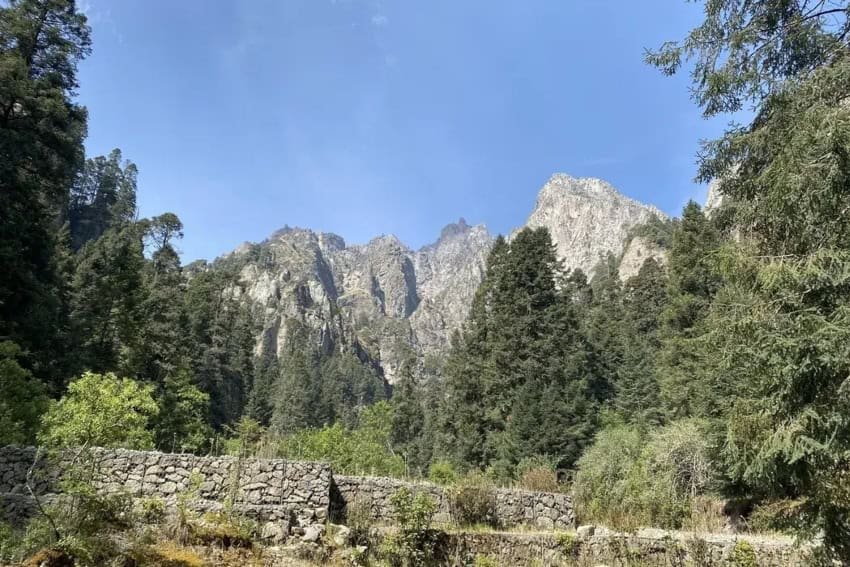
Upon entering La Malinche National Park from its eastern slopes — coming in from Veracruz, through the pueblo mágico of Huamantla in Tlaxcala — you can grasp the sheer magnitude of La Malinche. Listed as Mexico’s sixth-tallest peak, the inactive volcano rises with muscularity above the desert surroundings. The adjacent hills and peaks in the region are dwarfed by La Malinche’s vast circumference, which takes up a large chunk of real estate in Tlaxcala, and also creeps into the bordering state of Puebla.
At roughly 4,500 meters high, and occupying 458 square kilometers, La Malinche is an ideal getaway for mountain climbers, hikers and campers in central Mexico — with plenty of outdoor space to roam, explore and stay overnight. Roughly two and a half hours from Mexico City’s bustling core, and a short drive from Puebla’s International Airport, it’s conveniently located, yet surprisingly tranquil and only lightly visited.
A microhistory of La Malinche
The name Malinche (or Malintzin) refers to the historical figure of that title, an Indigenous woman who was enslaved by the Spanish and served as interpreter and advisor for Hernán Cortés during the conquest of the Mexica. Though “Malinche” generally denotes a negative connotation in Mexico, akin to being called a “Benedict Arnold” in the United States (a Revolutionary War hero who turned traitor), Tlaxcaltecos have a different view on her role in Mexico’s history. Rather than scorning her, she is viewed as a crucial ally because she facilitated an alliance between the Tlaxcalans and Cortés against their rival oppressors, the Mexica. That is, Malinche, in their view, is a key person who helped to liberate the region from Mexica control.
The mountain’s original name, as denoted by Indigenous communities, is Matlalcueye or Matlalcuéyatl, which roughly translates to “lady of the blue skirt,” and refers to a goddess of rain and water. In folk tradition, Matlalcueye (or Malinche) has always been paired with the volcanic peak of Poyauhtecatl (or Pico de Orizaba, the tallest in all of Mexico, located in neighboring Veracruz) as a feminine and masculine pairing.
The making of a national park
Today, La Malinche is an underrated destination for Mexico’s outdoor crowd — cyclists, bikers, mountain climbers and families camping for a weekend. Its national park designation was anointed in 1938 in an effort to conserve its unique, biodiverse ecosystem. The National Commission of Protected Natural Areas (CONANP) in Mexico has formally designated, and is tasked with managing, 79 national parks — in addition to 232 total areas that are federally protected — ranging from rainforests that surround archaeological sites in Chiapas, Monarch biosphere reserves in Michoacán and over 3,000 square kilometers of coral reefs off the coast of the Yucatán Peninsula. (Trivia bonus: the first national park to be inaugurated in Mexico’s history is Desierto de los Leones, established by then-President Venustiano Carranza in 1917 on the outskirts of Mexico City.)
Today, La Malinche is a well-kept bastion of pine and oak trees, bisected with smoothly paved roads that wind through the high-altitude grasslands and dense forests, leading in and out of both Tlaxcala and Puebla on either side of the volcano. To enter the park by vehicle, you must cross a series of free checkpoints, where attendants can answer your questions — to the best of their abilities — and guide you through the park.
On the mountain’s north-facing side, there is the Malintzi Vacation Center (appearing as Resort IMSS Malintzi on GPS) — an easy-to-reach, all-inclusive lodging area replete with rentable cabins, courts, playgrounds and areas for grilling. Be sure to reserve in advance, as that section of the park doesn’t always seem to be open (in a recent trip, my family found out the hard way that many sections of the park don’t seem to be open on certain hours of weekdays, although it’s still unclear to me what those hours are).
A mountain climber’s paradise
When visiting without a toddler or physically incapable family member, the majority of La Malinche’s visitors go to climb. The trail is listed as an intermediate level, with an approximate 5 to 8-hour round trip. It’s used by climbers-in-training as a way to acclimatize for higher peaks. The trail includes pine forests and, towards the summit, alpine tundras, depending on the season. November to March are dry seasons, but you are more likely to see snowfall, so prepare accordingly. Ice, strong winds and cold temperatures are highly probable in December and January.
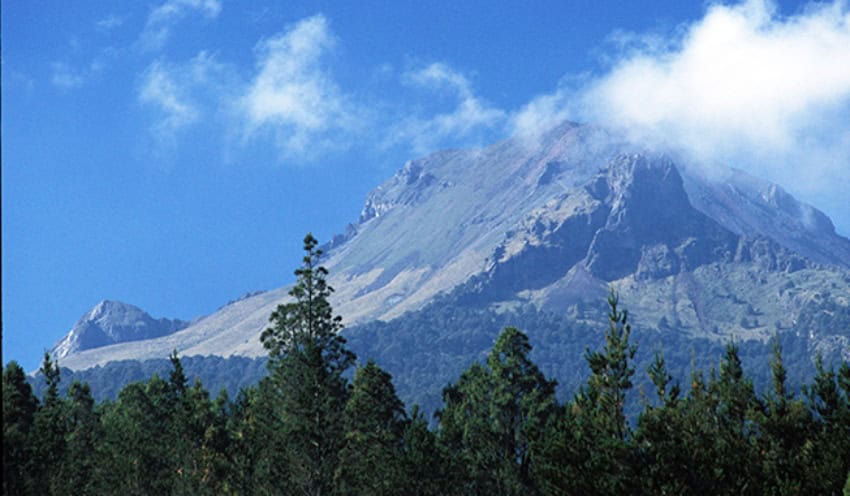
One notable element from my visit to La Malinche, and its surrounding towns — which include beautiful haciendas, cabins, saunas and more, often with a ridiculously unreal vista of the celestial peak — is the amount of friendly, stray dogs. There are reports of such dogs accompanying hikers and climbers to the mountain summit and back. Just as common are writing and experiences that describe a “false summit” frustration; the trail has many areas that appear to be the end, only to reveal more rocky terrain ahead.
Descent to cold beer
One experienced American climber describes his descent, after reaching the top, in hilariously true Mexican fashion: “After a snack and some photos, we descended, boot skiing down the scree slope and dropping 1500′ in what seemed like only a few minutes. The formerly slow and steady [guide] Roberto was now flying down the slope, his mass and inertia sending him down at an impressive speed. I could barely keep up! We made it back to the cabins in about 2 hours from the summit, and Roberto headed straight for the park restaurant for a Modelo, ‘the cream of Mexican beers!’” The beauty of mountain climbing in Mexico? You can hang out with friendly locals and drink bang-for-your-bucks Mexican brews, then maybe explore some nearby ruins the following day.
National treasures
Though the U.S., in contrast to Mexico, is internationally renowned and revered for its extensive national park system and plethora of outdoor offerings, Mexico — the geographically 13th largest territory on Earth — isn’t something to scoff at, either. A day or two exploring La Malinche and its provincial peripheries will prove that Mexico is, in fact, more than just beach getaways and taco tours — it’s also a naturally abundant and well-resourced land with national parks that await.
Alan Chazaro is the author of “These Spaceships Weren’t Built For Us” (Tia Chucha Press, 2026), “Notes from the Eastern Span of the Bay Bridge” (Ghost City Press, 2021), “Piñata Theory” (Black Lawrence Press, 2020), and “This Is Not a Frank Ocean Cover Album” (Black Lawrence Press, 2019). He is a graduate of June Jordan’s Poetry for the People program at UC Berkeley and was selected as a Lawrence Ferlinghetti Poetry Fellow at the University of San Francisco. His work can be found in NPR, The Guardian, SLAM, GQ, L.A. Times, and more. He is currently based in Veracruz.
