
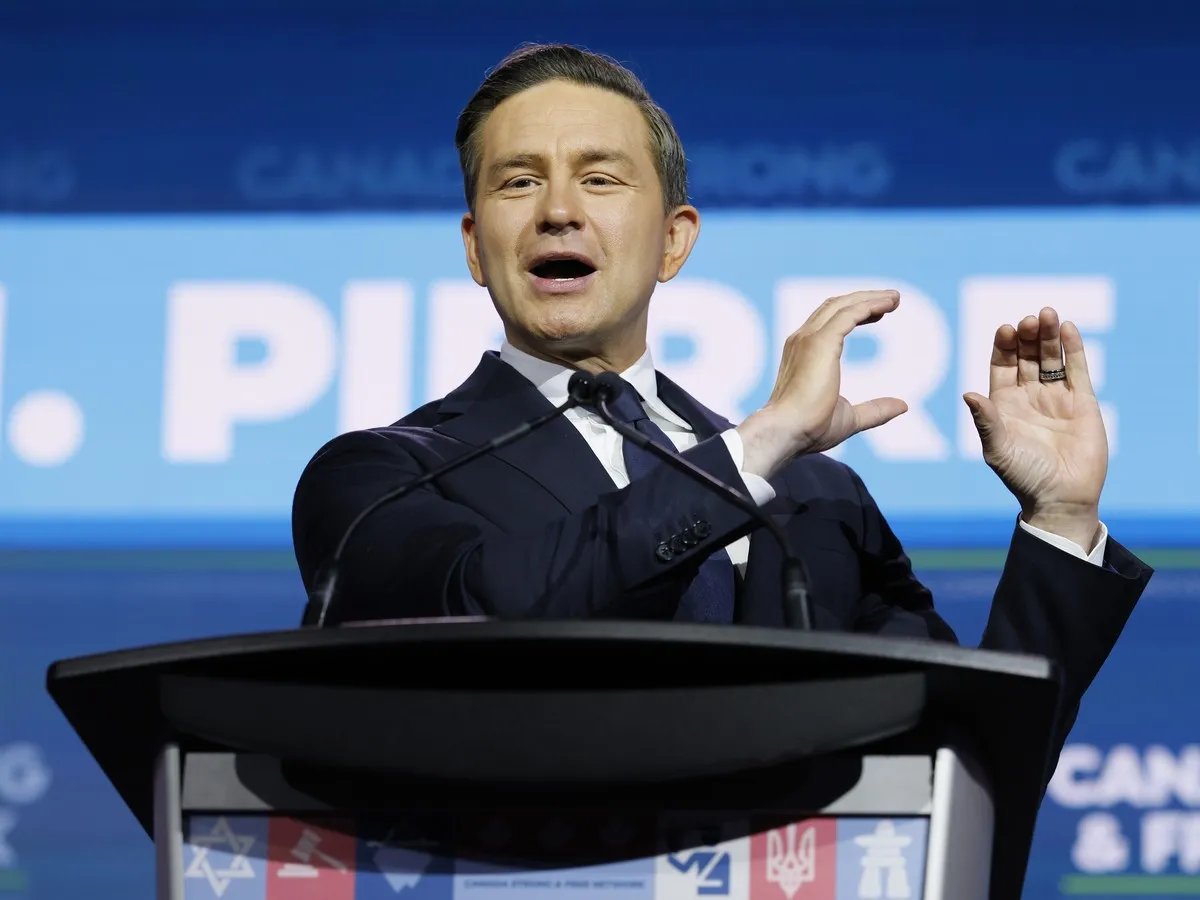
OTTAWA — When Conservative Leader Pierre Poilievre took the stage at a conservative networking event in Ottawa on Thursday, he posed a question many in his own party are asking.
“Where do we go from here? Where do things stand right now?”
The Conservative leader made his query in a hotel conference room minutes from Parliament Hill, where his party’s MPs find themselves squarely nestled into the Opposition benches after Prime Minister Mark Carney secured a majority government through a mix of byelection wins and five MPs who defected to the Liberals, four of whom came from Poilievre’s own party.
Taking to the stage at the annual Canada Strong and Free Network conference, Poilievre made one thing clear at the end of his roughly 20-minute speech: He’s not going anywhere.
“I keep fighting and I hope you will too.”
Those gathered at this week’s event, billed as the annual place to be for conservative activists, think tanks, party strategists, lobbyists and other supporters, did so under much different circumstances than previous ones.
The days of riding high in the polls, facing a near certain chance of forming government against a deeply unpopular prime minister after being shut out of power for close to a decade, have instead been replaced with the reality of seeing the Liberals return to majority rule under a popular prime minister , while questions swirl about Poilievre’s and the party’s future, including from within his own caucus.
What used to be hallway conversations and gossip over drinks about which of Poilievre’s MPs would form his cabinet and what he would do first as prime minister have been swapped for more existential ones, about what the party ought to spend its next three years doing and where, as Poilievre asks, should it go next.
“The Liberals have used fear, delusions and never-ending crises in order to seize and expand on democratic power. And all of that begs the question of where we go from here? Where do things stand right now?”
Poilievre began his address on Thursday with what he called the “good news.”
“We have won every single debate on every single public policy issue in the last decade,” he said to the sound of applause.
“On inflation, carbon taxes, housing, drugs, crime, resource development. We’ve been proven right on all of those issues where Liberals demonized us and acted and spoke in exactly the opposite direction.”
When it comes to Carney’s policy reversals, Poilievre criticized the prime minister’s about-face on Trudeau-era ideas, saying they amount to an “illusion,” a word he used no fewer than 13 times.
“The illusion was that he would be more moderate, maybe even a little bit conservative, but the reality is that he’s not changed the Trudeau agenda.”
That agenda, according to Poilievre, has been “accelerated,” by bigger deficits and more spending — measures that the Carney government has said will boost the country’s defence spending and provide financial support for industries struggling with U.S. tariffs.
As for the Canada-U.S. relationship, the Conservative leader took aim at the lack of a trade deal to see those levies removed — arguing in favour of returning to “tariff-free” trade — and Carney’s language about the country’s “rupture” with the U.S.
“We must reject the idea of a permanent rupture with our biggest customer who has two-thirds of our goods in favour of a strategic partnership for a new world order with Beijing,” Poilievre said, again to applause, this time referencing the closer trade ties Carney has sought to form with China.
At least half a dozen times Poilievre also pointed out to the crowd what he sees as remaining “unchanged” under Carney, from spending levels and his yet-to-be finalized criminal code reforms on bail, to Liberal policies around energy and housing affordability.
“What really has changed, really?” Poilievre said at one point. “Strip away the adjustments for style and image and ignore speeches and promises. What is different a year later?”
“Mark Carney is just another Liberal.”
As for his diagnosis of what Conservatives should do next, Poilievre provided an answer in saying, “we have to remember what and who we are fighting for” and be as an Opposition a “voice for the voiceless.”
Poilievre defended his fight, not just referring to the millions of Canadians who voted for the party’s message in the last election, but on a more personal level.
“Some people have accused me of being a fighter, but that’s because some things are actually worth fighting for.”
National Post
Our website is the place for the latest breaking news, exclusive scoops, longreads and provocative commentary. Please bookmark nationalpost.com and sign up for our politics newsletter, First Reading, here.
