
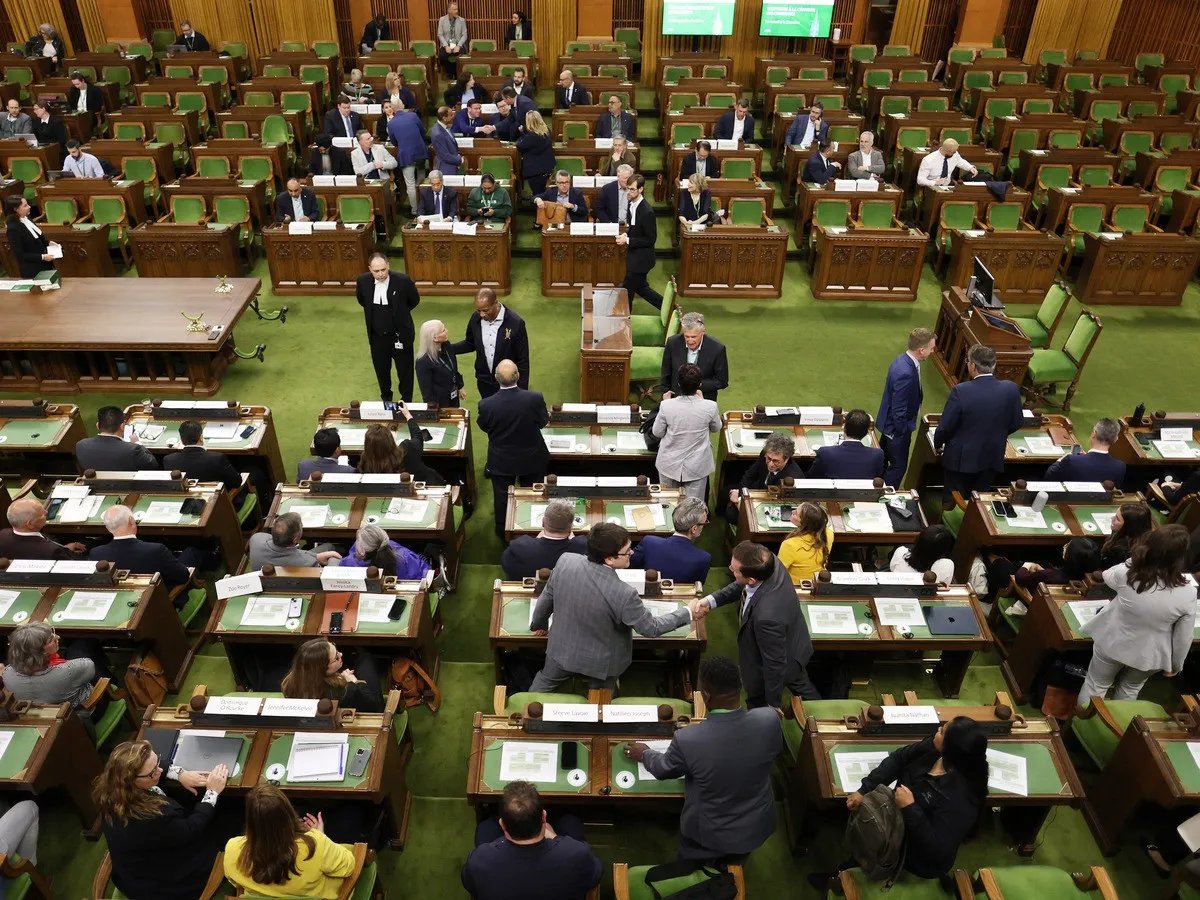
OTTAWA — Government ministers and opposition critics can add a new perk to their frontbench roles when the House of Commons moves back to Centre Block: desks.
A mock-up of the proposed future House of Commons seating in Centre Block is on display in the Parliamentary precinct to allow Members of Parliament to comment on the design before it’s finalized.
According to the proposal, out is the over century-old setup of rows of two-person desks assigned to specific MPs on each side of the House when Centre Block reopens from its over decade-long renovations around 2032.
Instead, the life-size mock-up of a column of seats shows the two first rows of MPs on either side of the aisle getting desks, and backbenchers in the four following rows sitting on benches accommodating up to seven people.
Instead of desks, backbenchers will have access to tray tables that pull out from the back of the seat in front of them, similar to what is found in economy seats of airplanes. A bar along the top of the bench would accommodate a movable lectern to hold MPs’ speeches
The goal: allow for up to 400 MPs to sit in the same space that originally held 245 when Centre Block was last rebuilt in 1919. There are currently 343 MPs.
The new layout, which officials caution is not final (but getting close), is now being shown to MPs for feedback.
Among the questions being put to MPs this week: should the benches have fixed seating or cinema-style flip seats?
Are they willing to accept new, shallower desks with less storage space in the front rows?
Can they do away with arm rests, both on the chairs at the desks and the benches, to allow the space to be used more efficiently?
And, in another potential historic Canadian first: are MPs OK with moving to unassigned seating beyond the first two rows?
These may seem like trivial questions in a $5-billion reconstruction project, but as Centre Block’s House of Commons is being designed to last another 100 years or so, the choices made now will be both consequential and part of Canada’s heritage.
The decisions will also have significant impact on heritage items such as MPs’ chairs, desks and the century-old tables in the centre of the House of Commons.
The redesign is also an opportunity to address long-time MP complaints about their seating arrangements, such as the fact that it’s difficult to stand up straight when voting because limited space pushes their seat into the back of their knees.
Unsurprisingly, many MPs who viewed the new setup told National Post they have strong thoughts about the new proposal.
Many said they liked the idea of flip seats to allow for more room to stand when voting or speaking, but all lamented the likely loss of their own desk and integrated storage space.
Others questioned how they would get by MPs seated at the end of a bench if the only available seats were in the middle of the row (a question the House of Commons staff is also still grappling with).
A change to the U.K.-style bench system in the House of Commons also leads to a series of other logistical questions for Parliament staff.
How, for example, do the Common pages reach MPs to hand them notes, refill their glasses of water or set up the lectern to hold their speeches if the member is seated in the middle of a seven-person bench?
If the House shifts to unassigned bench seating, how does the Speaker know which MP (whom they call upon by naming their riding) is asking to intervene and where they are sitting?
A proposed solution: a card reader in front of every seat that would read an MP’s parliamentary pass and add them to a speaking queue visible to the Speaker.
And then, there’s the ceremonial mace.
Since the House of Commons needs more space to seat MPs, the latest design under consideration is a slightly slimmer clerk’s table, which sits in the centre aisle of the chamber dividing the government and opposition sides.
The ceremonial mace, which is carried in by the sergeant-at-arms at the beginning of every sitting and removed when the House suspends for the day, sits along the width of the north end of the table with the head pointing toward the government side.
But with a smaller table, the mace would protrude slightly on both ends, raising concerns among MPs and House staff that they might bump into the historic (and famously untouchable) artifact.
One option on the metaphorical table, two sources said, is to have the mace placed on the table parallel to MP benches rather than perpendicular.
It would be a first in Canadian history.
National Post
cnardi@postmedia.com
Our website is the place for the latest breaking news, exclusive scoops, longreads and provocative commentary. Please bookmark nationalpost.com and sign up for our politics newsletter, First Reading, here.
