
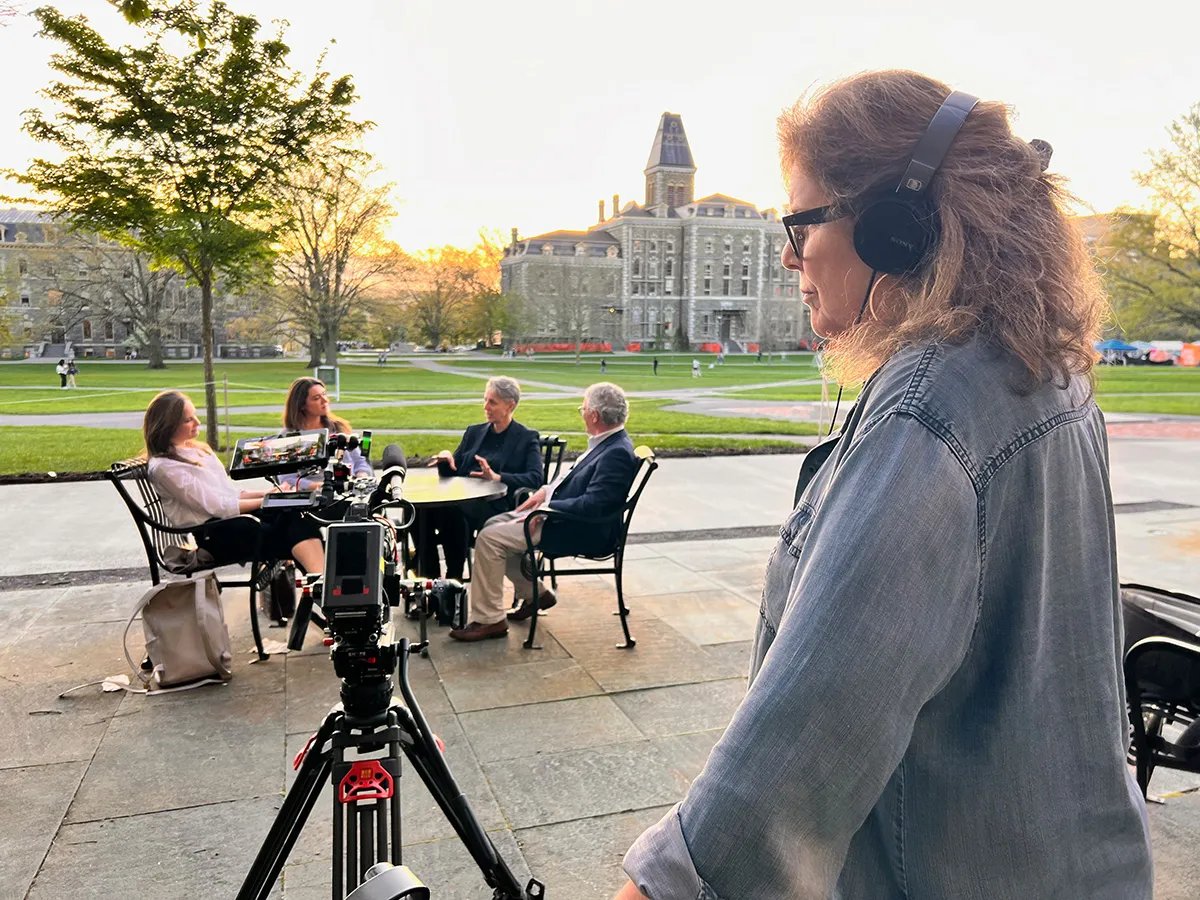
If you’re interested in how universities came to stifle ideas, Ric Esther Bienstock has made a movie for you.
Speechless , a new documentary for CBC and BBC about the political upheaval transforming universities in North America and the U.K., is now available on CBC Gem.
“For me, university was a place where you wrestled with new ideas,” the Emmy Award–winning director began in the film.
“Sex, politics, religion, war – we argued about all of it. But somewhere along the way, the climate changed. Students didn’t just disagree with ideas. They felt harmed by them. And the only way to feel safe was to silence the people expressing them.”
The Montreal-born Bienstock, who has long resided in Toronto, embedded with students, professors, and administrators at institutions including Harvard, Yale, Cornell, Stanford, Penn State, Evergreen State College, the University of Sussex, and New College of Florida.
What emerges is a character-driven portrait of how debates over race, gender, and social justice have escalated via viral outrage, reputational shrapnel, and institutional instability — and how campus flashpoints have migrated beyond university grounds.
Speechless brings together voices from across the ideological spectrum, from progressive organizers and critics of campus orthodoxy, to conservative activists and institutional reformers. Her cameras were rolling at New College of Florida as it became the first U.S. institution to dismantle its DEI office and eliminate its gender studies program.
Bienstock’s previous work includes Enslaved: The Lost History of the Transatlantic Slave Trade (with Samuel L. Jackson), The Accountant of Auschwitz , and Tales From the Organ Trade . She has won Emmys, two Edward R. Murrow Awards, and multiple Canadian Screen Awards, and is an Officer of the Order of Canada.
She spoke to Dave Gordon for National Post.
Walk me through how the film came about.
When I started filming, my kids were university age, and I started hearing stories coming out of campuses, about students wanting protection from ideas, and feeling harmed by words. I actually read an article in 2015 called “The Coddling of the American Mind” (Jonathan Haidt) that became a book, and it talked about safe spaces, microaggressions and cultural appropriation.
I just thought, ‘Wow, that didn’t mirror my university experiences.’ Of course, words can hurt people, but I didn’t see words or knowledge as harmful. Students asking for safe spaces from emotional harm — I found that just interesting, and I thought it would make for a good film.
An example is Bret Weinstein, former professor of evolutionary biology, at Evergreen State College in Washington, who opposed the school’s 2017 “Day of Absence” change. It demanded whites leave campus. He was called racist. I started filming when there were intense protests. He ultimately resigned when the school settled his suit.
I worried about higher education and what’s happening on campus. Higher ed is where we’re shaping the minds of the future generation of citizens, leaders, doctors, lawyers, policy makers, politicians and teachers. If you can’t engage with ideas that you don’t agree with, or that offend you, what does that mean?
I ended the film being concerned about democracy itself. A lot of the ideas that were starting on campuses really were bleeding out into society. People are walking on eggshells. I wanted to explore that, and why that happened.
Who do you believe is driving these speech issues — students, administrators, the cultural milieu…?
Initially I thought it was the students. I wasn’t a student in the ‘60s, but the birth of the free speech movement in Berkeley, was all about students wanting to be free from the administration telling them what to do.
They wanted to be able to protest things that were happening off campus, and I thought it was very student-driven. One of the things that I learned was that the administration and professor class was also part of this story.
Because the fear was so palpable, that’s what shocked me the most – the fear of being cancelled or socially ostracized. People were abandoned by their colleagues, and their friends, for asking questions, or for having certain ideas; it really silences people.
My producer and I spoke to hundreds of people who just said, ‘I want to keep my head down. I’m a student. I finally got in. I don’t want to ask a question, because it might piss somebody off. I can’t afford to lose marks or lose friends.’
Professors without tenure said, ‘I’m worried about offending someone in the class with a reading so I’m just going to change my reading list.’ If they get reported, then the administration will not have their back. We saw this happen again and again.
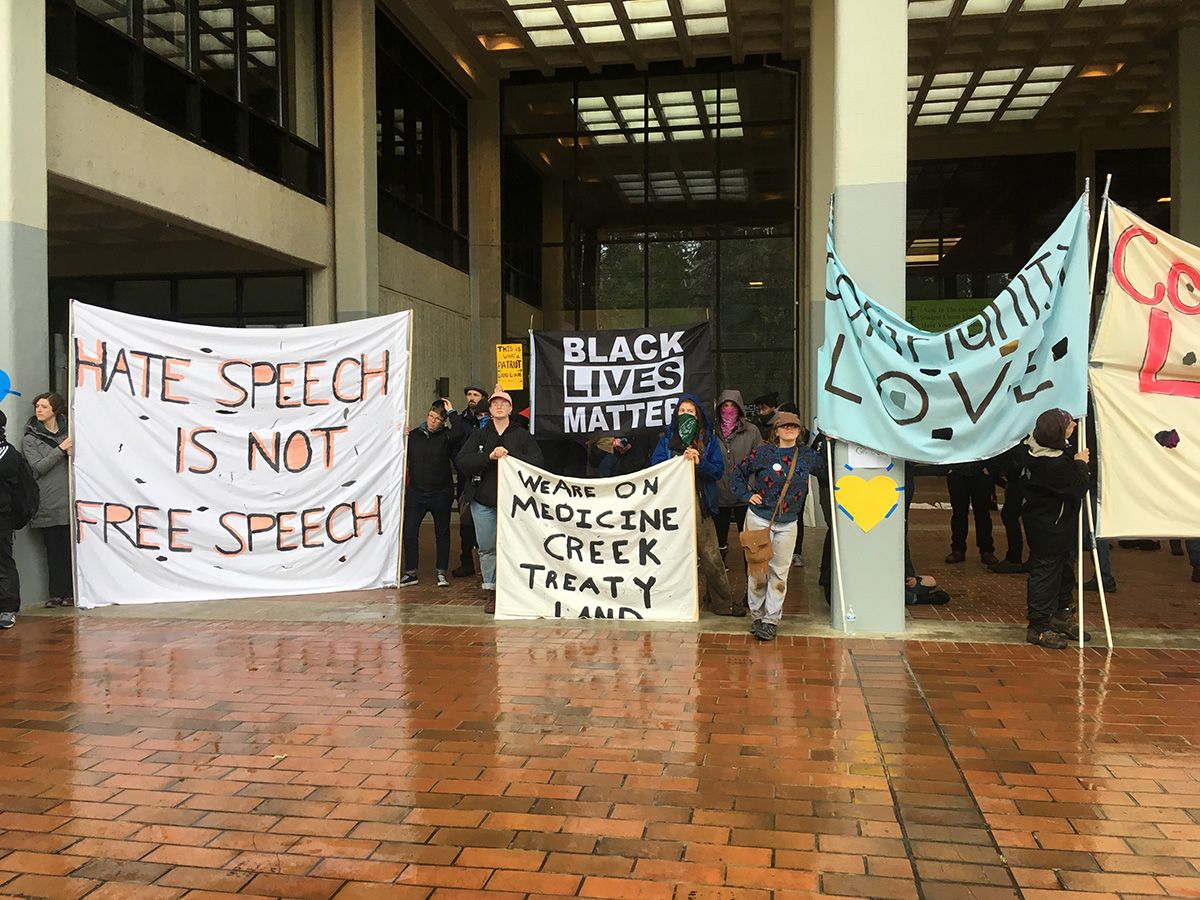
There’s self-censorship; there’s no free speech, rule or law or policy … very insidious. We can’t have dialogue on sensitive issues, like race, gender, October 7. We have the inability to speak across differences.
In the film’s Stanford example, a student chapter of the Federalist Society – a conservative legal organization with chapters at many elite law schools – invited Judge Stuart Kyle Duncan of the U.S. Court of Appeals for the Fifth Circuit to speak at Stanford Law School. Judge Duncan has taken positions against same-sex marriage.
Many law students protested his appearance, and tried to prevent the event from going forward, arguing that someone with his views should not be given a platform at the school.
What’s especially interesting is that the president of the Federalist Society chapter at Stanford is himself gay, and he doesn’t agree with some of the judge’s views. But he argues that, at a law school, students should be able to hear from a sitting federal judge, especially someone they may have to appear before, if they ever want to argue cases that could end up at the Supreme Court. You need to hear what he says, whether you agree with it or not.
When I spoke to students from that law school who would not speak to me on the record in the film – which says something also – they said to me, ‘why do I have to listen to someone who denies my existence, whose views I don’t agree with?’
I wanted to show you, and take you into that world, and then let viewers decide if they think it’s good or not.
At university, how can open-mindedness be facilitated?
If you want to live in a pluralistic society, you should expose yourself to different ideas, different views, different cultures. You can’t have institutions that are all monocultures.
We have to figure it out and change policy. I remember talking to PhD students at Harvard who, when I said this film is about free speech on campus, they recoiled – saying free speech was a right wing thing. When did free speech become a right wing dog whistle? That really surprised me. I kept saying free speech was foundational to democracy, it’s universal.
There’s a guy in the film, Erec Smith, associate professor of rhetoric at York College of Pennsylvania. He said of classical liberal values, that the problem isn’t the values in and of themselves. Rather, it’s not living up to those values. I wanted to hug him when he said that, because that’s the point.
This interview was edited for brevity.
Our website is the place for the latest breaking news, exclusive scoops, longreads and provocative commentary. Please bookmark nationalpost.com and sign up for our newsletters here.
