
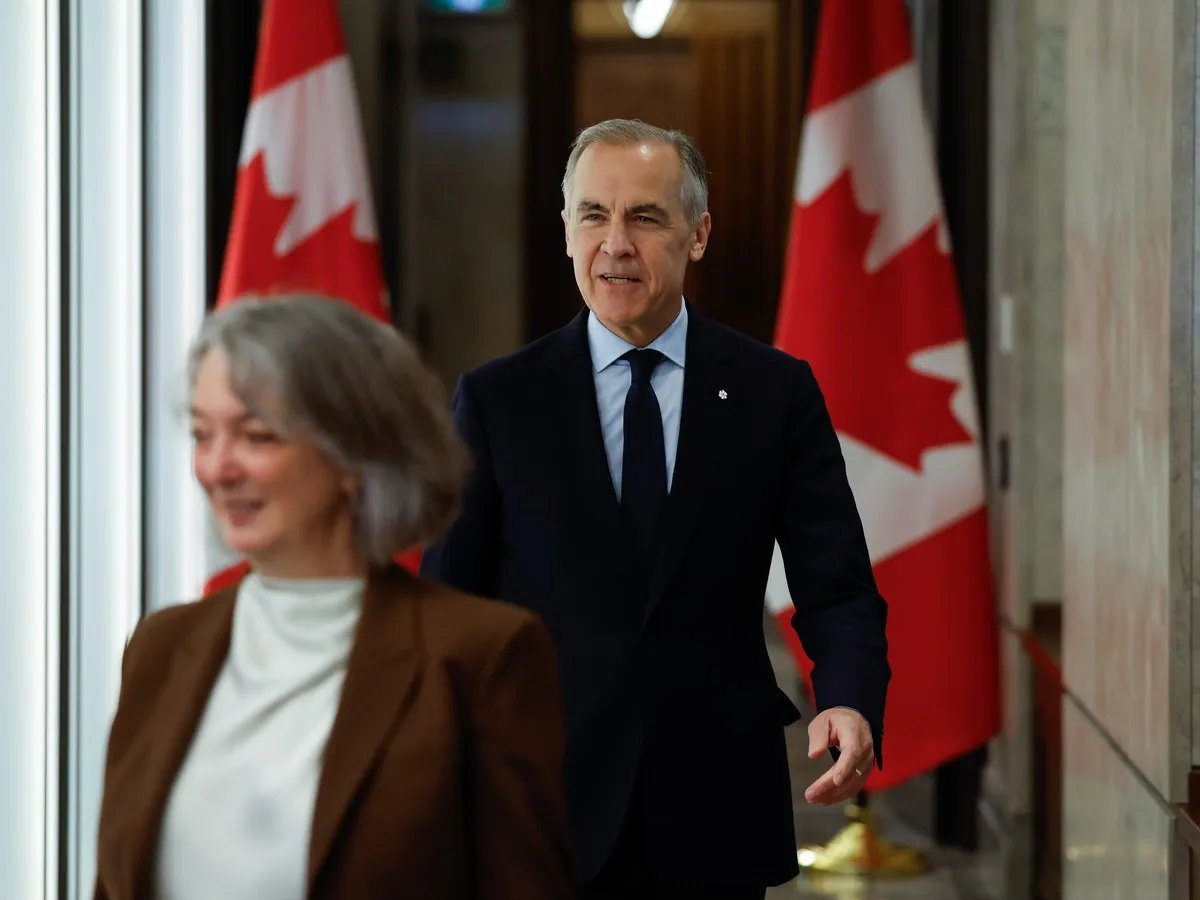
OTTAWA — Prime Minister Mark Carney announced his government’s intention to adjust clean electricity regulations on Thursday, in an effort double the capacity of Canada’s grid by 2050.
The announced change was part of the federal government’s new National Electricity Strategy.
As part of that strategy, the federal government will conduct consultations over “the next few months” with provinces and territories, Indigenous peoples, and utility industries and unions on how to best provide financing, labour and build out domestic manufacturing capacity to increase Canada’s grid output.
“As our industries expand, our economy grows, AI accelerates, electricity demand is expected to double by 2050, so we will double our grid,” said Carney, at a press conference on Thursday.
The announcement comes as Carney government seeks to accelerate the development of major projects like ports, mines, liquified natural gas export facilities and artificial intelligence data centres, which are projected to increase electricity demand.
The strategy includes several pillars: building out the infrastructure that is needed, supplying trades workers and connecting Canada’s “fragmented” grid by integrating provincial and territorial grids through expanded transmission lines.
The strategy also addresses the current clean electricity regulations which were finalized in December 2024, which aims to achieve a net-zero electricity grid by 2035 and net-zero emissions by 2050.
Industry has criticized the regulations and argue it will drive up costs and threaten grid reliability.
In response, the strategy aims to address those concerns, while also maintaining the goal of net-zero by 2050, however the changes to the regulations are expected to alter the emissions trajectory of the electricity sector. Currently, the sector represents seven per cent of Canada’s total emissions.
“The global context has changed, and Canada faces new and urgent pressures and threats,” the strategy reads. “An evolved approach is required.”
The document outlines the “strategic role” of natural gas, especially in Western Canada, which provides a level of operational flexibility that complements wind and solar renewables.
The strategy document also said change to the regulations is aimed at “avoiding stranded assets by enabling greater flexibility for existing units to maintain reliability and avoid costly premature replacement.”
Carney was asked directly if his government still intends to meet its 2030 emissions reduction targets.
“We are putting in place a series of initiatives that will make material emission reductions, we will update our climate plans and our emission reduction targets in due course,” he replied.
Building out the grid by 2050 will require an additional $1 trillion in investment over the next 25 years, according to estimates by the federal government. Since 2000, provincial and territorial ratepayers have supported investments of almost $450 billion in electricity infrastructure.
The sector already gets $25-30 billion of investment a year, but the strategy aims to get that number close to $40 billion a year to meet the $1 trillion investment target.
The strategy outlined a number of federal investments to help with financing this initiative including tens of billions in investment tax credits, strategic financing through the Canada Infrastructure Bank, the Canada Growth Fund and the Indigenous Loan Guarantee Program.
The strategy also outlined how institutional investors like pension funds are “increasingly gravitating towards infrastructure projects” and that these investors could bring significant private financing to the table.
The Major Projects Office is also expected to play a role in building out the interprovincial transmission lines.
Carney outlined the proposed regulatory reforms his government announced last week in getting infrastructure for the electricity grid built faster. Although like Thursday’s announcement, those regulatory reforms remain just a discussion paper, which will be the subject of consultations over the next 30 days.
The proposed regulations for major projects are already facing criticism by Indigenous leadership and environmental groups.
In a post on X, Conservative Leader Pierre Poilievre said Carney just re-announced “the same Liberal policies that hiked electricity prices by a third and cut production over the last decade.”
“The Liberal government has made history: they are now the first government ever to preside over a Canadian electricity shortfall,” said Poilievre. “In 2024, for the first time on record, Canada could not produce enough electricity for its own people without U.S. imports.”
A report by the U.S. Energy Information Administration published last year points to shift towards Canada becoming a larger importer of U.S. electricity starting in the fall of 2023, with electricity trade between the two countries becoming “more balanced.”
“Monthly average exports from the United States to Canada in 2023 increased 70 per cent on a year-over-year basis to 1,809 gigawatthours (GWh), while monthly average imports from Canada to the United States decreased by 36 per cent to 3,315 GWh,” the report said, citing Canada’s reduced hydropower generation due to drought conditions in western Canada as the reason.
Electricity Canada, an advocacy group that represents electricity suppliers, said in a statement that the government’s proposed changes to the clean electricity regulations are important.
“As the government moves to adjust the Clean Electricity Regulations, it will be critical to ensure they support the rapid, large-scale buildout required to double Canada’s grid,” the statement said.
“Clear, flexible, and investment-friendly regulations will give utilities the confidence to move forward with the generation, transmission, and distribution projects Canadians need,” the statement added.
Dale Beugin, executive vice-president at the Canadian Climate Institute, said Carney’s announcement sidesteps critical issues, including offering “little clarity on the role of gas power in the future.”
“Ultimately, the success of the strategy will depend on details of how—and how swiftly—the government follows through on expanding clean power generation, transmission, and widespread electrification,” said Beugin, in a statement.
Beugin also said the strategy remains silent on Saskatchewan’s efforts to bring back coal power.
“It’s unclear how the federal government will create incentives for provinces and territories to create the market conditions to scale-up electricity systems,” Beugin added.
Carney’s strategy unveiling comes one day before his government and Alberta are expected to announce further deals under its Memorandum of Understanding signed last fall. National Post has reported both governments are looking at a fall date for when Carney’s cabinet will designate a pipeline to the West Coast as being in the national interest.
An announcement on a long-awaited deal for industrial carbon pricing is also expected, with Alberta committing to increasing its industrial carbon tax to reach an “effective minimum credit price” of $130 per tonne by 2040.
In the MOU, the federal government suspended the clean electricity regulations for Alberta, pending the agreement on carbon pricing.
National Post
– with files from Stephanie Taylor
Our website is the place for the latest breaking news, exclusive scoops, longreads and provocative commentary. Please bookmark nationalpost.com and sign up for our daily newsletter, Posted, here.
